
I am looking to purchase a wafer that can be used as a 4 point colinear measurement standard. Meaning that we have a known material of a certain size with a known sheet resistance.
4-Point Probe Colinear Measurement
A postdoc requested an answer to the following question:
UniversityWafer Replied:
I suggest to use the wafers with the narrowest resistivity ranges. We offer them in practically each resistivity range.
Reference #245648 for specs/pricing.
Get Your Quote FAST! Or, Buy Online and Start Researching Today!
4-Point Probe FIB Resistance Measurements
A senior technology leader requested a quote for the following.
Question: I was wondering if you guys sell wafers that have structures for taking 4-point measurement to measure resistance of a Focused Ion Beam deposited line?
Answer: We can make 4-point measurement for resistivity on 100mm diameter substrates with laser markers.
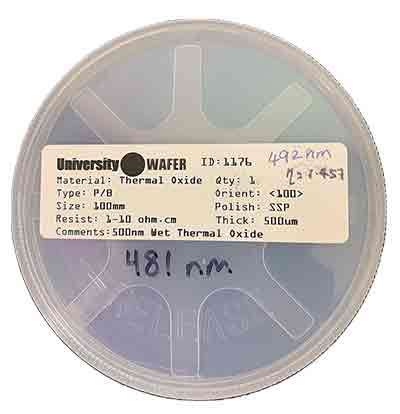
4-Point Probe Metrology: Key Concepts
| Metrology Term | Application |
|---|---|
| Sheet Resistance | Characterizing thin films and conductive coatings. |
| Contact Resistance | Mitigating errors between probe tips and sample surface. |
| Non-Contact Gauges | Metrology used to avoid marring polished wafer surfaces. |
Silicon Wafer Resistivity Measurement FAQs
Question: Is a silicon wafer's resistivity measured from the polished surface?
Answer: A silicon wafer ideally has uniform resistivity throughout its body. However, a 4-point probe can damage a polished surface; therefore, non-contact resistivity gauges are often used for final characterization of polished wafers.
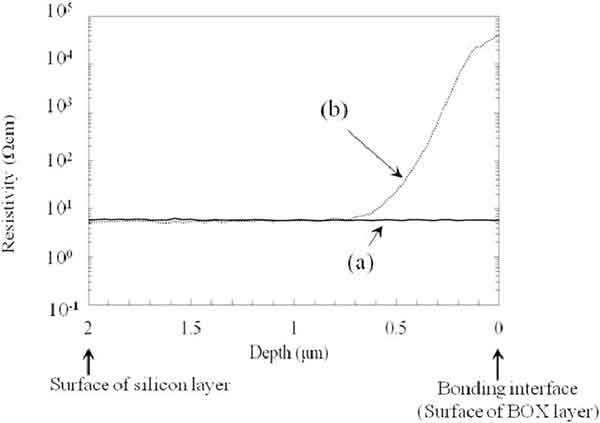
Common Errors in GaAs Resistivity Testing
When measuring Gallium Arsenide (GaAs) using the 4-point probe method, common sources of error include contact resistance, inhomogeneous material, surface contamination, and probe misalignment.
What is a Vertical Tunnel Diode?
A vertical tunnel diode exhibits negative differential resistance (NDR) via quantum tunneling. Current flows vertically through stacked p-n junction layers, offering benefits in high-frequency oscillators and fast switches.