
Get an Ingot Quote
Case Studies
Solar Wafer Fabrication
A solar panel manufacturer contacted us regarding silicon kerf loss. "We have kerf loss of about 50%... silicon dust residue... can you assist to test this residue for other applications?" Yes, we can!
Oxygen Content Analysis
Researcher: "Could you tell me the Oxygen content standard? e.g. ASTM F121-83?"
UniversityWafer: Oxygen content is normally measured by FTIR. However, FTIR cannot be used on heavily doped silicon. For low resistivity ingots, we assume oxygen content matches high-resistivity ingots grown under identical conditions.
Echelle Grating Research
A scientist needed a large silicon block (500mm x 250mm x 80mm) for an EPSRC Grating Manufacturing project. They required specific CTE matching but low purity to keep costs down.
Quote #266862: Polycrystalline Silicon Block.
Related Products
Silicon Ingot Inventory
We stock various diameters and specifications. Note: Material is CZ unless noted as FZ.
| Weight (Kg) | Material Description |
|---|---|
| 6 Inch (150mm) Diameter | |
| 2.7 | FZ 6"Ø ingot P/B[100] ±2.0°, Ro: 1-2 Ohmcm, Lifetime>1777μs, NO Flats |
| 1.15 | FZ 6"Øx25mm ground ingot, n-type Si:P[100], 7000+ Ohmcm, 1 SEMI Flat |
| 3.8 | FZ 6"Øx80mm ingot, n-type Si:P[100], 57-62 Ohmcm, 1 SEMI Flat |
| 10.68 | FZ 6"Øx248mm ground ingot, n-type Si:P[100], 0.5 Ohmcm, NO Flats |
| 5 Inch (125mm) Diameter | |
| 5.5 | FZ 5"Ø ingot P/B[100], Ro: 3000 Ohmcm, As-Grown, 1 Flat |
| 13.5 | 5"Øx420mm n-type Si:As[100], Ro=0.003 Ohmcm, As-Grown |
| 4 Inch (100mm) Diameter | |
| 5.3 | FZ 4"Øx320mm ingot P/B[100], 1.0 Ohmcm, Lifetime=1511µs, NO Flats |
| 0.74 | FZ 4"Øx38mm ground ingot, n-type Si:P[100], 1-2 Ohmcm, Low Oxygen |
| 3 Inch (76mm) Diameter | |
| 4.05 | FZ Ingot 3"Ø, P/B[111], 2000 Ohmcm, NO Flats |
| 5.18 | FZ NTD 3"Ø ground ingot, n-type Si:P[111], 50-60 Ohmcm |
| 2 Inch & Smaller Diameters | |
| 4.49 | FZ 2"Ø ingots, P/B[100], 1000-3000 Ohmcm, 1 SEMI Flat |
| 0.5 | FZ 1"Ø ingot P/B[100], 1-3 Ohmcm, NO Flats |
How to Grow Silicon: CZ vs FZ
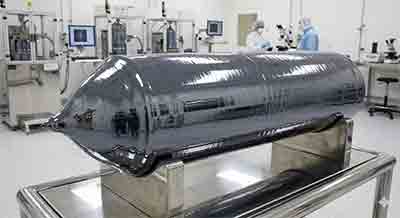
Pure polycrystalline silicon is heated to its melting point. A seed crystal is dipped into the molten silicon and slowly withdrawn while rotating. The silicon atoms align with the seed, creating a monocrystalline ingot.
Czochralski (CZ) Method
In the CZ method, silicon is melted in a quartz crucible. Dopants (Boron, Phosphorus) are added to the melt. As the crystal is pulled, oxygen from the quartz crucible is incorporated into the crystal lattice. This oxygen improves the mechanical strength of the wafers, making CZ silicon ideal for standard integrated circuits.
Float Zone (FZ) Method
The Float Zone method does not use a crucible. Instead, a polycrystalline rod is passed through a heating coil, creating a localized molten zone. Because there is no crucible contact, FZ silicon has extremely low oxygen and carbon impurities. This high-purity silicon is used for high-voltage, high-power devices, and RF applications.
From Ingot to Wafer
Once grown, the silicon boule is ground to a precise diameter. Flats or notches are machined to indicate crystal orientation (e.g., <100> or <111>). The ingot is then sliced into thin wafers using a diamond edge saw or wire saw.
After slicing, the wafers undergo lapping, etching, and polishing to create the mirror-smooth surface required for device fabrication. Watch Video: Crystal Silicon Ingot Formation
Impurities and Specs
Silicon ingots must meet strict purity standards. Common impurities include Oxygen (interstitial) and Carbon. In CZ silicon, oxygen precipitates can be beneficial for "gettering" metallic impurities away from active device regions. However, for applications requiring high resistivity, FZ silicon is preferred due to its lower impurity background.