
Consult with Our Materials Specialists
Unsure which cut or dopant fits your optical or RF system? Speak with our technical team for personalized recommendations and optimization guidance for your application.
Get Your LiNbO3 Quote FAST! Or, Buy Online and Start Researching Today!
Discover Customized Lithium Niobate Substrates: Applications & Specifications
Lithium Niobate (LiNbO₃) has become one of the most versatile and essential materials in modern science and technology. Combining optical transparency, high electro-optic coefficients, and excellent piezoelectric behavior, it enables innovations across telecommunications, sensing, photonics, and quantum research. As semiconductors increasingly integrate photonic components, LiNbO₃ provides the bridge between light-based and electronic systems.
Material Overview
LiNbO₃ is a synthetic crystal with a trigonal structure that exhibits strong birefringence, allowing it to manipulate light polarization and phase. Its transparency range spans approximately 350–5200 nm, covering visible and infrared wavelengths. With a high refractive index (>2.3) and an electro-optic coefficient (r33) near 30 pm/V, it remains a premier choice for modulators, waveguides, and nonlinear optics.
Crystal Structure and Properties
The unique trigonal structure of LiNbO₃ produces a spontaneous polarization along its Z-axis, leading to strong ferroelectric and piezoelectric behavior. These characteristics allow precise modulation of both light and sound. Its Curie temperature, near 1142°C, ensures that the material retains stability even under demanding thermal conditions. This combination of stability and responsiveness supports applications requiring high performance and reliability.
Optical and Piezoelectric Functions
Lithium Niobate’s optical quality and controllable domain structure make it a powerful medium for frequency conversion and electro-optic modulation. Engineers can use different crystal cuts (X-, Y-, or Z-cut) to enhance specific effects. Meanwhile, its piezoelectric response supports surface acoustic wave (SAW) devices, resonators, and sensors that translate mechanical vibrations into electrical signals for precision electronics.
Applications Across Industries
LiNbO₃’s combination of properties allows it to serve a wide range of industries:
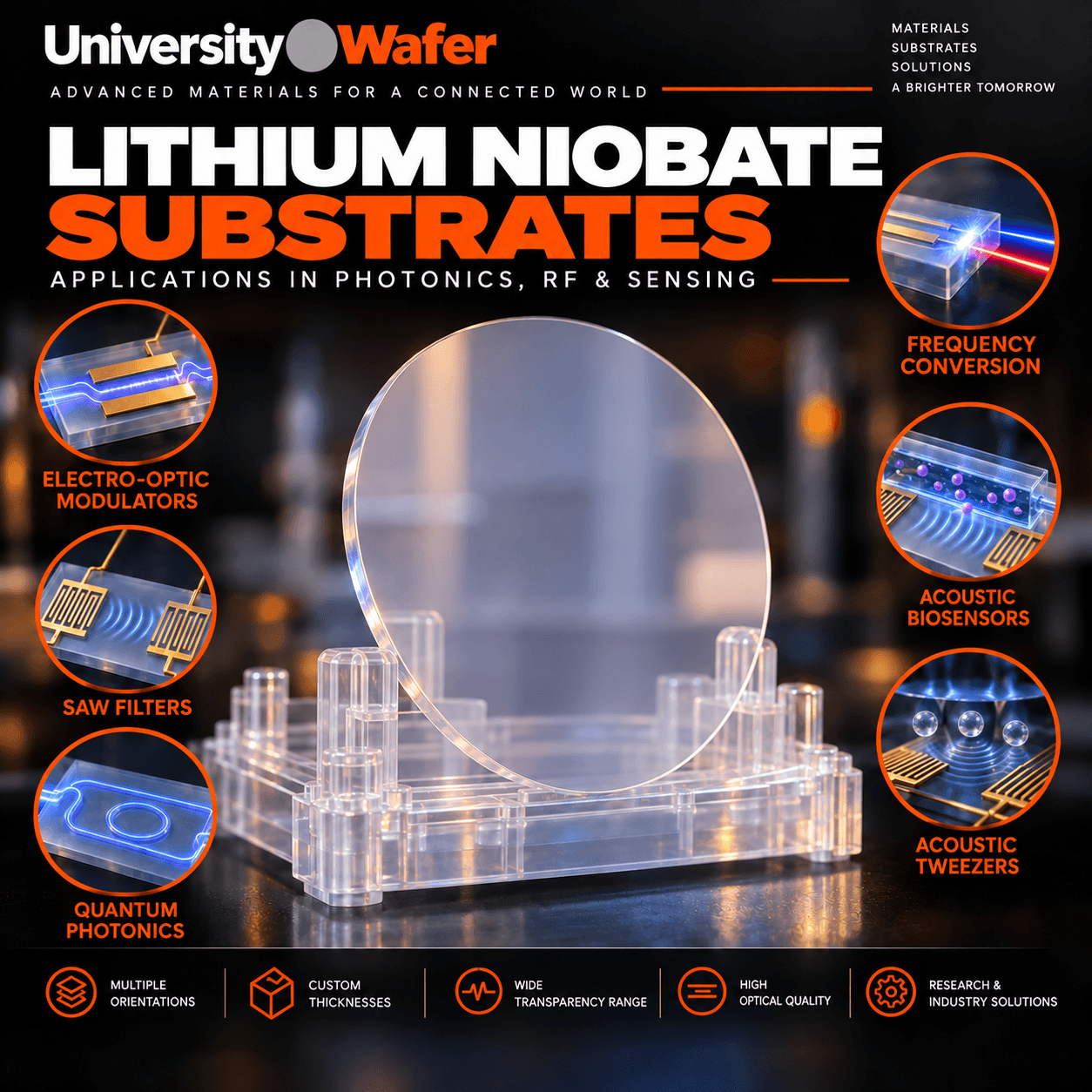
- Telecommunications: Electro-optic modulators and signal converters for fiber networks.
- RF and Acoustic Systems: SAW filters and delay lines for mobile and satellite communication.
- Quantum Photonics: Generation and manipulation of entangled photons for quantum computing.
- Biomedical Research: Lab-on-chip biosensors and optogenetic interfaces for cellular manipulation.
Doping and Advanced Material Control
Doping modifies the internal structure and performance of Lithium Niobate. MgO doping enhances optical damage resistance for high-power lasers, Fe improves photorefractive performance for holography, and Zn tuning offers better conductivity for hybrid optical-electronic systems. Precise doping levels—from 0.01% to over 7 mol%—allow engineers to optimize substrates for specific frequencies, light intensities, or environmental conditions.
Research and Biomedical Innovation
Lithium Niobate’s biocompatibility makes it invaluable for modern research. It is used to design biosensors that detect proteins, DNA, and chemical compounds with high accuracy. In medicine, LiNbO₃-based acoustic tweezers manipulate single cells for diagnostics and tissue engineering. Its stability in biological environments makes it suitable for implantable or long-term monitoring systems that maintain reliability over extended periods.
Manufacturing and Quality Control
The production of LiNbO₃ substrates follows the Czochralski method, producing single-crystal boules with exceptional uniformity. Each wafer undergoes X-ray diffraction to verify orientation, interferometric inspection for flatness, and optical tests to confirm surface quality. Premium wafers achieve λ/10 flatness at 633 nm—an essential feature for precision optical cavities and low-loss waveguides.
Customized Substrate Options
UniversityWafer provides Lithium Niobate substrates in diameters from 1″ to 4″+ and thicknesses ranging from 0.1 mm to over 1 mm, with tolerances as tight as ±5 µm. Surface finishes include SSP (single-side polish) and DSP (double-side polish), and custom options such as notches, flats, and laser markings are available for alignment or handling requirements. Tailored specifications ensure optimal results for photonics, RF, and sensing research.
Educational Summary
Understanding how crystal orientation, doping, and polishing affect Lithium Niobate’s optical and acoustic behavior is essential for developing next-generation technologies. This material continues to support progress in semiconductors, photonics, quantum research, and biomedical science—proving its role as one of the most adaptable and future-facing materials in advanced engineering.
Why Lithium Niobate Is Crucial
Lithium Niobate (LiNbO₃) stands out among modern materials for its ability to unify optical, electrical, and mechanical properties in a single substrate. As the semiconductor industry approaches the trillion-dollar mark, its integration into photonics and optoelectronics becomes essential for devices that combine the speed of light with the logic of electronics. Its versatility drives applications from high-speed communications to sensing and biomedical innovation.
Physical and Optical Significance
LiNbO₃’s optical clarity extends from 350 nm to 5200 nm, making it ideal for visible and infrared systems. With a refractive index over 2.3, it offers strong light confinement and excellent transmission. Its birefringent nature allows engineers to tune polarization and phase-matching for nonlinear optical processes such as second-harmonic generation. These properties have made it indispensable in waveguide design and optical modulation.
Piezoelectric and Ferroelectric Properties
The crystal’s piezoelectric response enables precise acoustic devices like surface acoustic wave (SAW) filters, resonators, and ultrasonic sensors. Its ferroelectric nature—with a Curie temperature around 1142°C—ensures stability even under harsh conditions. Domain engineering techniques, including periodic poling, exploit these traits to create powerful frequency-conversion and high-speed modulation structures.
RF, Acoustic, and Sensing Applications
Lithium Niobate substrates are the foundation for 5G RF filters, radar delay lines, and resonators used in telecommunications, aerospace, and defense. In sensing, its piezoelectric and optical effects enable multi-modal sensors for temperature, pressure, and biological detection. Researchers have leveraged LiNbO₃-based biosensors to detect biomarkers at low concentrations, aiding early disease diagnostics and precision environmental monitoring.
Doping and Customization
Material customization allows control over optical and electrical performance. Mg-doping increases the optical damage threshold, ideal for high-power lasers; Fe enhances photorefractive sensitivity for holography; and Zn modifies conductivity and transparency for hybrid photonic applications. Adjusting Li/Nb ratios and rare-earth doping further extends usability for laser and amplifier designs.
Biomedical Applications
LiNbO₃’s biocompatibility supports lab-on-a-chip platforms, biosensors, and optogenetic interfaces. Its ability to manipulate acoustic and optical waves enables tools like acoustic tweezers—allowing researchers to move or isolate individual cells without physical contact. These applications are expanding the material’s role in diagnostics and regenerative medicine.
Manufacturing and Quality Control
UniversityWafer’s LiNbO₃ wafers are grown by the Czochralski method, ensuring excellent uniformity. Each substrate undergoes X-ray orientation verification, interferometric surface mapping, and optical defect inspection. Premium wafers achieve flatness better than λ/10 at 633 nm, critical for optical cavities and interferometric precision. This meticulous quality control guarantees consistency for both research and industrial-scale photonic systems.
Educational Takeaway
Understanding how orientation, doping, and polishing alter LiNbO₃ performance allows researchers to engineer devices with unmatched control over light and sound. The same substrate that drives quantum photonics can also underpin biosensing or high-frequency filters—demonstrating the remarkable adaptability of this material in both academic and commercial innovation.
Key Facts — LiNbO₃
- Electro-optic, nonlinear, piezoelectric & ferroelectric in one platform.
- Wide transparency (~350–5200 nm), high refractive index (>2.3).
- Large EO coefficient r33 ≈ 30 pm/V (ultrafast modulation).
- High Curie temperature (~1140 °C) and stable performance.
Cuts & Orientations
- Z-cut: Maximizes EO effect for modulators and waveguides.
- Y-cut / 128° Y: SAW filters/resonators; high K² and stability.
- X-cut: Optical / acousto-optic uses.
- Angle accuracy typically ±0.5°; tighter on request.
Sizes & Thickness
- Round wafers ~1″–4″+; rectangles/squares on request.
- Thickness control to ±5–10 µm with bow/warp management.
- Industry flats/notches supported.
Surface Quality
- SSP (single-side) and DSP (double-side) optical polish.
- Epi-ready options with sub-nanometer roughness for critical photonics.
Dopants & Material Mods
- MgO: Raises optical-damage threshold (high-power NLO).
- Fe, Zn: Tailor photorefractive/optical behavior.
- All standard cuts available with these dopants.
Thin-Film LNOI
- ~300–700 nm LiNbO₃ on SiO₂/handle for compact PICs.
- High-index contrast → tight confinement, small bend radii.
- Sizes up to ~4″; custom film thickness & handle options.
Applications (Where It Fits)
- Telecom & Photonics: EO modulators, waveguides, frequency conversion.
- RF & Acoustic: SAW filters, resonators, delay lines.
- Sensing & Biomedical: Lab-on-chip, optical/acoustic biosensors, acoustic tweezers.
- Quantum/Integrated: SPDC sources, QKD, integrated PICs.
Manufacturing & QA
- Czochralski growth; precision slicing, grinding, optical polishing.
- QA: XRD (orientation), interferometry (flatness), AFM/profilometry (roughness), optical inspection.
- Traceable reports per wafer/batch.
Related Lithium Niobate Resources
- Lithium niobate wafers and substrates — explore available LiNbO₃ options.
- LiNbO₃ for optical modulators — review electro-optic device applications.
- LiNbO₃ substrates for SAW devices — learn about RF and acoustic applications.
- Lithium niobate on insulator (LNOI) — compare thin-film substrates for integrated photonics.
- LiNbO₃ for nonlinear optics — explore frequency-conversion research.
- Periodically poled lithium niobate — learn about engineered crystal domains.