
What Is TEOS Oxide?
TEOS oxide is silicon dioxide (SiO2) deposited using tetraethyl orthosilicate (TEOS), Si(OC2H5)4, as a silicon-containing precursor. TEOS is a liquid silicon alkoxide at room temperature and can be delivered as a vapor to a chemical vapor deposition (CVD) reactor.
TEOS-based processes are used to deposit SiO2 thin films on silicon wafers and other compatible substrates. Depending on the deposition method and process conditions, TEOS-derived oxide can provide useful conformality, electrical insulation, surface coverage, and integration with semiconductor and MEMS fabrication.
An important distinction is that TEOS is the precursor, not the final oxide film. After the deposition chemistry occurs, the deposited film is primarily silicon dioxide, while volatile reaction products are removed from the reactor.
How Is TEOS Oxide Deposited?
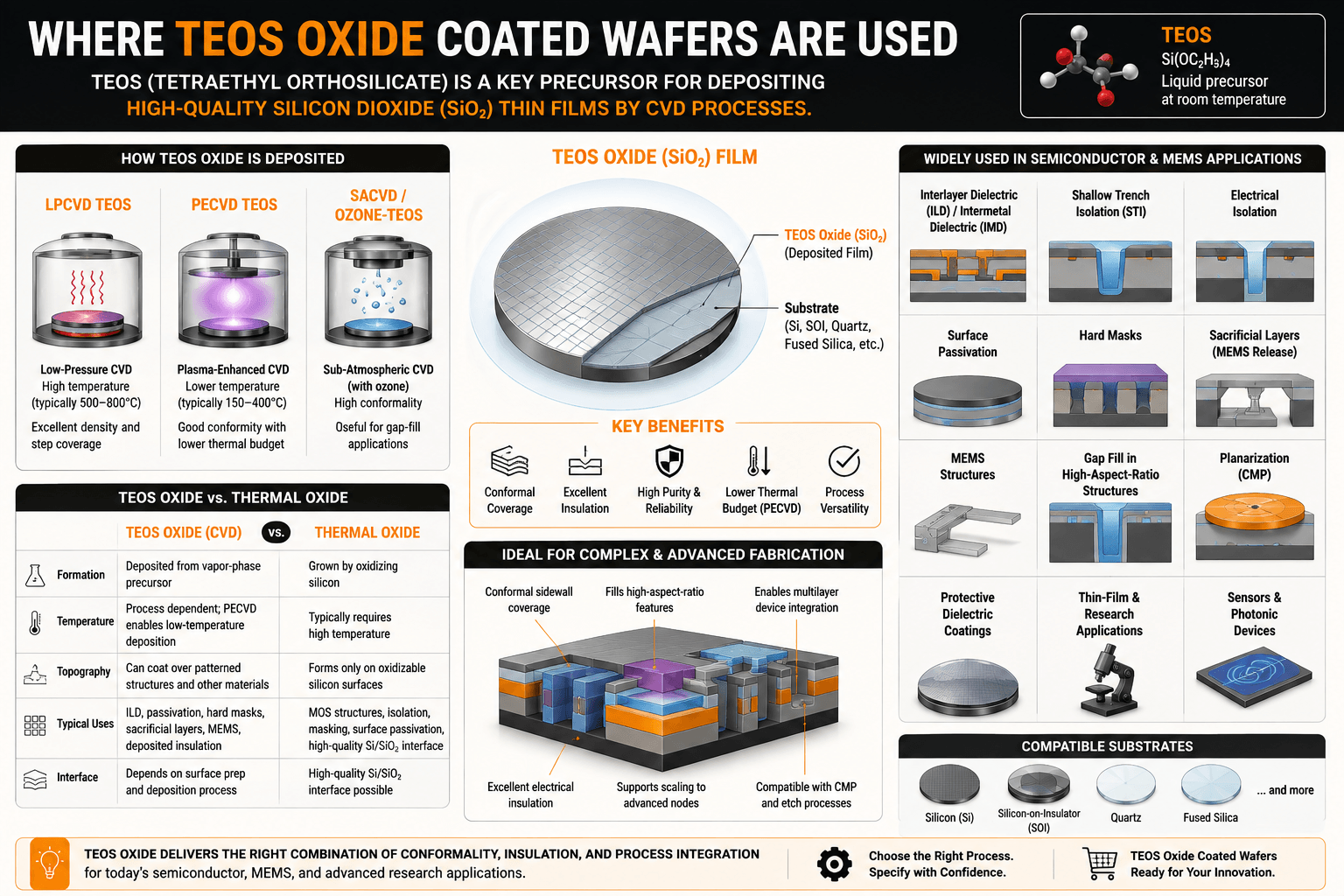
TEOS-derived SiO2 can be deposited using several forms of chemical vapor deposition. The exact chemistry, temperature, pressure, deposition rate, conformality, film density, stress, and impurity content depend on the reactor and process conditions.
Common TEOS-based deposition approaches include:
- LPCVD TEOS – low-pressure chemical vapor deposition performed at elevated substrate temperatures.
- PECVD TEOS – plasma-enhanced chemical vapor deposition that uses plasma activation to enable deposition at lower substrate temperatures than many thermal CVD processes.
- SACVD TEOS – sub-atmospheric chemical vapor deposition, including TEOS/ozone processes used in selected dielectric and gap-fill applications.
LPCVD TEOS Oxide
Low-pressure chemical vapor deposition (LPCVD) can use TEOS to form SiO2 films at elevated temperatures. Exact deposition temperatures depend on the reactor chemistry and process recipe, but thermal TEOS LPCVD is commonly performed at temperatures of several hundred degrees Celsius.
LPCVD TEOS is useful when relatively conformal oxide coverage over patterned surfaces is required and the substrate can tolerate the thermal budget of the process.
Film characteristics such as density, refractive index, stress, wet-etch rate, and impurity concentration depend on deposition conditions and may also be modified by subsequent thermal treatment.
PECVD TEOS Oxide
Plasma-enhanced chemical vapor deposition (PECVD) uses plasma-generated reactive species to assist the deposition reaction. This allows TEOS-derived SiO2 to be deposited at lower substrate temperatures than typical thermal LPCVD processes.
PECVD TEOS is useful when the fabrication process has a limited thermal budget, such as when temperature-sensitive films, metals, or previously fabricated device structures are already present on the wafer.
PECVD oxide properties depend strongly on plasma power, pressure, substrate temperature, gas chemistry, TEOS delivery rate, and other reactor parameters. Consequently, PECVD TEOS should not be assumed to have the same density, conformality, hydrogen content, stress, or electrical properties as thermally deposited TEOS oxide.
SACVD TEOS and Ozone-TEOS Deposition
Sub-atmospheric CVD (SACVD) processes can combine TEOS with ozone (O3) to deposit silicon dioxide. TEOS/ozone chemistry has been used in semiconductor fabrication where conformal oxide deposition and filling of patterned features are important.
As with other TEOS processes, actual gap-fill capability depends on feature geometry, process chemistry, deposition conditions, and the integration scheme. TEOS should therefore not be treated as a universal solution for every high-aspect-ratio structure.
Why Use TEOS for Silicon Dioxide Deposition?
TEOS-based CVD provides an alternative to growing SiO2 by thermal oxidation. The two processes are fundamentally different.
Thermal oxidation consumes part of a silicon surface to grow SiO2, whereas TEOS CVD deposits oxide onto the substrate. Because it is a deposition process, TEOS-derived oxide can be applied to surfaces where oxide growth by consuming underlying silicon is not the desired approach.
Depending on the specific CVD process, TEOS can offer advantages such as:
- Useful conformal coverage over patterned topography
- Controlled deposited oxide thickness
- Compatibility with patterned semiconductor structures
- Deposition over materials other than bare silicon
- Electrical insulation between device structures
- Integration with MEMS and microfabrication processes
- Lower-temperature processing with plasma-enhanced deposition
TEOS Oxide vs. Thermal Oxide
TEOS oxide and thermal oxide both consist primarily of SiO2, but they are formed by different mechanisms and should not automatically be treated as interchangeable.
Thermal oxide is grown by oxidizing silicon at elevated temperature. Because the oxide forms by consuming silicon at the interface, high-quality thermal oxide is widely used when excellent silicon/SiO2 interface properties are important.
TEOS oxide is deposited from a vapor-phase precursor and can therefore coat silicon as well as compatible films and structures already present on a wafer. This makes deposited oxide useful for interlayer insulation, passivation, sacrificial layers, hard masks, and other fabrication steps.
The correct oxide depends on the device structure, thermal budget, interface requirements, desired thickness, topography, and subsequent processing.
TEOS Oxide for Conformal Coatings and Step Coverage
One reason TEOS-based CVD is used in microfabrication is its ability, under appropriate process conditions, to provide useful coverage over non-planar surfaces.
Conformality describes how uniformly a deposited film covers different parts of a three-dimensional feature, such as horizontal surfaces, sidewalls, trenches, and recessed structures.
Conformality is not an intrinsic fixed property of TEOS itself. It depends on the deposition technique, surface-reaction kinetics, gas transport, feature dimensions, pressure, temperature, plasma conditions, and other process variables.
TEOS Oxide in Semiconductor Fabrication
Deposited silicon dioxide is used throughout semiconductor fabrication because SiO2 is an electrical insulator and can also function as a masking, passivation, sacrificial, or dielectric material.
Depending on the process technology, TEOS-derived oxide can be used for:
- Interlayer and intermetal dielectric structures
- Electrical isolation
- Surface passivation
- Gap-fill processes
- Hard masks
- Sacrificial oxide layers
- MEMS fabrication
- Planarization process stacks
- Protective dielectric coatings
TEOS-derived CVD oxide should not automatically be described as equivalent to a high-quality thermally grown MOS gate oxide. Gate-dielectric requirements are especially sensitive to interface quality, defect density, leakage, reliability, and the specific semiconductor technology.
TEOS Oxide for MEMS Fabrication
TEOS-derived SiO2 is also used in microelectromechanical systems (MEMS) and other microfabrication processes. Depending on the device design, deposited oxide can serve as an insulating film, masking layer, structural-support layer, or sacrificial material.
Sacrificial SiO2 layers can be selectively removed during selected MEMS process flows to release mechanical structures. The suitability of TEOS oxide for a particular release process depends on film composition, density, thickness, etchant, selectivity, and the other materials present in the device.
TEOS Oxide and Chemical Mechanical Planarization
Deposited oxide can be incorporated into process flows that use chemical mechanical polishing (CMP). CMP combines chemical and mechanical interactions to remove material and improve wafer-scale planarity.
In semiconductor fabrication, deposited dielectric films may be polished after deposition to reduce topography before subsequent lithography, metallization, or multilayer processing.
What Substrates Can Be Coated with TEOS Oxide?
TEOS-derived SiO2 can be deposited on a range of substrates when they are compatible with the selected CVD process and its temperature, plasma, and surface-chemistry requirements.
Silicon Wafers
Silicon wafers are the most common substrates for semiconductor and MEMS research involving deposited oxide. Researchers can specify wafer diameter, orientation, resistivity, conductivity type, thickness, surface finish, and oxide requirements.
SOI Wafers
Silicon-on-insulator (SOI) wafers can receive additional deposited dielectric films for MEMS, photonics, sensors, and semiconductor process development.
Quartz and Fused Silica
Fused silica and other compatible glass or quartz substrates may be used for selected thin-film, optical, microfluidic, and research applications. Compatibility should be evaluated for the particular CVD process.
TEOS Oxide Film Properties
A TEOS-derived oxide should be specified by more than thickness alone. Depending on the application, researchers may need information about:
- Film thickness
- Thickness uniformity
- Refractive index
- Film stress
- Density
- Wet-etch rate
- Surface roughness
- Hydrogen or impurity content
- Electrical properties
- Deposition temperature
These properties depend on whether the film was deposited by LPCVD, PECVD, SACVD, or another process and on the specific deposition and post-deposition conditions.
How to Specify TEOS Oxide Coated Wafers
When requesting TEOS oxide coated wafers, provide as much information as possible about both the substrate and deposited film. Useful specifications include:
- Wafer material – silicon, SOI, fused silica, or other substrate
- Wafer diameter
- Wafer thickness
- Crystal orientation – when applicable
- Conductivity type and resistivity – when applicable
- Surface finish – SSP or DSP
- TEOS oxide thickness
- Deposition method – LPCVD, PECVD, SACVD, or specified process
- Single-side or double-side deposition
- Film-property requirements – if critical
- Quantity
Need TEOS Oxide Coated Wafers?
UniversityWafer supplies wafer substrates and can support deposited SiO2 requirements for semiconductor, MEMS, microfabrication, dielectric, and thin-film research. Include your required wafer specifications, TEOS oxide thickness, deposition method, and quantity when requesting a quote.
Get Your TEOS Oxide Wafer Quote FAST!
Or, Buy Wafers Online
and Start Researching Today!
TEOS Oxide in Semiconductor Fabrication
TEOS-derived silicon dioxide (SiO2) is used in semiconductor and microfabrication processes when a deposited dielectric layer is required. Tetraethyl orthosilicate (TEOS), Si(OC2H5)4, serves as the silicon-containing precursor; the resulting film is primarily SiO2.
TEOS-based oxide can be deposited using chemical vapor deposition processes such as LPCVD, PECVD, and SACVD. The resulting film properties are not determined by the precursor alone. Temperature, pressure, plasma conditions, oxidant chemistry, deposition rate, reactor design, and post-deposition treatment can all affect the final oxide.
TEOS-derived SiO2 is used for dielectric isolation, interlayer insulation, passivation, masking, sacrificial layers, selected gap-fill processes, and other semiconductor and MEMS applications.
Why Is TEOS Used to Deposit SiO2?
TEOS is useful because it enables SiO2 to be deposited rather than grown by consuming the underlying silicon. This distinction allows oxide to be formed over patterned structures and over compatible materials other than bare silicon.
Depending on the deposition process, TEOS-based CVD can provide:
- Controlled SiO2 film thickness
- Useful step coverage over patterned topography
- Electrical insulation between device structures
- Compatibility with multilayer semiconductor fabrication
- Deposited oxide over silicon and other compatible surfaces
- Lower-temperature deposition through plasma-enhanced processes
- Integration with MEMS and micromachining processes
The magnitude of these advantages depends on the particular TEOS chemistry and deposition conditions. LPCVD TEOS, PECVD TEOS, and ozone-TEOS SACVD, for example, should not be assumed to produce identical films.
What Properties Matter in TEOS Oxide?
Choosing a TEOS oxide process requires more than specifying the desired thickness. Important film characteristics can include:
- Thickness and thickness uniformity
- Conformality and step coverage
- Film density
- Refractive index
- Intrinsic and thermal stress
- Wet-etch rate
- Surface roughness
- Hydrogen and impurity content
- Dielectric strength and leakage behavior
- Thermal stability
The importance of each property depends on the application. An oxide used as a sacrificial MEMS layer, for example, may have different requirements from an oxide used for electrical isolation or passivation.
TEOS Oxide Conformality and Step Coverage
Step coverage describes how effectively a deposited film covers horizontal surfaces, vertical sidewalls, corners, trenches, and other topographical features.
Some TEOS-based CVD processes can provide useful conformal coverage because film formation occurs through surface chemical reactions rather than purely line-of-sight physical deposition.
However, it is not scientifically accurate to assign one universal conformality value to all TEOS processes. Step coverage depends on surface-reaction kinetics, precursor transport, pressure, temperature, plasma conditions, sticking probability, feature geometry, and aspect ratio.
Very demanding high-aspect-ratio structures may require specially optimized CVD processes or other deposition techniques rather than conventional TEOS deposition alone.
TEOS Oxide for Shallow Trench Isolation (STI)
Silicon dioxide has historically played an important role in shallow trench isolation (STI), where dielectric material electrically isolates neighboring active regions in integrated circuits.
TEOS-based oxide processes, including ozone-TEOS and related CVD approaches, have been used in STI process flows. After oxide deposition, excess dielectric can be removed using chemical mechanical polishing (CMP) to produce a more planar wafer surface.
Gap-fill performance depends strongly on trench geometry and deposition conditions. For this reason, TEOS should not be described as automatically producing void-free fill in every trench or high-aspect-ratio structure.
TEOS Oxide for Interlayer Dielectrics
Deposited SiO2 can electrically isolate conductive layers in multilevel device structures. TEOS-based CVD has historically been used for interlayer dielectric (ILD) and intermetal dielectric (IMD) applications.
Important requirements for these films can include electrical isolation, controlled thickness, acceptable stress, low defect density, suitable planarization behavior, and compatibility with the surrounding materials.
In advanced integrated circuits, conventional SiO2 has been supplemented or replaced in many interconnect levels by lower-permittivity dielectric materials to reduce parasitic capacitance. TEOS-derived oxide nevertheless remains important in many semiconductor and research fabrication processes.
TEOS Oxide for MEMS
TEOS-derived SiO2 can serve several functions in MEMS fabrication, including electrical insulation, masking, passivation, and sacrificial layers.
In a sacrificial-layer process, oxide can be deposited beneath or around a structural material and later selectively removed to release a movable MEMS structure. The effectiveness of this process depends on oxide thickness, density, etch rate, etchant selectivity, and compatibility with the structural materials.
Film stress is particularly important in MEMS because residual stress or stress gradients can contribute to bending, deformation, or dimensional changes in released structures.
TEOS Oxide as a Hard Mask
Deposited SiO2 can be patterned and used as a hard mask when its etch resistance provides useful selectivity relative to the underlying material.
Whether TEOS oxide is suitable as a mask depends on the chemistry of the subsequent wet or dry etch. Mask thickness must also be selected according to the oxide etch rate and the required etch depth.
TEOS Oxide as a Sacrificial Layer
SiO2 deposited from TEOS can be used as a sacrificial material in selected micromachining processes. The oxide is patterned or incorporated into a multilayer structure and subsequently removed to create cavities, gaps, suspended structures, or movable components.
Hydrofluoric-acid-based wet etchants and HF vapor processes are commonly used for selective SiO2 removal in compatible process flows. Actual selectivity and etch rate depend on oxide properties, etchant chemistry, temperature, and the surrounding materials.
TEOS Oxide and Chemical Mechanical Polishing
Deposited dielectric films can create surface topography that interferes with subsequent photolithography and multilayer fabrication.
Chemical mechanical polishing (CMP) can be used to remove excess oxide and improve wafer-scale planarity. CMP is therefore an important complementary process in some dielectric deposition and trench-isolation process flows.
CMP performance depends on oxide properties, slurry chemistry, polishing pad, pressure, removal rate, selectivity, and the materials incorporated into the wafer structure.
LPCVD TEOS vs. PECVD TEOS
Both LPCVD and PECVD can produce TEOS-derived SiO2, but the deposition mechanisms and resulting film properties can differ substantially. The values below are general trends rather than fixed specifications.
| Property | LPCVD TEOS | PECVD TEOS |
|---|---|---|
| Activation | Primarily thermal | Plasma-assisted |
| Substrate Temperature | Generally higher | Generally lower |
| Thermal Budget | Higher | Lower |
| Conformality | Can provide good conformality under optimized conditions | Process-dependent; plasma conditions and geometry strongly affect coverage |
| Film Density | Can produce relatively dense oxide | Strongly dependent on deposition conditions and post-treatment |
| Hydrogen Content | Typically lower than many low-temperature PECVD oxides | Can contain more hydrogen depending on chemistry and conditions |
| Typical Selection Reason | Higher-temperature processing with useful film quality and step coverage | Lower-temperature processing for limited thermal budgets |
Exact deposition temperature, rate, pressure, refractive index, stress, density, and etch rate should be specified from the actual deposition recipe rather than inferred solely from the terms LPCVD or PECVD.
TEOS Oxide vs. Thermal Oxide
| Property | TEOS CVD Oxide | Thermal Oxide |
|---|---|---|
| Formation | SiO2 is deposited from vapor-phase precursors | SiO2 is grown by oxidizing silicon |
| Underlying Surface | Can coat various compatible materials and structures | Requires an oxidizable silicon surface for SiO2 growth |
| Temperature | Depends strongly on CVD method; PECVD enables lower-temperature processing | Typically requires elevated oxidation temperatures |
| Topography | Can deposit oxide over patterned surfaces | Oxide grows where silicon is oxidized |
| Si/SiO2 Interface | Depends on substrate preparation and deposition process | High-quality thermal oxidation can provide an excellent Si/SiO2 interface |
| Common Uses | ILD/IMD, passivation, hard masks, sacrificial films, deposited insulation | MOS structures, isolation, masking, surface passivation and other silicon oxidation applications |
Learn more about thermal oxide silicon wafers when deciding whether deposited or thermally grown SiO2 is appropriate for your process.
TEOS vs. Silane for SiO2 Deposition
TEOS and silane (SiH4) are both silicon-containing precursors that can be used in processes for depositing silicon dioxide, but comparing them simply as "TEOS is conformal and silane is not" is inaccurate.
| Property | TEOS | Silane |
|---|---|---|
| Formula | Si(OC2H5)4 | SiH4 |
| Physical State at Room Temperature | Liquid | Gas |
| Precursor Delivery | Typically vaporized and delivered to the reactor | Delivered as a process gas |
| Applicable CVD Processes | Includes thermal CVD, PECVD and ozone-assisted processes | Includes PECVD and other CVD chemistries |
| Conformality | Depends on the specific TEOS process and feature geometry | Depends on the specific silane chemistry and process conditions |
| Film Properties | Depend on oxidant, temperature, pressure, plasma and post-treatment | Depend on oxidant, temperature, pressure, plasma and post-treatment |
The appropriate precursor should therefore be selected according to the required film properties and integration constraints rather than assuming one precursor is universally superior.
How to Choose a TEOS Oxide Process
Researchers selecting a TEOS oxide should consider the complete fabrication process rather than film thickness alone. Important questions include:
- What is the maximum allowable substrate temperature?
- How thick must the SiO2 film be?
- Is conformal coverage over topography required?
- Is the oxide electrically active in the device?
- Will the film later be wet or dry etched?
- Is low film stress important?
- Will the oxide be polished using CMP?
- Is the oxide permanent or sacrificial?
- Are refractive index or optical properties important?
- What materials are already present on the wafer?
TEOS Oxide Coated Wafer Applications
- Semiconductor dielectric layers
- Interlayer and intermetal insulation
- MEMS fabrication
- Sacrificial oxide layers
- Hard masks
- Surface passivation
- Shallow trench isolation process development
- Microfabrication research
- Dielectric gap-fill research
- CMP process development
- Sensor fabrication
- Thin-film materials research