
Order Lithium Niobate for Nonlinear Optics
UniversityWafer, Inc. supplies high-quality lithium niobate (LiNbO₃) substrates engineered for nonlinear optical applications, including second-harmonic generation (SHG), optical parametric oscillation (OPO), electro-optic modulation, quantum optics, and frequency conversion. Our wafers are available in bulk crystal and thin-film LNOI platforms to support both traditional optics and next-generation integrated photonic devices.
Available Lithium Niobate Options
- Bulk Lithium Niobate Wafers – SSP or DSP polished, low-defect surfaces
- MgO-doped LiNbO3 – Higher resistance to photorefractive damage
- Lithium Niobate on Insulator (LNOI) – Thin-film platform for integrated photonics
- Periodically Poled Lithium Niobate (PPLN) – For quasi-phase matching and high-efficiency frequency conversion
Common Orientations
- Z-cut – Accesses the highest nonlinear coefficient d33
- X-cut – Useful for specialty waveguide and modulator designs
- Y-cut – Supports mixed optical and SAW-based optical systems
- Custom orientations available on request
Typical Specifications
- Diameters: 1”, 2”, 3”, 4” (custom sizes available)
- Thickness: multiple options including thin-film LNOI
- Surfaces: SSP, DSP, polished, epi-ready
- Doping: Undoped, MgO-doped, Fe-doped (special requests)
- Domain engineering: PPLN options for SHG & OPO
Researchers trust our lithium niobate substrates for frequency converters, waveguide devices, quantum photonics, optical modulators, and integrated LNOI circuits. We can match your wavelength targets, poling periods, orientation, doping, and thickness requirements.
Get Your LiNbO3 Quote FAST! Or, Buy Online and Start Researching Today!
Related Substrate Technologies and Materials
Researchers working with lithium niobate for nonlinear optics may also benefit from exploring related substrate platforms and optical materials:
Core Properties That Make LiNbO₃ Ideal for Nonlinear Optics
Lithium niobate (LiNbO₃) is one of the most important materials used in nonlinear optics due to its strong second-order nonlinear response, broad optical transparency window, and excellent electro-optic characteristics. These properties make it a foundational material for frequency conversion, modulators, integrated photonic circuits, and advanced quantum optical devices.
Why Lithium Niobate is Essential for Nonlinear Optics
The unique crystal structure of lithium niobate enables efficient second-harmonic generation, sum- and difference-frequency generation, and optical parametric processes. Its high nonlinear coefficient (d₃₃) allows compact, energy-efficient devices that convert light between visible, infrared, and telecom wavelengths. The material’s strong electro-optic effect also supports fast, low-voltage optical modulation.
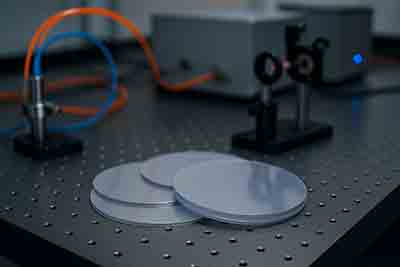
Material Properties that Impact Nonlinear Performance
Lithium niobate’s performance depends on both intrinsic material quality and substrate specifications. Key parameters include:
- Nonlinear coefficient: High d₃₃ enables efficient frequency conversion.
- Birefringence: Supports phase-matching across a wide spectral range.
- Transparency: 0.35 µm to ~5 µm, covering visible and IR applications.
- Electro-optic response: Enables high-speed optical modulators.
- Damage threshold: Material doping can reduce photorefractive effects.
Crystal Orientation and Optical Performance
The crystal orientation of LiNbO₃ determines how the material interacts with propagating light. Z-cut is typically preferred for accessing the highest nonlinear coefficient (d₃₃), while X-cut and Y-cut offer alternative propagation modes for modulators and resonators.
Common Orientations
- Z-cut LiNbO₃ – Maximizes nonlinear efficiency and electro-optic tuning.
- X-cut LiNbO₃ – Useful for waveguides and modulators requiring specific polarization behavior.
- Y-cut LiNbO₃ – Used in both optical and SAW applications where alternative propagation modes are desired.
Thin-Film Lithium Niobate on Insulator (LNOI)
Thin-film lithium niobate has transformed the field of integrated photonics. LNOI platforms provide submicron confinement of optical modes, dramatically enhancing nonlinear efficiency while enabling dense chip-scale photonic integration.
By bonding a thin LiNbO₃ film to a SiO₂ insulator and silicon handle wafer, LNOI supports low-loss waveguides, resonators, electro-optic modulators, and frequency converters on a compact platform. This technology enables significantly lower power consumption and smaller device footprints than traditional bulk waveguides.
Periodically Poled Lithium Niobate (PPLN)
PPLN enables quasi-phase matching, which is critical for maximizing the efficiency of nonlinear optical processes. By periodically inverting the ferroelectric domains in the crystal, designers can match the interacting wavelengths and dramatically increase frequency-conversion efficiency. PPLN is widely used for visible and IR laser generation, quantum light sources, and spectroscopic applications.
Applications Across Nonlinear and Integrated Optics
Lithium niobate substrates support a wide range of nonlinear optical and photonic devices, including:
- Second-harmonic generation (SHG): Frequency doubling for visible-light lasers.
- Optical parametric oscillators (OPOs): Tunable signal and idler generation.
- Difference-frequency generation: Mid-IR light sources for sensing.
- Electro-optic modulators: Telecom-band, high-speed modulation.
- Resonant nonlinear devices: Microrings, nanowaveguides, and integrated frequency converters.
- Quantum optics: Photon-pair generation and entangled photon sources.
Comparison with Alternative Nonlinear Optical Materials
Although materials such as lithium tantalate (LiTaO₃), potassium titanyl phosphate (KTP), and beta-barium borate (BBO) can be used for nonlinear optical applications, lithium niobate offers a balance of strong nonlinearity, mature fabrication processes, and compatibility with integrated photonics. LNOI gives LiNbO₃ a significant advantage for chip-scale photonic solutions, where other materials face integration challenges.
Future Trends in Nonlinear Lithium Niobate Photonics
As integrated photonics advances, lithium niobate continues to gain prominence in quantum technologies, high-bandwidth communication, microwave-to-optical conversion, frequency comb generation, and low-loss resonator platforms. Ongoing improvements in film quality, etching methods, and wafer bonding continue to push the limits of nonlinear optical performance.
Lithium niobate remains one of the most versatile and powerful materials for nonlinear optics, and ongoing research ensures its position at the center of next-generation photonic and quantum technologies.