
Metal Deposition for Research and Device Fabrication
Metal thin films are used throughout semiconductor processing, MEMS, photonics, sensors, microelectronics, RF devices, optical coatings, and materials research. The correct substrate, metal stack, and deposition method depend on the electrical, optical, mechanical, and thermal requirements of the device.
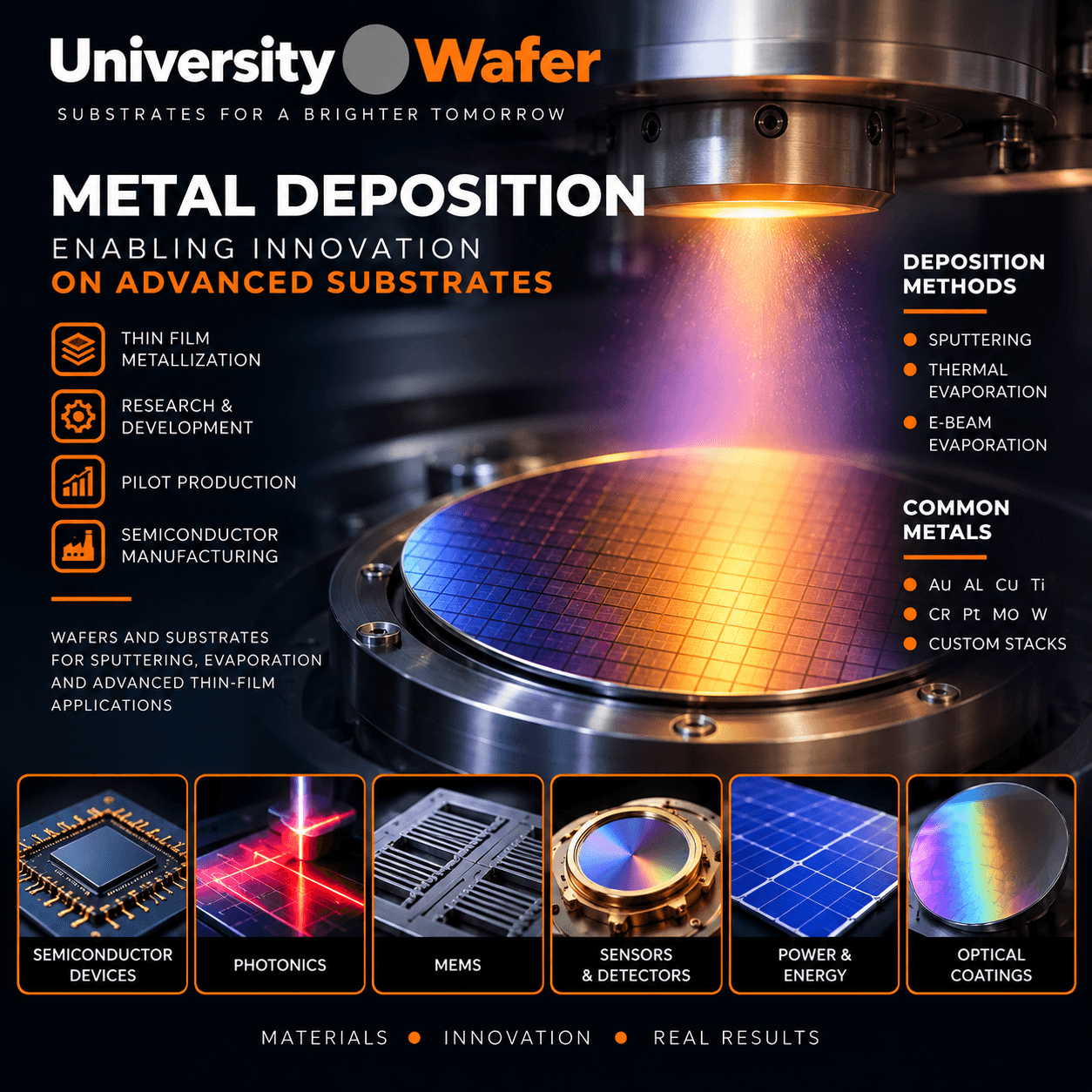
UniversityWafer supplies wafers and substrates suitable for sputtering, thermal evaporation, electron-beam evaporation, metallization, and other thin-film deposition processes. Researchers can source standard substrates or request custom specifications for specialized experiments and fabrication processes.
Metal Deposition Topics
- Overview: What Metal Deposition Does
- Processes: Sputtering vs. Evaporation
- Metal Films: Common Metals & Multilayer Stacks
- Film Quality: Adhesion, Stress & Surface Preparation
- Substrates: Selecting the Right Wafer
- Specifications: What to Include in Your Quote
Choosing a Substrate for Metal Deposition
The substrate can influence film adhesion, surface morphology, electrical isolation, thermal behavior, optical performance, and compatibility with later fabrication steps.
Common substrate options include:
- Silicon – Commonly used for semiconductor devices, MEMS, electrodes, interconnects, and microfabrication.
- Silicon with SiO2 – Useful when an electrically insulating dielectric surface is required beneath the metal layer.
- Sapphire – Electrically insulating crystalline substrate used in optical, RF, high-temperature, and sensor research.
- Fused Silica – Useful for optical coatings, photonics, sensors, and devices requiring a transparent insulating substrate.
- Quartz – Used in specialized optical, piezoelectric, RF, and thin-film research.
- Silicon Carbide (SiC) – Suitable for research involving high-power, high-temperature, RF, and harsh-environment devices.
- Glass – Useful for sensors, microfluidics, thin-film electronics, displays, and optical devices.
Common Metal Films
Metal selection depends on the required conductivity, adhesion, reflectivity, chemical stability, processing temperature, and compatibility with the underlying substrate.
- Gold (Au) – Conductive and chemically stable; often deposited over an adhesion layer.
- Aluminum (Al) – Common for semiconductor metallization and reflective coatings.
- Copper (Cu) – Highly conductive and often used with adhesion or diffusion-barrier layers.
- Titanium (Ti) – Frequently used as an adhesion layer and in multilayer stacks.
- Chromium (Cr) – Common adhesion layer beneath metals such as gold.
- Platinum (Pt) – Used in electrodes, sensors, and specialized high-temperature applications.
- Tungsten (W) and Molybdenum (Mo) – Refractory metals used when higher-temperature stability is required.
What Should You Include in Your Quote?
Providing complete specifications helps UniversityWafer identify an appropriate substrate and metal configuration more quickly.
- Substrate material
- Diameter or dimensions
- Substrate thickness
- Surface finish: SSP, DSP, or optical polish
- Crystal orientation, when applicable
- Conductivity type and resistivity, when applicable
- Metal or multilayer stack
- Thickness of each deposited layer
- One-side or two-side deposition
- Blanket or patterned coating
- Required quantity
Request Metal Deposition Substrates
Get Your Metal Deposition Quote FAST! Or, Buy Online and Start Researching Today!
Metal Deposition on Wafers and Research Substrates
Metal deposition is used to form thin conductive, reflective, barrier, seed, and contact layers on semiconductor wafers and research substrates. Deposited metals can become electrodes, interconnects, contact pads, optical reflectors, diffusion barriers, or components of multilayer thin-film structures.
UniversityWafer supplies substrates for metallization research, including silicon, sapphire, fused silica, quartz, silicon carbide (SiC), and glass. The appropriate substrate depends on the electrical, optical, thermal, mechanical, and processing requirements of the device.
Sputtering vs. Evaporation
Sputtering and evaporation are two widely used physical vapor deposition (PVD) techniques. Both can produce high-quality metal films, but they transfer material to the substrate through different physical mechanisms.
Sputter Deposition
In sputtering, energetic ions generated in a plasma strike a solid target and eject atoms from its surface. These atoms travel through the deposition chamber and condense on the substrate to form a thin film.
Sputtering is commonly used when researchers require:
- Good film uniformity
- Dense thin films
- Metal, alloy, or compound films
- Adhesion and barrier layers
- Multilayer thin-film stacks
DC sputtering is commonly used with electrically conductive targets, while RF sputtering can be used with insulating as well as conductive target materials.
Film properties depend strongly on parameters such as chamber pressure, plasma power, substrate temperature, deposition rate, target-to-substrate geometry, and substrate preparation.
Thermal and Electron-Beam Evaporation
Evaporation forms a thin film by heating a source material in vacuum until atoms or molecules enter the vapor phase and subsequently condense on the substrate.
In thermal evaporation, the source is heated resistively. In electron-beam (e-beam) evaporation, a focused electron beam heats the source material, allowing materials with relatively high melting temperatures to be evaporated.
Evaporation is commonly used for:
- Gold (Au)
- Aluminum (Al)
- Silver (Ag)
- Copper (Cu)
- Chromium (Cr)
- Titanium (Ti)
- Platinum (Pt), depending on the deposition system
Because evaporation is generally a directional, line-of-sight process, it is particularly useful for many lift-off processes. However, coverage of steep sidewalls and complex three-dimensional structures can be limited compared with more conformal deposition methods.
Common Metal Thin-Film Stacks
Metal layers are often deposited as a multilayer stack rather than as a single material. Each layer can provide a different electrical, mechanical, optical, or chemical function.
- Ti/Au: Titanium can provide adhesion beneath a conductive gold layer.
- Cr/Au: Chromium is another commonly used adhesion layer beneath gold.
- Ti/Pt/Au: Used in some contact and metallization schemes where separate adhesion, barrier, and conductive layers are useful.
- Al: Used extensively for semiconductor metallization and reflective coatings.
- Cu: Provides high electrical conductivity but often requires appropriate adhesion and diffusion-barrier strategies.
- Mo and W: Refractory metals that can be useful where higher-temperature stability is required.
The appropriate metal stack depends on the substrate, device architecture, required contact behavior, processing temperature, environment, and subsequent fabrication steps.
Why Are Adhesion Layers Used?
Some metals do not adhere strongly to common substrate surfaces. Gold, for example, can exhibit poor adhesion to silicon dioxide and many glass surfaces. A thin titanium or chromium layer is therefore frequently deposited before the gold layer.
Adhesion-layer selection and thickness should be considered carefully, particularly in optical, electrical, or high-temperature applications, because the additional material can influence the properties of the final thin-film stack.
Substrate Selection for Metal Deposition
The substrate is an important part of a thin-film deposition process. Researchers should consider surface roughness, cleanliness, electrical properties, thermal expansion, temperature tolerance, optical properties, and chemical compatibility before selecting a wafer.
Silicon Wafers
Silicon wafers provide a mature microfabrication platform for thin-film research. Bare silicon or silicon with a dielectric layer such as thermal SiO2 can be selected depending on whether electrical conduction or isolation is required.
Sapphire Wafers
Sapphire (Al2O3) is electrically insulating and can provide useful optical, mechanical, and high-temperature properties for specialized thin-film devices.
Fused Silica and Quartz
Fused silica and quartz substrates are useful when optical transparency, electrical insulation, or chemical stability is important. They are frequently used for optical coatings, sensors, photonics, and experimental thin-film structures.
Silicon Carbide
Silicon carbide (SiC) is used in high-power, high-temperature, RF, and harsh-environment semiconductor research. Metallization schemes for SiC must be selected according to the intended device and contact requirements.
Glass Substrates
Borosilicate, aluminosilicate, and other glass substrates can provide electrically insulating and optically transparent platforms for sensors, microfluidics, displays, thin-film electronics, optical devices, and laboratory prototypes.
Surface Preparation and Film Quality
A deposited film is strongly influenced by the condition of the underlying surface. Organic contamination, particles, residual photoresist, moisture, or uncontrolled surface chemistry can contribute to poor adhesion and inconsistent film properties.
Important considerations include:
- Surface cleanliness before deposition
- Surface roughness and polish quality
- Native oxide or dielectric layers
- Deposition temperature
- Film thickness and uniformity
- Residual film stress
- Adhesion between layers
- Compatibility with later annealing or processing
Understanding Thin-Film Stress
Deposited films can contain tensile or compressive residual stress. Excessive stress can contribute to wafer curvature, cracking, delamination, or deformation of thin substrates and microfabricated structures.
Film stress depends on the material system and deposition conditions. For sputtered films, parameters such as gas pressure, power, deposition rate, temperature, and film thickness can significantly influence the resulting stress state.
Metal Deposition Applications
Metal-coated wafers and substrates are used in research involving:
- Electrical contacts and electrodes
- Semiconductor metallization
- MEMS and microsystems
- RF and microwave devices
- Optical mirrors and reflective coatings
- Photonic devices
- Thin-film sensors
- Solar and energy research
- Seed layers for electroplating
- Micro- and nanofabrication
What to Specify for Your Metal Deposition Substrate
When requesting a substrate or metallized wafer, provide as much information as possible about the intended process and final device.
- Substrate material
- Diameter or dimensions
- Substrate thickness
- Surface finish: SSP, DSP, or optical polish
- Crystal orientation, when applicable
- Resistivity or conductivity requirements
- Metal or multilayer stack
- Target thickness of each layer
- Deposition on one or both sides
- Patterned or blanket deposition
- Quantity
Related Metal Deposition Resources
- Thin Film Coated Wafers – Explore sputtering and e-beam evaporation for custom metal, oxide, nitride, and multilayer coatings.
- Sputtered Films – Learn about sputtered metal, dielectric, and semiconductor films for research and production.
- Vacuum Thin-Film Deposition – Explore PVD, sputtering, e-beam evaporation, and wafer coating applications.
- Thin-Film Deposition Substrates – Compare silicon, sapphire, fused silica, glass, and other substrates for thin-film processing.
- Sputtering Targets – Explore high-purity target materials used for PVD and thin-film deposition research.
- Silicon Wafers – Silicon substrates for metallization, electrodes, contacts, MEMS, and semiconductor fabrication.
- Fused Silica Wafers – Optical and insulating substrates for metallic thin films, sensors, and photonic structures.
- Sapphire Wafers – Crystalline Al2O3 substrates for metal coatings, electronics, optics, and high-temperature research.
- Atomic Layer Deposition (ALD) – Learn about conformal thin-film deposition for semiconductor, MEMS, photovoltaic, and nanotechnology research.