
Ready to Scale Your Nanosheet Fabrication?
Don't let substrate quality limit your device performance. Whether you need ultra-thin SOI for GAA-FETs or precise Thermal Oxide for 2D materials, UniversityWafer has the inventory to support your research and production.
Request a Quote
Popular Substrates for Nanosheets
UniversityWafer stocks the following materials commonly used in nanosheet research and fabrication:
- Silicon (Si): (100) / (111), P-type & N-type
- Silicon-on-Insulator (SOI): Custom device layer thicknesses
- Sapphire: C-Plane, A-Plane, R-Plane
- Silicon Carbide (SiC): 4H-SiC and 6H-SiC
- Thermal Oxide: High quality SiO2 ranging from 50nm to 2µm
The Foundation of Next-Gen Electronics
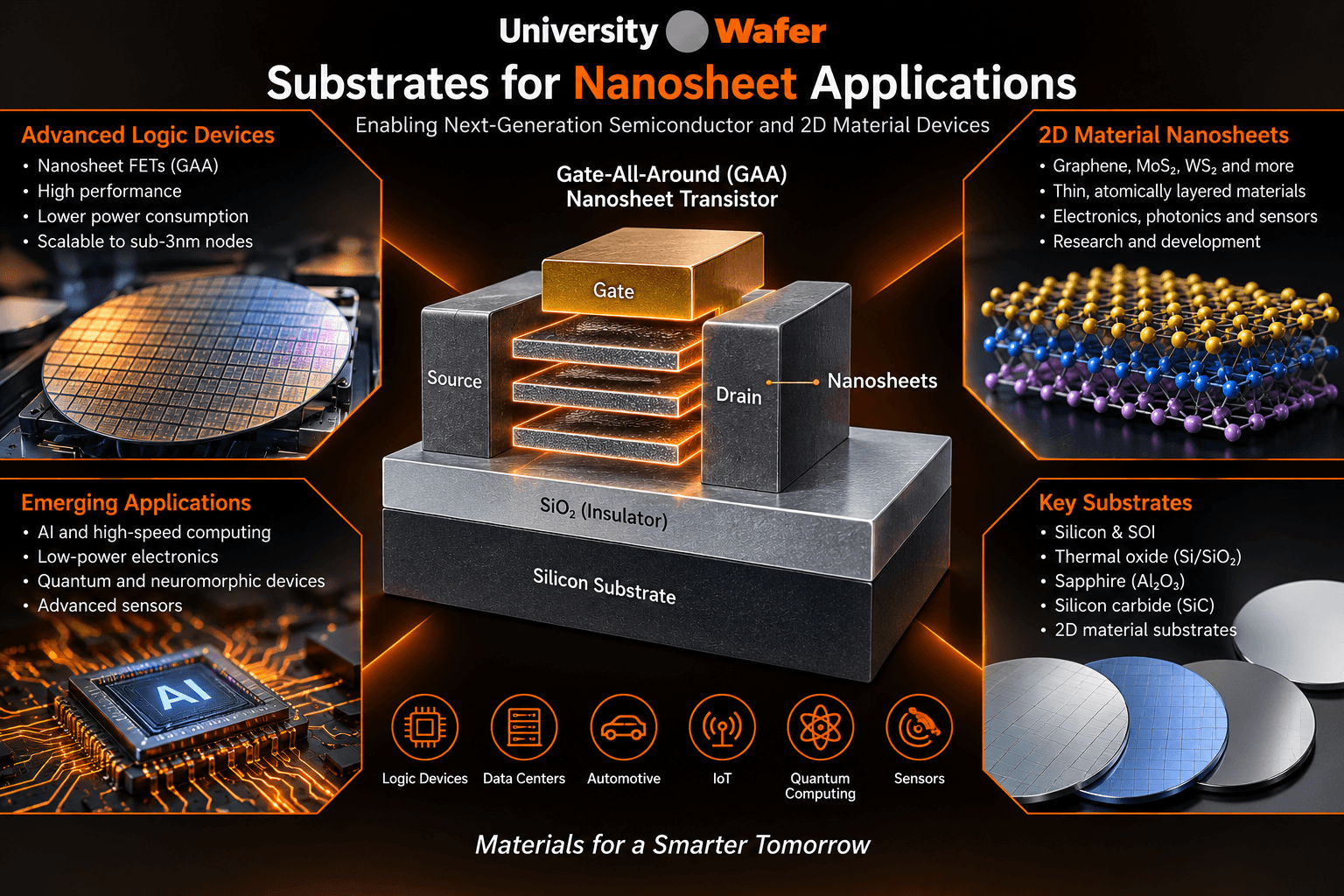
The fabrication of nanosheets—whether for advanced Gate-All-Around (GAA) field-effect transistors or 2D material research—relies heavily on the quality and characteristics of the underlying substrate. As semiconductor technology nodes shrink beyond 5nm, and as the exploration of Transition Metal Dichalcogenides (TMDs) accelerates, selecting the correct wafer is critical for device performance.
UniversityWafer, Inc. supplies a wide range of substrates optimized for nanosheet growth, lithography, and integration.
Silicon-on-Insulator (SOI) for Nanosheet FETs
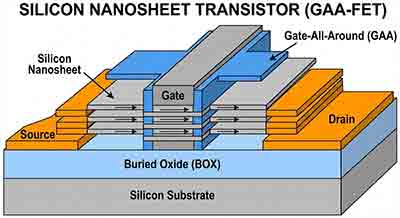
Silicon-on-Insulator (SOI) wafers are increasingly becoming the standard for fabricating Silicon Nanosheet FETs (GAA-FETs). Unlike traditional FinFETs, nanosheet transistors stack silicon channels vertically to increase current drive per footprint.
- Isolation: The buried oxide (BOX) layer in SOI wafers provides excellent electrical isolation, reducing parasitic capacitance and leakage currents.
- Process Control: SOI substrates allow for precise control over the silicon channel thickness, which is essential for creating uniform nanosheets.
- Etch Stop: The oxide layer acts as a natural etch stop during the fabrication of suspended nanosheet structures.
Substrates for 2D Material Nanosheets
Beyond silicon, "nanosheets" also refers to two-dimensional materials such as Graphene, Molybdenum Disulfide (MoS2), and Boron Nitride (h-BN). The growth of these materials via Chemical Vapor Deposition (CVD) or Epitaxy requires substrates with specific lattice constants and thermal properties.
Common substrates include:
- Sapphire (Al2O3): Widely used for the epitaxial growth of TMDs like MoS2 and WS2 due to its chemical stability and insulating properties.
- Silicon with Thermal Oxide (Si/SiO2): The most common substrate for exfoliating and characterizing 2D nanosheets. The oxide layer (typically 90nm or 285nm) provides optical contrast that makes mono- and few-layer nanosheets visible under a microscope.
- Silicon Carbide (SiC): Essential for high-power applications and often used as a template for epitaxial graphene growth.
Why Choose UniversityWafer?
We understand that nanosheet fabrication requires tight tolerances. We offer:
- Custom Oxide Thicknesses: We can thermally grow SiO2 to your exact specifications to maximize optical contrast for 2D materials.
- Ultra-Flat Wafers: Prime grade silicon with low Total Thickness Variation (TTV) for critical lithography steps.
- Wide Inventory: From single research wafers to production volumes of SOI and SiC.
Ready to start your project? Use the form on this page to request a quote or contact us for technical assistance.