
Accelerate Your Research with Precision Substrates
At UniversityWafer.com, we understand that the foundation of groundbreaking research lies in the quality of your materials. Whether you are exploring Thin Solid Films for electronics, optics, or advanced coatings, our substrates provide the reliability and precision required for high-impact results.
Why Researchers Choose Our Substrates:
-
Expert Synthesis Support: Our materials are ideal for studying a variety of unique properties at the confluence of surface science and applied physics.
-
Optimized for Characterization: Our wafers are designed to facilitate advanced analysis, including X-ray diffraction (XRD), scanning electron microscopy, and nanoindentation.
-
Precision Optical Properties: We provide substrates that ensure accurate measurements in spectroscopic ellipsometry and IR-spectroscopy by minimizing optical inhomogeneities.
-
Versatile Applications: From investigating quantum confinement effects to developing nanostructured films, our substrates serve as the essential starting point for photonics and biochemical sensing.
-
Researcher-Focused Service: We offer discounts specifically for the research community and allow you to buy as few as one wafer to suit your specific project needs.
Ready to Elevate Your Project?
Don't let subpar materials delay your next breakthrough. Join the thousands of universities and labs that trust us for their thin film and substrate needs.
Get Your Quote FAST! Or, Buy Online and Start Researching Today!
What are Thin Solid Films?
Thin solid films are a type of crystalline material featuring an inorganic or organic material deposited on a surface. These materials are vital for modern electronics, optical applications, and protective coatings.
Synthesis and Breakthroughs
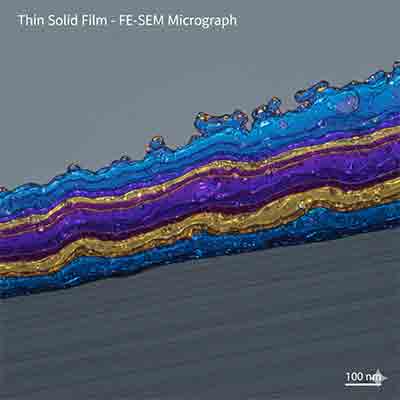
Recent decades have seen massive breakthroughs in synthesis, positioning thin solid films at the confluence of surface science and applied physics. Modern techniques allow for micro- and nano-chemical characterization including scanning electron microscopy and X-ray diffraction.
Deposition by chemical techniques often produces conformal morphology, characterized by an extended network of voids and grooves. In contrast, amorphous thin films utilize different deformation mechanisms, often resulting in lower hardness due to changes in bonding states.
Advanced Characterization
Characterizing thin films involves analyzing the transmittance spectrum and using spectroscopic ellipsometry to measure polarization changes in light reflected from the film surface. These properties are highly dependent on the electronic properties of the materials.
Journal Insights
Thin Solid Films (TSF) is a leading international journal founded in 1967.
- ISSN: 406090
- H-Index: 199
- Publisher: Elsevier
TSF serves as a forum for fundamental knowledge in materials chemistry and nanotechnology.