
D263 Glass Wafers for Research
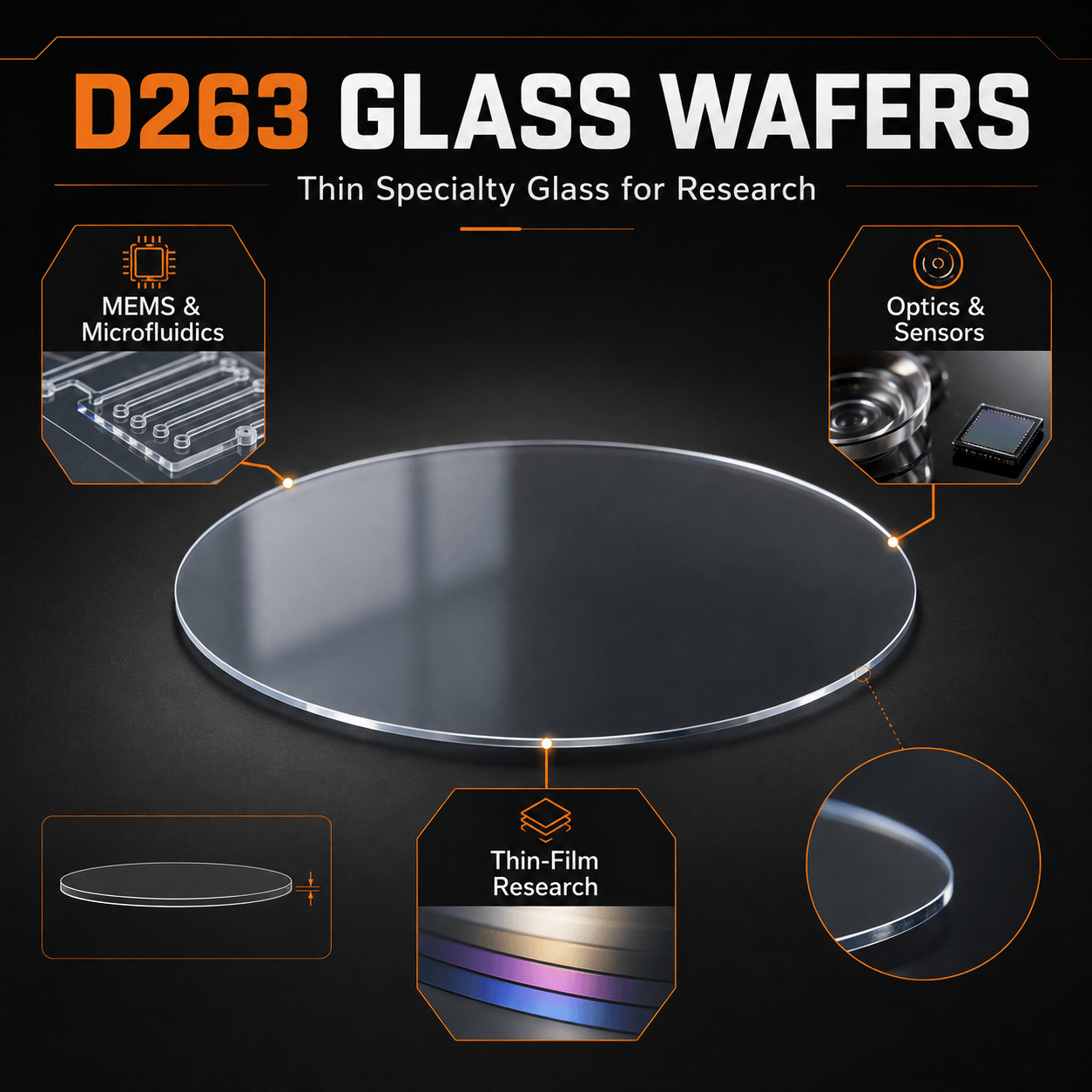
UniversityWafer supplies D263 glass wafers and substrates for researchers who need thin, transparent glass for precision laboratory and microfabrication applications. D263 glass is well suited for experiments involving optics, sensors, MEMS, microfluidics, thin films, and wafer bonding.
Applications of D263 Glass
The combination of optical transparency, smooth surfaces, and thin substrate availability makes D263 glass useful across many research fields, including:
- MEMS: substrates for microsensors and micromechanical structures.
- Microfluidics: transparent substrates for channels and lab-on-a-chip devices.
- Thin Films: surfaces for deposition, coating, and material characterization.
- Optics: transparent substrates for imaging, sensing, and optical experiments.
- Wafer Bonding: glass substrates for bonding and packaging research.
- Microelectronics: insulating substrates for experimental device fabrication.
Choosing Your D263 Substrate
When selecting a D263 glass substrate, researchers should consider the required thickness, dimensions, surface quality, quantity, and downstream fabrication process. UniversityWafer can help researchers identify suitable glass specifications for both experimental and prototype applications.
Need D263 Glass for Your Research?
Tell us the size, thickness, quantity, and application you require. Our team can help you source D263 glass substrates that meet your research requirements.
Get Your D263 Glass Quote FAST! Or Buy Online and Start Researching Today!
What is D263 Glass?
D263 glass is a thin specialty glass valued for its excellent optical transmission, smooth surface, dimensional stability, and ability to be manufactured in very thin sheets. These characteristics make D263 glass substrates useful for research and precision microfabrication where conventional glass may be too thick or heavy.
D263 Glass for Research Applications
UniversityWafer supplies D263 glass wafers and substrates for a variety of laboratory, university, and industrial research applications. Its combination of optical and mechanical properties makes it suitable for applications such as:
- MEMS and microsystem research
- Microfluidic devices and lab-on-a-chip systems
- Optical sensors and imaging applications
- Thin-film deposition and coating research
- Display and electronic device development
- Microscopy and optical experiments
- Wafer-level packaging and bonding studies
Why Use D263 Glass Substrates?
Researchers choose D263 glass substrates when they require a thin, transparent, and precisely manufactured glass surface. Its optical clarity makes it particularly useful for experiments that require light transmission through the substrate, while its smooth surface supports thin-film deposition, patterning, bonding, and other microfabrication processes.
D263 Glass Sizes and Thicknesses
D263 glass can be supplied in different dimensions and thicknesses to accommodate specific research requirements. If your application requires a particular substrate size, thickness, surface specification, or quantity, contact UniversityWafer with your requirements for availability and a quotation.