
Gorilla Glass for Research & Development
Gorilla Glass is a chemically strengthened aluminosilicate glass designed to combine optical transparency with improved resistance to scratches and mechanical damage. These characteristics make strengthened glass substrates useful for research involving displays, sensors, microelectronics, optics, coatings, and advanced device development.
UniversityWafer supplies glass substrates for university laboratories, R&D facilities, and industrial researchers who need transparent surfaces for experimentation, prototyping, and materials characterization.
Why Use Chemically Strengthened Glass?
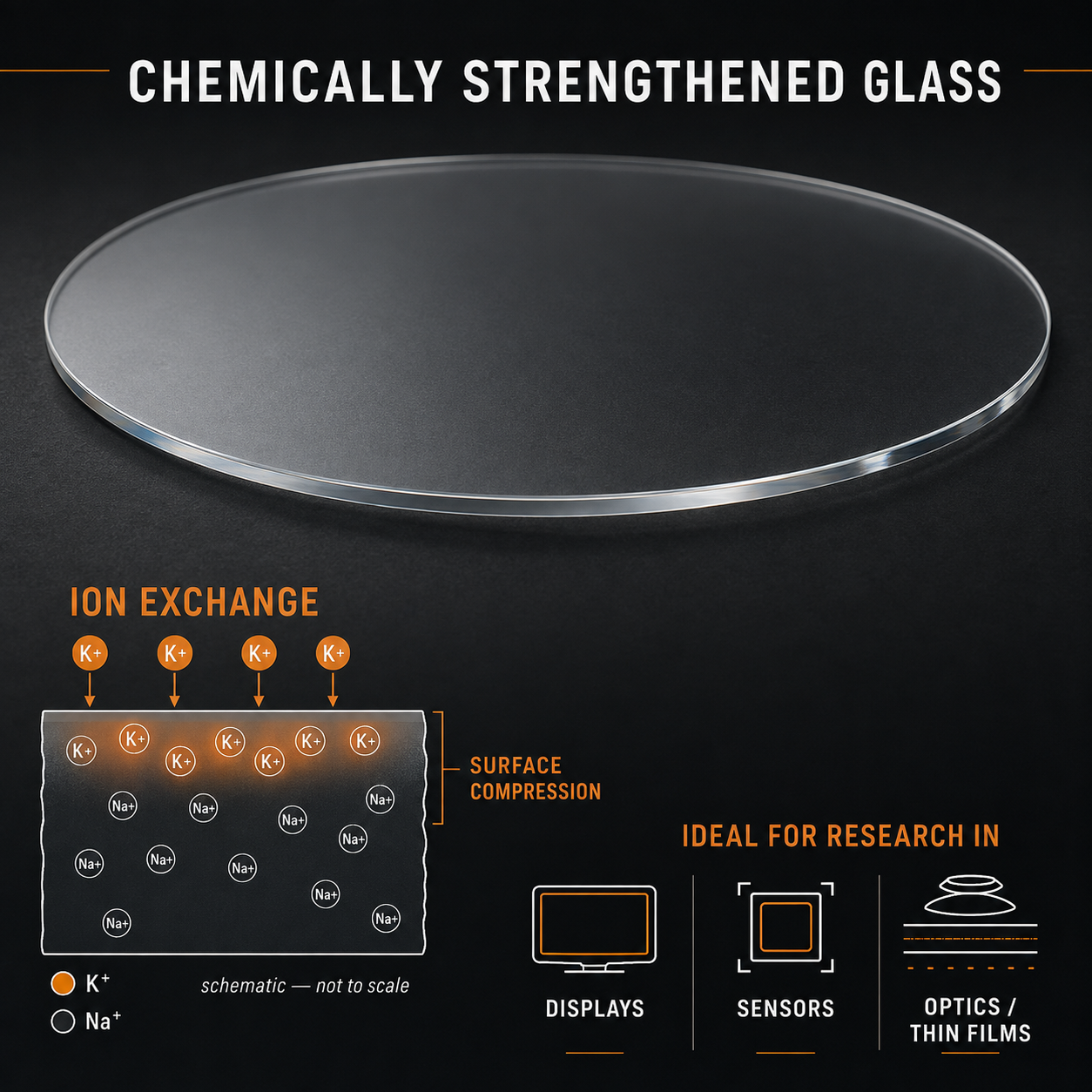
Chemical strengthening typically uses an ion-exchange process that creates compressive stress near the glass surface. This surface compression helps improve resistance to damage and crack initiation while maintaining the transparency required for many optical and display-related applications.
- High optical transparency
- Improved resistance to scratches and surface damage
- Thin and mechanically durable substrate options
- Suitable for optical and display-related research
- Useful for thin-film deposition and coating studies
- Compatible with many sensor and device-development applications
Research Applications
Strengthened aluminosilicate glass can serve as a research substrate or protective transparent layer in a variety of experimental technologies, including:
- Touchscreen and display research
- Optical sensors and imaging systems
- Thin-film deposition
- Protective coatings and surface treatments
- MEMS and microfabrication research
- Wearable and portable device development
- Mechanical strength and fracture studies
- Materials-science experiments
Glass Substrates for Thin-Film Research
Transparent glass provides researchers with a useful platform for depositing and characterizing optical, dielectric, metallic, and functional thin films. Depending on the experiment, researchers may also compare strengthened aluminosilicate glass with fused silica wafers, BK7 glass, and other glass substrates.
Selecting a Strengthened Glass Substrate
When requesting glass for research, consider the required dimensions, thickness, surface finish, optical requirements, quantity, and intended fabrication process. Providing these specifications helps identify a substrate appropriate for your experiment.
Need Gorilla Glass or Strengthened Glass Substrates?
Tell us your required dimensions, thickness, surface requirements, quantity, and research application.
Get Your Glass Substrate Quote FAST! Or, Buy Online and Start Researching Today!
What Is Gorilla Glass?
Gorilla Glass is a chemically strengthened aluminosilicate glass engineered to provide a combination of optical transparency, thinness, and resistance to mechanical damage. Its properties make it useful for research involving displays, protective covers, sensors, optics, thin films, and advanced electronic devices.
How Is Gorilla Glass Strengthened?
Chemical strengthening is commonly achieved through an ion-exchange process. During this process, smaller ions near the glass surface are replaced by larger ions. The resulting compressive stress at the surface helps increase resistance to crack initiation and damage while preserving optical transparency.
Properties of Strengthened Aluminosilicate Glass
| Property | Research Significance |
|---|---|
| Material | Chemically strengthened aluminosilicate glass |
| Transparency | Suitable for many visible-light optical and display applications |
| Surface Strength | Ion exchange creates surface compressive stress that improves damage resistance |
| Surface | Can provide a smooth platform for coatings, thin films, and device research |
| Form Factor | Thin glass substrates can support compact optical and electronic experiments |
Gorilla Glass Research Applications
Chemically strengthened glass provides a transparent and durable platform for a variety of research projects. Potential applications include:
- Touchscreen and display research
- Optical and imaging systems
- Sensor development
- Thin-film deposition and characterization
- Protective optical covers
- Surface coating research
- Wearable and portable electronics
- Mechanical strength and fracture testing
- MEMS and microfabrication research
Gorilla Glass for Thin-Film Deposition
The transparent glass surface can serve as a substrate for depositing dielectric, metallic, conductive, and other functional thin films. This makes strengthened glass useful for experiments involving optical coatings, transparent electronics, sensors, and materials characterization.
Gorilla Glass vs. Other Glass Substrates
The appropriate glass depends on the requirements of the experiment. Chemically strengthened aluminosilicate glass is useful when mechanical durability is important, while BK7 glass is commonly selected for general optical applications. Fused silica may be preferred when low thermal expansion, high temperature capability, or ultraviolet optical performance is required.
Selecting Glass for Your Research
When choosing a strengthened glass substrate, researchers should consider substrate dimensions, thickness, surface finish, optical requirements, thermal conditions, and compatibility with the intended fabrication process. UniversityWafer can help researchers identify glass substrates suitable for experimental and device-development requirements.