
BK7 Glass for Optical and Photonics Research
BK7 glass is widely used in optical research because of its high transparency in the visible and near-infrared regions, good surface quality, and reliable optical properties. BK7 wafers and substrates provide researchers with a versatile platform for optical coatings, imaging systems, sensors, laser experiments, and photonics applications.
UniversityWafer supplies BK7 glass wafers and substrates for university laboratories, R&D facilities, and industrial research. Substrates can be selected according to dimensions, thickness, surface finish, and other experimental requirements.
Why Choose BK7 Optical Glass?
BK7 is a borosilicate crown optical glass known for its combination of optical clarity, relatively low dispersion, and good mechanical properties. These characteristics make it a useful substrate material for both fundamental research and optical device development.
- Excellent visible-light transmission
- Low optical dispersion
- Good surface quality for optical applications
- Suitable for polishing and optical coatings
- Useful for prototyping and laboratory experiments
- Available in custom substrate dimensions and thicknesses
BK7 Glass Applications
BK7 substrates can support a wide variety of optical, photonic, and materials-science experiments. Common research applications include:
- Optical windows and components
- Laser and beam-delivery experiments
- Optical coating development
- Imaging and microscopy systems
- Sensor and detector research
- Photonics research and prototyping
- Thin-film deposition
- MEMS and microfabrication research
BK7 Substrates for Thin-Film Deposition
The smooth optical surface of BK7 makes it useful as a substrate for experimental coatings and thin films. Researchers can use BK7 for deposition studies involving dielectric, optical, metallic, and functional coatings and subsequently evaluate their optical characteristics.
For applications requiring alternative transparent substrates, researchers can also consider fused silica wafers or Borofloat 33 glass, depending on the required optical, thermal, and material properties.
Specify Your BK7 Glass Requirements
When requesting BK7 glass, consider the required substrate diameter or dimensions, thickness, surface finish, dimensional tolerances, and quantity. Providing these specifications can help determine the most appropriate substrate for your research.
Need BK7 Glass Wafers or Optical Substrates?
Tell us the size, thickness, surface finish, quantity, and other specifications required for your optical or materials research.
Get Your BK7 Glass Quote FAST! Or, Buy Online and Start Researching Today!
What Is BK7 Glass?
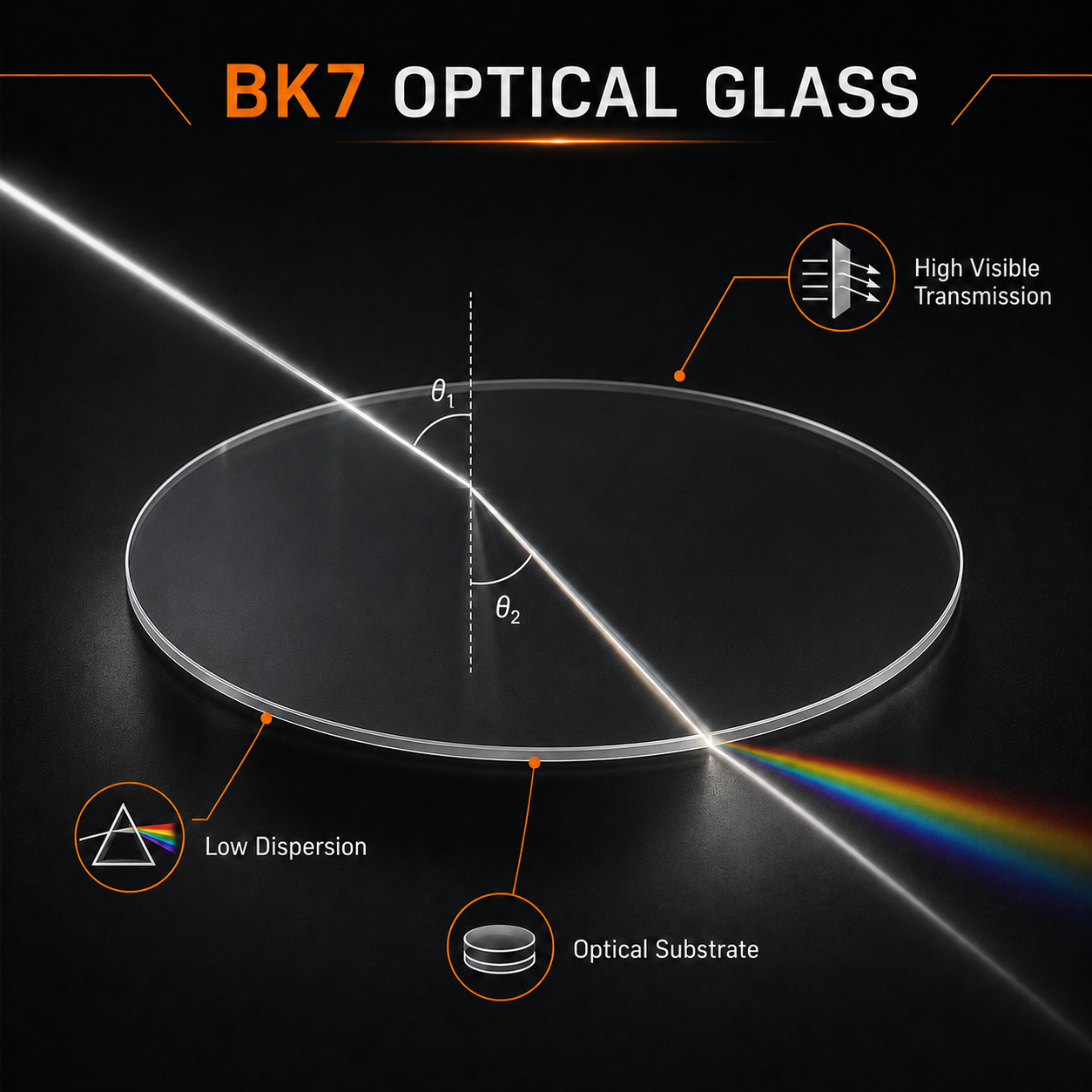
BK7 glass is a widely used optical crown glass known for its high optical transparency, low dispersion, and consistent refractive properties. It is commonly fabricated into windows, wafers, plates, lenses, and other optical components for laboratory, photonics, imaging, and laser applications.
UniversityWafer supplies BK7 glass wafers and substrates for research, prototyping, thin-film deposition, and optical experiments.
BK7 Optical Properties
BK7 offers a useful combination of optical performance, mechanical stability, and ease of fabrication. Its refractive index is approximately 1.517 at the sodium D-line (587.6 nm), although the exact value varies with wavelength and glass grade.
| Property | Typical BK7 Value |
|---|---|
| Glass Type | Optical crown glass |
| Refractive Index (nd) | ≈ 1.517 |
| Abbe Number (Vd) | ≈ 64.2 |
| Density | ≈ 2.51 g/cm³ |
| Optical Characteristic | High visible transparency and relatively low dispersion |
BK7 Glass for Optical Research
Because of its optical clarity and predictable refractive behavior, BK7 is frequently used in experiments involving light transmission, reflection, refraction, imaging, and optical coatings. Polished BK7 substrates can also provide a smooth surface for depositing dielectric, metallic, and other functional thin films.
- Laser optics and beam experiments
- Optical windows and protective components
- Imaging and microscopy
- Thin-film and optical coating research
- Photonics and sensor development
- Interferometry and spectroscopy
- Laboratory prototypes
BK7 vs. Fused Silica
BK7 and fused silica are both widely used transparent optical materials, but they are not interchangeable. BK7 is commonly selected for general visible and near-infrared optical applications, while fused silica is often preferred when greater ultraviolet transmission, lower thermal expansion, or improved resistance to thermal changes is required.
BK7 vs. Borofloat Glass
Researchers may also consider Borofloat 33 for applications where borosilicate glass properties, chemical durability, and thermal stability are important. The appropriate material depends on the optical wavelength range, temperature conditions, surface requirements, and fabrication process.
Selecting a BK7 Substrate
When selecting a BK7 optical substrate, researchers should consider dimensions, thickness, surface finish, flatness, dimensional tolerances, and optical quality. Substrate requirements can vary significantly between thin-film deposition, imaging, laser, sensor, and general materials-research applications.