Ultra-Flat Silicon Wafers for Optical Sensor Mirrors
Precision optical systems can require silicon substrates with tightly controlled
flatness, thickness, total thickness variation (TTV), and surface quality.
These parameters are especially important when a silicon wafer is used as a substrate
for a mirror, reflector, MEMS structure, or other precision optical component.
A PhD researcher contacted UniversityWafer looking for ultra-flat silicon wafers
for optical sensor mirror fabrication.
Research Request:
The researcher required
150mm silicon wafers
with the following specifications:
- Diameter: 150mm
- Conductivity: P-type
- Crystal orientation: (100)
- Thickness: 650µm
- Surface: Double-side polished (DSP)
- Total Thickness Variation: 1µm
- Application: Mirrors for optical sensor fabrication
Reference #117003 for specifications and pricing.
Why Low TTV Matters in Precision Optical Fabrication
Total Thickness Variation (TTV)
describes the difference between the maximum and minimum wafer thickness measured
under specified conditions. A low TTV indicates good thickness uniformity across
the wafer.
For precision optical and microfabrication applications, thickness uniformity can
help support consistent processing and predictable geometry. However, TTV is
not the same as surface flatness, bow, or warp. These are separate wafer
parameters and may also need to be specified when tight optical tolerances are required.
Why Use Double-Side-Polished Silicon?
Double-side-polished (DSP) silicon wafers have polished front and
back surfaces and are useful when both sides of the substrate participate in fabrication,
alignment, bonding, optical inspection, or other precision processes.
For an optical mirror or reflector, the required surface specification depends on
the operating wavelength and optical design. Researchers may need to consider
surface roughness, local and global flatness, TTV, bow, warp, and coating
requirements rather than relying on polish alone.
Ultra-Thin Silicon Reflectors for Optical Sensors
Some optical sensor designs require silicon components that are much smaller and
thinner than standard semiconductor wafers. UniversityWafer received one such request
from an engineer developing a miniature silicon reflector for an optical sensor.
Research Request:
The proposed reflector was approximately 750µm in diameter and 16µm
thick and was intended to be attached to a fused silica rod.
The researcher asked whether silicon could be supplied close to the required
dimensions and whether thicker material could subsequently be thinned and polished.
Reference #128860 for specifications and pricing.
Challenges of Ultra-Thin Silicon
Ultra-thin silicon
can provide low mass and compact dimensions for specialized optical and MEMS
components, but reducing silicon to tens of micrometers introduces additional
fabrication and handling challenges.
As silicon becomes thinner, researchers should consider:
- Mechanical fragility and risk of breakage
- Bow and warpage during processing and handling
- Thickness uniformity after thinning
- Surface roughness after grinding, lapping, or polishing
- Temporary or permanent bonding for mechanical support
- Handling and mounting methods for very small components
- Final dimensional tolerances required by the optical assembly
Processes such as grinding, lapping, polishing, and other wafer-thinning techniques
may be used to reach a target thickness. The appropriate process depends on the
starting material, final thickness, surface requirements, dimensional tolerances,
and available fabrication equipment.
Silicon Reflectors and Optical Coatings
A silicon substrate does not automatically provide the optimum reflectance for
every optical sensor. Its optical response varies with wavelength, incidence
angle, polarization, surface condition, and surrounding materials.
When a higher or wavelength-specific reflectance is needed, the silicon substrate
may be combined with a metallic or dielectric optical coating. In
this configuration, silicon provides the precision mechanical substrate while the
coating is designed to produce the required optical response.
Selecting Silicon for Optical Sensor Research
The appropriate wafer specification depends on the device and fabrication process.
Researchers developing optical mirrors, reflectors, MEMS structures, and photonic
components may need to specify:
- Wafer diameter or custom dimensions
- Silicon thickness and tolerance
- Total Thickness Variation (TTV)
- Bow and warp requirements
- Surface roughness and polish
- Single-side or double-side polishing
- Crystal orientation
- Conductivity type and resistivity
- Optical coating requirements
UniversityWafer supplies standard and custom silicon substrates for
optical sensors, precision mirrors, reflectors, MEMS, photonics, and
experimental optical device fabrication.
Get Your Optical Sensor Wafer Quote FAST!
Or,
Buy Online
and Start Researching Today!
How Are Silicon Wafers Used in Optical Sensors?
Silicon wafers are widely used as structural, optical, and microfabrication substrates in optical sensing systems. Their precisely controlled thickness, surface finish, mechanical properties, and compatibility with semiconductor processing make them useful for fabricating components such as MEMS mirrors, scanning mirrors, optical reflectors, photonic structures, and sensor platforms.
For reflective optical components, the performance of silicon depends on the operating wavelength, surface quality, angle of incidence, and any optical coating applied to the surface. When higher or wavelength-specific reflectance is required, silicon can serve as the mechanically precise substrate beneath a metallic or dielectric reflective coating.
Why Surface Quality Matters for Optical Applications
Optical components require careful control of surface characteristics. Surface roughness, flatness, total thickness variation (TTV), bow, and warp can influence fabrication accuracy and optical performance.
Depending on the device, researchers may specify:
- Low surface roughness to reduce unwanted light scattering
- Low TTV for improved thickness uniformity across the wafer
- Controlled bow and warp for precision fabrication and alignment
- Single-side or double-side polishing depending on the optical design
- Specific wafer thickness for mechanical or optical requirements
- Crystal orientation and resistivity when relevant to fabrication or device operation
Double-side-polished (DSP) silicon is especially useful when both wafer surfaces must have high-quality finishes or when tight geometrical tolerances are important.
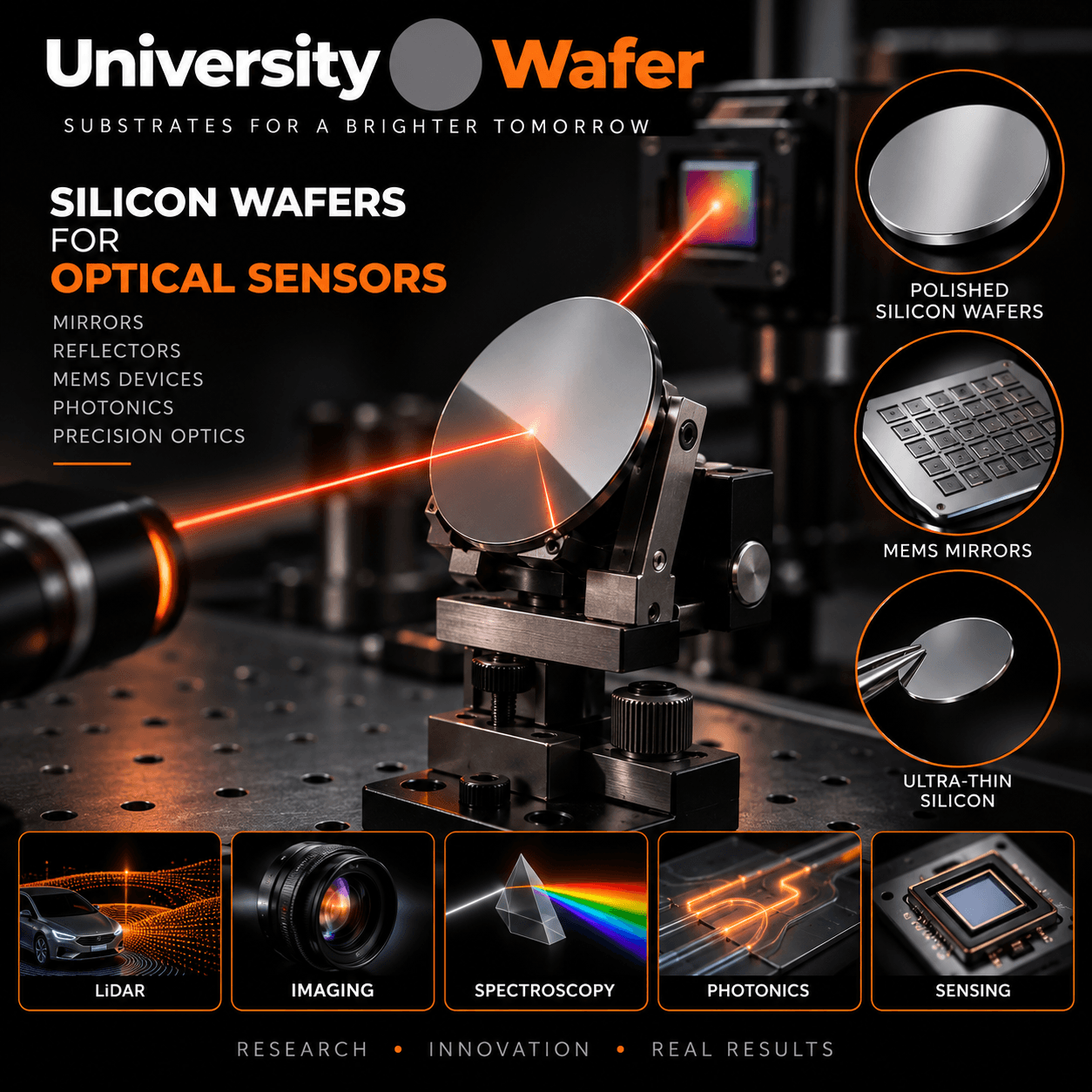
Silicon Mirrors and Reflective Optical Components
A polished silicon surface has wavelength-dependent reflectance, but many optical systems require additional coatings to achieve the desired spectral response. In these cases, silicon provides the underlying substrate while the coating is engineered for the operating wavelength.
Metallic Reflective Coatings
Metals such as aluminum, silver, and gold can be deposited onto silicon substrates using techniques such as evaporation or sputtering. The appropriate metal depends on the wavelength range, required reflectance, environmental conditions, and device design.
Dielectric Mirror Coatings
Multilayer dielectric stacks can also be deposited on silicon to create wavelength-selective, highly reflective surfaces. These coatings use alternating layers with different refractive indices so that reflected waves interfere constructively over a designed spectral range.
The exact materials and layer thicknesses must be engineered for the intended wavelength, angle of incidence, polarization, and environmental requirements.
Silicon for MEMS Optical Mirrors
Silicon is particularly important in microelectromechanical systems (MEMS). Photolithography, thin-film deposition, and dry or wet etching can be used to fabricate small movable structures that redirect or scan light.
MEMS optical mirrors may be incorporated into systems for:
- Beam steering and scanning
- Optical switching
- Compact imaging systems
- Spectroscopy
- LiDAR and ranging research
- Other miniaturized optical instrumentation
The wafer specification required for a MEMS mirror depends on its geometry, actuation mechanism, fabrication process, operating wavelength, and mechanical requirements.
Thin Silicon for Optical Reflectors
Ultra-thin silicon wafers can be useful when researchers need reduced substrate thickness, lower mass, or specialized mechanical behavior. Thin silicon may be considered for experimental mirrors, MEMS structures, optical assemblies, and other research devices where conventional wafer thicknesses are unsuitable.
As silicon becomes thinner, however, handling becomes more challenging and mechanical deformation can become increasingly important. Researchers should therefore consider thickness tolerance, bow, warp, surface finish, handling method, and mounting conditions when selecting very thin substrates.
Optical Sensor Fabrication
Depending on the device architecture, fabrication of silicon-based optical sensor components may involve several semiconductor and optical processing steps:
- Wafer Selection: Choose the required diameter, thickness, orientation, resistivity, surface finish, and geometrical tolerances.
- Surface Preparation: Use polished surfaces when low roughness and controlled surface quality are required.
- Patterning: Photolithography or other lithographic methods can define micro- and nanoscale structures.
- Etching: Wet or dry etching can transfer patterns into silicon or deposited films.
- Thin-Film Deposition: Metallic, dielectric, or other functional layers may be deposited depending on the device.
- Integration: Fabricated structures can be combined with light sources, photodetectors, lenses, electronics, or other optical components.
What Is an Optical Flow Sensor?
An optical flow sensor estimates relative motion between a sensor and a scene by analyzing changes in image information over time. Many systems use an image sensor together with processing algorithms that compare sequential frames or image features to estimate motion.
Optical flow techniques are used in applications such as robotics, drones, navigation, computer vision, motion tracking, and automation. The exact implementation varies considerably between systems and does not necessarily require a silicon mirror, although silicon-based semiconductor devices are commonly used in imaging and signal-processing hardware.
What Is an Optical Dissolved Oxygen Sensor?
An optical dissolved oxygen sensor measures oxygen concentration using an oxygen-sensitive luminescent material. A light source excites the sensing material, and oxygen affects characteristics of its luminescence, such as its intensity, phase, or lifetime.
A photodetector measures the optical response, which can then be related to dissolved oxygen concentration after appropriate calibration. These sensors are used in water-quality monitoring, aquaculture, wastewater treatment, and laboratory research.
Unlike electrochemical dissolved-oxygen sensors that consume oxygen during measurement, luminescence-based optical sensors generally do not consume oxygen at the sensing element.
Choosing Silicon Wafers for Optical Sensor Research
The appropriate silicon substrate depends on the optical component and fabrication process. Researchers should consider the operating wavelength, surface roughness, wafer flatness, TTV, bow, warp, thickness, crystal orientation, resistivity, polishing requirements, and coating compatibility.
UniversityWafer supplies standard and custom silicon substrates for optical sensors, MEMS mirrors, reflectors, photonics, spectroscopy, LiDAR research, and precision optical fabrication.
Related Optical Sensor Substrates and Research
-
Silicon Wafers
– Explore silicon substrates for optical sensors, MEMS, photonics, and precision device fabrication.
-
Ultra-Thin Silicon Wafers
– Thin silicon substrates for lightweight optical structures, MEMS devices, and specialized research applications.
-
Laser Scanning Mirrors
– Learn about substrates and fabrication considerations for laser beam steering and scanning mirror research.
-
Photodiodes
– Silicon substrates used in research involving light detection and optoelectronic devices.
-
Integrated Photonics
– Explore wafer materials for waveguides, optical components, sensors, and integrated photonic devices.
-
Silicon MEMS Devices
– Learn how silicon substrates support microfabricated sensing structures and MEMS research.
-
Semiconductor Spectroscopy
– Explore semiconductor materials and substrates used in optical characterization and spectroscopy research.
-
Bandpass Filters
– Learn about materials and substrates used in wavelength-selective optical filtering applications.
