
Single Crystal Quartz Wafers for Research
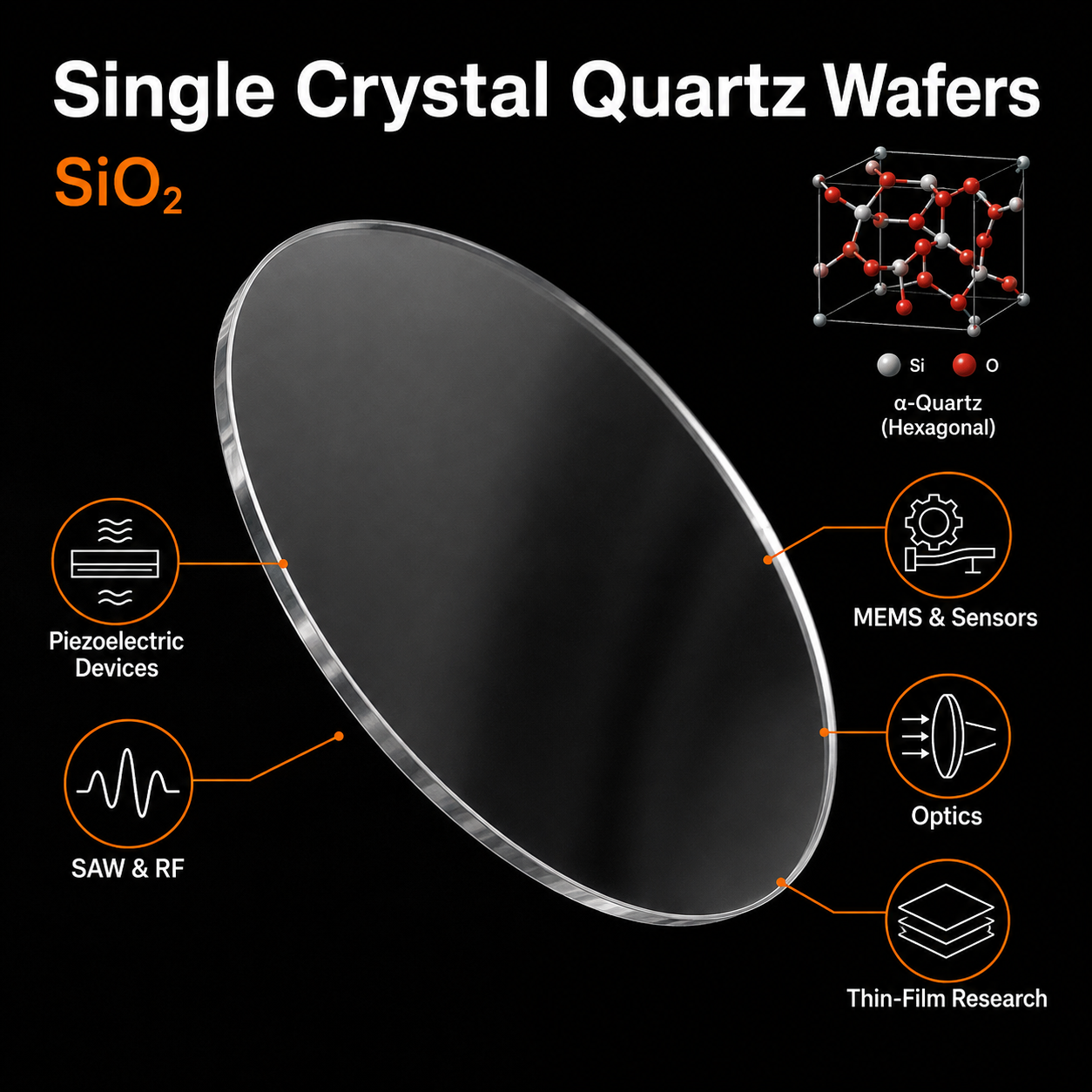
UniversityWafer supplies single crystal quartz wafers and substrates for research involving piezoelectric devices, MEMS, RF electronics, optics, sensors, and advanced materials. Unlike fused quartz, single crystal quartz has an ordered crystalline structure that provides orientation-dependent properties and piezoelectric behavior.
Why Use Single Crystal Quartz?
Crystalline quartz combines piezoelectric properties with optical transparency, chemical stability, and good dimensional stability. These characteristics make quartz substrates useful in applications where precise mechanical, electrical, or optical behavior is required.
Single Crystal Quartz Applications
- Piezoelectric devices: resonators, oscillators, and frequency-control research
- RF and acoustic devices: development of surface acoustic wave (SAW) devices
- MEMS: sensors, resonators, and microfabricated structures
- Optical research: substrates and components for optical experiments
- Sensor development: pressure, mass, force, and other sensing research
- Thin-film research: crystalline substrates for deposition and material characterization
Quartz Crystal Orientation
Crystal orientation is an important specification for single crystal quartz wafers because quartz properties vary with crystallographic direction. Researchers may require specific cuts or orientations depending on the desired piezoelectric, acoustic, thermal, or optical response.
Choosing Your Quartz Substrate
When requesting a quartz wafer, consider the wafer diameter, thickness, crystal cut or orientation, surface finish, and quantity. Double-side polished or other specialized surface configurations may also be required for optical, MEMS, or thin-film applications.
Need Single Crystal Quartz Wafers?
Send us your required diameter, thickness, crystal orientation or cut, surface finish, and quantity, and UniversityWafer can help identify a suitable quartz substrate for your research.
Get Your Single Crystal Quartz Wafer Quote FAST! Or Buy Online and Start Researching Today!
Single Crystal Quartz for Precision Research
Single crystal quartz (SiO2) is a crystalline material valued for its piezoelectric, optical, mechanical, and electrical properties. Unlike amorphous fused silica, crystalline quartz has an ordered crystal structure that makes its properties dependent on crystallographic orientation. This makes quartz wafers particularly useful for precision acoustic, RF, sensor, MEMS, and optical research.
Piezoelectric Quartz Wafers
One of the most important characteristics of single crystal quartz is its piezoelectric behavior. Mechanical deformation can generate an electrical response, while an applied electric field can produce mechanical strain. Researchers use these properties when developing resonators, oscillators, acoustic devices, and precision sensors.
Quartz for SAW and RF Devices
Single crystal quartz substrates can be used in surface acoustic wave (SAW) devices and other RF research. Crystal cut and orientation are important because they influence acoustic propagation and device behavior.
Applications of Single Crystal Quartz
- SAW devices: acoustic wave and RF device research
- Resonators and oscillators: frequency-control experiments and device development
- MEMS: microfabricated sensors, resonators, and precision structures
- Piezoelectric sensors: force, pressure, mass, and vibration research
- Optics: substrates for optical and photonic experiments
- Thin-film deposition: crystalline surfaces for material growth and characterization
Single Crystal Quartz vs. Fused Silica
Although both materials are primarily composed of SiO2, they have very different structures. Single crystal quartz has an ordered crystalline lattice and exhibits piezoelectric behavior, while fused silica is amorphous and is commonly selected for optical, thermal, and laboratory applications.
Choosing a Single Crystal Quartz Wafer
Important specifications include crystal cut or orientation, wafer diameter, thickness, surface finish, and polishing configuration. Selecting the appropriate specifications helps ensure that the quartz substrate provides the required mechanical, acoustic, piezoelectric, or optical characteristics for the experiment.
UniversityWafer can help researchers source single crystal quartz wafers and substrates for university, laboratory, and industrial R&D.