
Research-Grade Advantages
Each wafer is engineered for ultra-low optical loss, consistent birefringence, and precise mechanical stability—qualities essential for reproducible results in integrated photonics and quantum device fabrication. UniversityWafer ensures every LiNbO₃ substrate meets strict homogeneity and surface standards, verified by dark-field microscopy and XPS analysis.
This level of quality supports academic, government, and industrial researchers working in telecom, quantum optics, sensing, and acousto-optic device development.
Accelerate Your Photonics Research
Explore premium Lithium Niobate (LiNbO₃) wafers engineered for research accuracy and device reliability. Choose from multiple orientations, diameters, and finishes to match your experimental needs.
Get Your LiNbO3 Substrate Quote FAST! Or, Buy Online and Start Researching Today!
Quick Facts: Lithium Niobate Wafers
- Material: Lithium Niobate (LiNbO₃)
- Crystal Orientations: X-cut, Y-cut, Z-cut, and 128°Y-cut
- Diameter Options: 2", 3", 4" (custom sizes on request)
- Thickness Range: 0.5–1.0 mm for bulk; 300 nm–several µm for thin films
- Orientation Accuracy: ±0.1° via X-ray diffraction alignment
- Flatness/Bow/Warp: Typically <10 µm for 3″ wafers
- Surface Roughness: <1 nm RMS (optical grade polish)
- Defect Density: <10 particles >0.3 µm per cm²
- Refractive Index Homogeneity: Δn < 10⁻⁵ across wafer
- Absorption @1550 nm: <0.1 cm⁻¹
Material Comparison Snapshot
| Material | EO Coeff. | Nonlinear | Integration | Key Advantage |
|---|---|---|---|---|
| LiNbO₃ | High | Very High | Good | Excellent all-around performance |
| Silicon | Low | Low | Excellent | CMOS compatibility |
| InP | Moderate | Moderate | Good | Direct emission |
| LiTaO₃ | High | High | Good | Stable thermal properties |
| SiN | Very Low | Low | Excellent | Ultra-low loss |
Why Researchers Choose Us
- Custom diameters and cuts for specialized projects
- Fast global shipping and ISO-compliant packaging
- Thin-film bonding for integrated photonics
- Support for hybrid silicon–LiNbO₃ process integration
Lithium Niobate (LiNbO₃) Wafers for Advanced Photonics Research
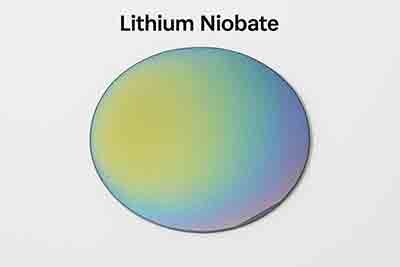
Lithium niobate (LiNbO₃) is one of the most versatile and powerful materials in modern photonics. Its combination of optical, piezoelectric, and ferroelectric properties makes it indispensable for cutting-edge applications ranging from high-speed optical modulators to quantum photonics. First synthesized in the 1950s, lithium niobate has evolved from a scientific curiosity into a foundation for integrated photonic devices that define the next generation of optical communication and signal processing systems:contentReference[oaicite:0]{index=0}.
Fundamental Properties and Advantages
Lithium niobate’s exceptional electro-optic coefficient enables modulation speeds up to 100 GHz, giving it a clear advantage in telecommunication systems where high-speed light modulation is critical. Its strong nonlinear properties make it a preferred material for frequency conversion, optical parametric amplification, and quantum light generation. The wide transparency window, spanning from approximately 350 nm to 5 μm, allows researchers to design devices that operate across visible, infrared, and mid-infrared spectral regions:contentReference[oaicite:1]{index=1}.
Another remarkable feature is its availability in multiple crystal orientations (X-cut, Y-cut, Z-cut, and 128° Y-cut), enabling tailored device design for specific applications. These orientations affect the material’s electro-optic and acoustic properties, allowing fine-tuning for modulators, surface acoustic wave (SAW) devices, and frequency filters. As photonics research increasingly merges optical and electronic functionalities, LiNbO₃’s ability to function as both a passive and active substrate gives it an unrivaled position in hybrid integration platforms:contentReference[oaicite:2]{index=2}.
Key Photonic Applications
In telecommunications and data-center applications, lithium niobate modulators translate electrical signals into optical ones at astonishing speeds. Recent advancements have demonstrated devices exceeding 100 GHz bandwidth with driving voltages below 2V, achieving data transmission rates up to 200 Gbps per wavelength channel. These devices form the optical backbone of global networks, ensuring high-fidelity data transmission with minimal signal loss:contentReference[oaicite:3]{index=3}.
Beyond modulation, LiNbO₃ is central to waveguide fabrication. Its high refractive index (≈2.2) enables tight optical confinement, allowing for compact, low-loss on-chip photonic circuits. Techniques such as titanium diffusion, proton exchange, and direct laser writing are used to tailor optical confinement, propagation loss, and fabrication scalability. Today, LiNbO₃ waveguides routinely achieve propagation losses below 0.03 dB/cm—rivaling even the best silicon photonics platforms:contentReference[oaicite:4]{index=4}.
In quantum photonics, LiNbO₃ plays a critical role as a nonlinear medium for generating entangled photons via spontaneous parametric down-conversion (SPDC). Brightness levels above 10⁶ pairs/s/mW and long-lived quantum memories in rare-earth-doped LiNbO₃ have made it a cornerstone for future quantum networks and quantum repeaters:contentReference[oaicite:5]{index=5}.
Its piezoelectric nature also makes it invaluable for acoustic-electrical coupling in SAW devices. Operating frequencies can reach up to 10 GHz, with quality factors exceeding 10,000—ideal for RF filters in wireless communication systems. Advanced designs with temperature-compensated and apodized transducers enable sharp frequency responses and minimal insertion loss:contentReference[oaicite:6]{index=6}.
Thin-Film Lithium Niobate: A New Era in Integration
Thin-film lithium niobate (TFLN) represents the next step in photonic integration. These submicron films (typically 300 nm–1 μm thick) maintain LiNbO₃’s exceptional electro-optic and nonlinear properties while allowing device miniaturization and high-density integration. Waveguide cross-sections as small as 300×600 nm enable circuits nearly 100 times smaller than traditional designs, packing hundreds of components onto a few square millimeters:contentReference[oaicite:7]{index=7}.
The strong light–matter interaction within thin-film waveguides leads to half-wave voltage-length products (VπL) below 1 V·cm, compared to 10–20 V·cm in bulk devices. This efficiency allows sub-volt operation and ultrahigh modulation bandwidths surpassing 150 GHz, a milestone for next-generation optical computing and data transmission:contentReference[oaicite:8]{index=8}. Moreover, TFLN can be processed using standard semiconductor lithography and etching methods, supporting wafer-scale fabrication up to 6 inches and enabling seamless hybrid integration with silicon or silicon nitride photonic platforms:contentReference[oaicite:9]{index=9}.
Material Quality and Research-Grade Standards
Optical performance in LiNbO₃ devices depends heavily on surface and bulk quality. UniversityWafer’s research-grade wafers are characterized by surface roughness below 1 nm RMS, flatness better than 10 μm across 3″ wafers, and low particle contamination (<10 particles larger than 0.3 μm per cm²). Refractive index homogeneity is typically Δn < 10⁻⁵, and absorption at 1550 nm remains under 0.1 cm⁻¹. These parameters ensure reproducibility, low optical loss, and uniform birefringence across the wafer, all critical for large-scale integration and consistent device performance:contentReference[oaicite:10]{index=10}.
Conclusion: A Platform for the Future of Photonics
Lithium niobate wafers remain a cornerstone for advancing photonics, bridging research and industry needs. Whether used for classical communication systems, nonlinear optics, or quantum networks, LiNbO₃ continues to enable technological breakthroughs due to its unmatched combination of optical, electrical, and mechanical properties. At UniversityWafer, each wafer is crafted to meet the highest standards of precision and purity, supporting researchers in achieving new frontiers in optical science:contentReference[oaicite:11]{index=11}.
Tell us your preferred cut, diameter, thickness, and surface finish. UniversityWafer provides academic, government, and industry-grade customization to accelerate your photonics research.