
Select the Right Fused Silica Wafer
Choosing the correct fused silica wafer is critical for achieving optimal optical performance. Factors such as grade, surface quality, thickness, and wavelength compatibility can significantly impact transmission, alignment, and device stability.
Get Your Quote FAST! Or, Buy Online and Start Researching Today!
Related Optical Substrate Pages
- Fused Silica Wafers
- Quartz Substrates
- Glass Wafers
- Silicon Wafers
- Borofloat 33 Glass
- BK7 Glass Substrates
- ITO Coated Glass
- Quartz and Fused Silica Wafers
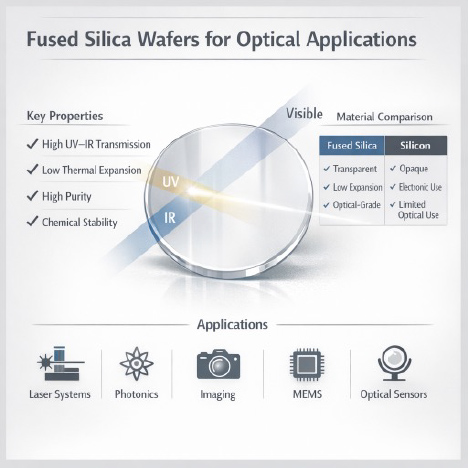
Fused Silica Wafers for Optical Applications
Fused silica wafers are widely used in optical applications due to their exceptional transmission across ultraviolet (UV), visible, and infrared (IR) wavelengths. Compared to traditional
Engineers and researchers rely on fused silica wafers when high purity, low thermal expansion, and minimal optical distortion are required. These properties make fused silica an ideal material for advanced imaging systems, MEMS, and semiconductor-related optical platforms.
Why Fused Silica is Used in Optical Systems
Optical applications require materials that maintain clarity and stability under varying environmental conditions. Fused silica provides excellent optical transmission, chemical resistance, and dimensional stability, making it a preferred choice for high-precision systems.
- High transmission from UV to IR wavelengths
- Low thermal expansion for dimensional stability
- Excellent chemical resistance
- High surface quality for optical performance
Fused Silica vs Quartz and Glass Substrates
Fused silica is often compared to other optical materials such as quartz wafers and general glass wafers. While quartz offers crystalline structure and similar optical properties, fused silica is amorphous, providing more uniform performance and fewer defects.
In comparison, materials like
Optical Grades and Surface Quality
Selecting the correct fused silica grade is essential for achieving optimal performance. Different grades are designed for specific wavelength ranges and applications.
- UV-grade fused silica for ultraviolet applications
- Standard optical grades for visible wavelengths
- IR-grade materials for infrared systems
For high-precision applications, double-side polished wafers are often used to reduce scattering and improve optical alignment. Surface roughness and flatness also play a critical role in device performance.
Wafer Specifications for Optical Applications
When selecting fused silica wafers, engineers must evaluate several key parameters to ensure compatibility with their system design.
- Wafer diameter and thickness
- Surface polish (single-side or double-side)
- Flatness and total thickness variation (TTV)
- Purity and optical grade
Applications of Fused Silica Wafers
Fused silica wafers are used in a wide range of optical and photonic applications where performance and reliability are critical.
- Laser systems and optical components
- Photonics and optical communication devices
- Imaging and sensing systems
- MEMS and semiconductor optical platforms
- Scientific and research instrumentation
As optical technologies continue to evolve, fused silica wafers remain a key material for enabling high-performance systems across research, industrial, and commercial applications.