
Order Lithium Niobate Substrates for SAW Devices
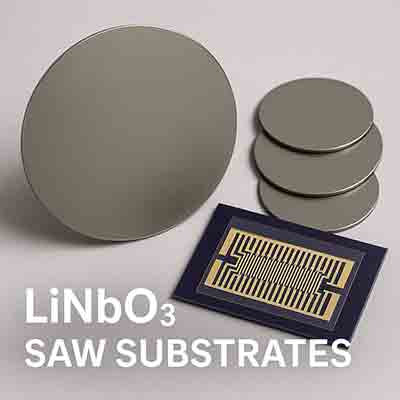
UniversityWafer, Inc. provides high-quality lithium niobate (LiNbO₃) substrates optimized for Surface Acoustic Wave (SAW) devices used in RF filters, sensors, microfluidics, and acoustic research. Our wafers are selected for strong electromechanical coupling, excellent surface quality, and consistent performance across orientations.
Get Your Quote FAST! Or, Buy Online and Start Researching Today!
Available LiNbO₃ SAW Substrate Materials
- Standard Lithium Niobate – High coupling efficiency for most SAW applications
- MgO-Doped Lithium Niobate – Increased resistance to optical damage
- Thin-Film Lithium Niobate (LNOI) – For advanced, high-frequency SAW and phononic devices
Common Orientations
- 128° Y-Cut – Industry standard for SAW filters and resonators
- 36° Y-X Cut – Excellent for temperature control and high-frequency designs
- Y-Z and Z-Cut – Used for specific propagation and sensing modes
- Custom orientations available upon request
Typical Specifications
- Diameters: 2”, 3”, 4” (other sizes available)
- Thickness: multiple options with tight tolerances
- Surface: SSP or DSP polished, epi-ready surfaces
- Low defect density for high-frequency stability
- Custom thickness, orientation, and doping options
Researchers use our LiNbO₃ substrates for SAW filters, RF modules, wireless sensors, acoustofluidic devices, biosensing, and quantum phononic applications. We assist in selecting the correct cut, grade, and thickness for your design.
Related SAW and Piezoelectric Substrate Resources
- Lithium Tantalate (LiTaO3) Wafers for SAW and RF Filters
- Single Crystal Quartz Substrates for Frequency Control
- Sapphire Wafers for High-Temperature SAW Devices
- Silicon Wafers for RF and CMOS Integration
- SOI Wafers for RF Front-End Modules
- Lithium Niobate Substrates for Nonlinear Optics
- GaN on Sapphire for High-Frequency RF Systems
- Semiconductor Materials for Energy and Sensing Devices
Understanding How LiNbO₃ Crystal Cuts Influence SAW Device Efficiency
Lithium niobate (LiNbO₃) is one of the most widely used materials for Surface Acoustic Wave (SAW) devices due to its excellent piezoelectric properties, strong electromechanical coupling, and versatility across orientations. Its ability to efficiently convert electrical signals into acoustic waves makes it an ideal platform for RF components, sensors, microfluidics, and quantum technologies.
Why Lithium Niobate is Ideal for SAW Devices
The superior performance of lithium niobate stems from its high electromechanical coupling coefficient, which enables strong acoustic wave generation and propagation. Its ferroelectric and piezoelectric nature allows flexible device design, and its broad transparency range and thermal stability make it compatible with a wide range of operating environments. These properties allow LiNbO₃-based SAW devices to function at high frequencies with precise control.
Crystal Orientation and SAW Performance
The crystal cut of lithium niobate plays a crucial role in determining SAW velocity, temperature stability, sensitivity, and propagation direction. Different orientations offer different trade-offs for RF filtering, sensing, and actuation applications.
Common Lithium Niobate Cuts for SAW Devices
- 128° Y-Cut LiNbO₃ – Offers high coupling and strong wave generation, widely used for filters and resonators.
- 36° Y-X Cut LiNbO₃ – Provides a balance of velocity and temperature stability, commonly used in advanced SAW filters.
- Y-Z and Z-Cut LiNbO₃ – Useful for devices requiring specific propagation modes or temperature characteristics.
Acoustic Velocity and Temperature Behavior
SAW velocity varies with crystal orientation and directly influences device frequency. Lithium niobate substrates allow designers to achieve a wide range of acoustic velocities suitable for low-, mid-, and high-frequency SAW structures. Temperature coefficients also depend on orientation, so selecting the correct cut is key for stability in precision RF or sensing applications.
Surface Preparation and Polishing
The surface condition of the LiNbO₃ wafer affects SAW propagation quality. Double-side polished wafers reduce scattering and enable consistent SAW behavior. Low-defect, low-roughness surfaces are especially important for high-frequency or highly sensitive devices.
Thin-Film Lithium Niobate for Advanced SAW Technology
Thin-film lithium niobate on insulator (LNOI) has transformed SAW and photonic device fabrication. By confining acoustic waves within a thin LiNbO₃ layer bonded to an insulator, LNOI enables higher frequencies, greater precision, and stronger interactions. The platform is being rapidly adopted for integrated RF components, high-performance resonators, quantum phononic devices, and acoustofluidics.
Applications of LiNbO₃ SAW Devices
Lithium niobate-based SAW devices are essential across multiple industries. Their sensitivity to mass, pressure, and temperature makes them especially valuable for sensing applications, while their high-frequency behavior is ideal for RF filters and communication systems.
- RF Filters and Resonators – Used in mobile devices, satellite systems, and telecommunications equipment.
- Chemical and Gas Sensors – Surface interactions with functional coatings enable selective detection.
- Biosensors – Detect biological binding events through mass loading.
- Pressure and Temperature Sensors – Exploit LiNbO₃’s piezoelectric and thermoelastic properties.
- Microfluidics and Lab-on-Chip – SAW manipulation allows mixing, pumping, and particle sorting on a chip.
- Quantum Acoustics – LiNbO₃’s strong coupling supports phononic quantum devices.
Design Considerations for SAW Device Optimization
Selecting the ideal lithium niobate substrate involves balancing frequency requirements, environmental conditions, and desired coupling strength. Orientation, wafer thickness, polish quality, and metallization compatibility all play roles in final device performance. Specialized cuts such as 128° Y and 36° Y-X are chosen based on application-specific trade-offs between sensitivity, velocity, and thermal stability.
Lithium niobate remains the material of choice for next-generation SAW technologies, enabling devices that are faster, more sensitive, and more reliable across a broad range of applications.