
I have succeeded in fabricating a device we call "Spectrum Emitting Plasma" using an 8" silicon wafer that eliminates heat loss completely from a lighting device called LED. The new lighting device employs Co-Silicide conductors built in 8" intrinsic silicon wafers But your intrinsic silicon wafer lists only 150mm wafers. Therefore, I am asking you to provide 200mm Intrinsic Silicon Wafers. 3 Year SEP Chip Fabrication Plan & Cost Estimates is attached below.
Spectrum Emitting Plasma for Semiconductor Processing
A PhD requested a quote for the following.
Reference #319468 for specs and pricing.
We have a large selection of substrates for all your semiconductor research needs!
Get Your Quote FAST! Or, Buy Online and Start Researching Today!
What Is A Semiconductor Processor?
In chip form, a semiconductor processor refers to a microprocessor or central processing unit (CPU)—the core computing unit in electronic devices. It is fabricated using semiconductor materials, primarily silicon, and consists of millions to billions of transistors that perform computations and execute instructions.
Key Components of a Semiconductor Processor (Chip)
- Transistors: Tiny electronic switches that control electrical signals, forming the basis of logic operations.
- Logic Gates: Arrangements of transistors that perform basic operations like AND, OR, and NOT to process data.
- Registers & Cache: Temporary storage areas within the processor that speed up access to frequently used data.
- Control Unit (CU): Directs the flow of instructions within the processor.
- Arithmetic Logic Unit (ALU): Performs mathematical and logical operations.
- Clock & Bus Systems: The clock synchronizes operations, while the bus system transfers data within the processor.
How It Works
- The processor fetches instructions from memory, decodes them, processes them using the ALU, and stores results.
- Modern chips use nanometer-scale transistor technology (e.g., 5nm, 3nm) to enhance performance and power efficiency.
- Multi-core processors contain multiple processing units (cores) on a single chip for parallel computing.
Types of Semiconductor Processors
- CPUs (Central Processing Units): General-purpose processors for computing tasks.
- GPUs (Graphics Processing Units): Specialized for parallel processing, graphics, and AI workloads.
- SoCs (System on Chips): Integrate CPU, GPU, and memory controllers in compact mobile/embedded devices.
- ASICs (Application-Specific Integrated Circuits): Custom-designed chips for specific applications (e.g., Bitcoin mining, networking).
- FPGAs (Field-Programmable Gate Arrays): Reconfigurable processors for specialized computations.
Would you like a comparison of semiconductor processors used in different applications?
What Is A Semiconductor Processing Engineer?
A Semiconductor Processor is a specialized technician responsible for manufacturing and processing semiconductor wafers into microchips, integrated circuits, and other semiconductor devices. These professionals work in cleanroom environments, using advanced equipment and techniques to fabricate, test, and package semiconductor components.
Roles and Responsibilities
- Wafer Processing: Operate and monitor machines that fabricate semiconductor wafers through
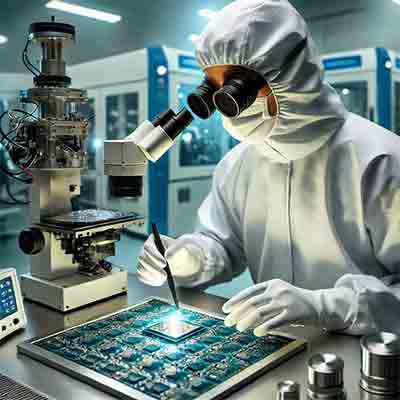 steps like photolithography, etching, doping, deposition, and polishing.
 - Quality Control: Inspect wafers and chips using microscopes and automated testing equipment to detect defects.
- Equipment Maintenance: Perform routine calibration, cleaning, and minor repairs on semiconductor manufacturing tools.
- Chemical Handling: Work with chemicals and gases used in semiconductor fabrication, ensuring safety and adherence to protocols.
- Data Analysis: Collect and analyze process data to maintain consistency and optimize yields.
- Packaging and Testing: Assist in cutting, assembling, and packaging semiconductor devices for end-use applications.
Work Environment
- Semiconductor processors work in cleanrooms with controlled temperature, humidity, and particle levels to prevent contamination.
- They wear cleanroom suits (bunny suits) to minimize human contamination.
- They work with highly automated equipment and advanced materials.
Skills and Qualifications
- Technical Knowledge: Understanding of semiconductor fabrication processes, including deposition, etching, and photolithography.
- Attention to Detail: Precision is crucial in semiconductor manufacturing.
- Problem-Solving Skills: Ability to troubleshoot equipment and process issues.
- Mathematical Skills: Basic understanding of measurements, ratios, and calculations related to wafer processing.
- Education: Typically requires an associate’s degree or certification in semiconductor manufacturing, engineering technology, or a related field.
Career Outlook
- Demand for semiconductor processors is expected to grow due to increasing global reliance on chips for electronics, AI, and automotive industries.