
Could you provide a quote for silicon chips measuring 15 mm × 15 mm, 2.5 mm × 3 mm, and 6.5 mm × 6.5 mm with thicknesses up to approximately 1 mm? Quantities required are 50 or 100 pieces of each size.
Custom Silicon Chip Wafers and Diced Silicon Substrates
UniversityWafer supplies silicon chip wafers, diced silicon substrates, silicon squares, and custom wafer pieces for semiconductor research, MEMS development, photonics, microelectronics, sensors, and advanced device fabrication. We can provide custom dimensions, thicknesses, crystal orientations, dopant types, and surface finishes in quantities ranging from a single piece to production volumes.
A Technical Support Manager from a semiconductor company requested the following quote:
UniversityWafer, Inc. Quoted:
- Silicon Wafer – 15 × 15 × 1.5 mm, DSP, P<100>, 1–20 Ω·cm
- Silicon Wafer – 2.5 × 3.0 × 2 mm, DSP, P<100>, 1–20 Ω·cm
- Silicon Wafer – 6.5 × 6.5 × 2 mm, DSP, P<100>, 1–20 Ω·cm
Reference #254029 for specifications and pricing.
Get Your Silicon Chip Wafer Quote FAST! Or, Buy Online and Start Researching Today!
Diced Silicon Chips for Research Applications
A Ph.D. candidate requested the following:
I need silicon chips to use as substrates for research and require approximately 40–50 pieces.
UniversityWafer, Inc. quoted:
GU13 — 50 silicon substrates diced from SEMI Prime wafers.
4" diameter, 1,000 ±25 µm thick, p-type Si:B <100>.
Diced into 55 mm × 55 mm × 1 mm squares.
Double-side polished, TTV <5 µm, Bow <40 µm, Warp <40 µm.
Reference #253849 for pricing.
Silicon Chip Carriers and Custom Wafer Machining
UniversityWafer can also provide custom-machined silicon substrates, carrier wafers, and specialty wafer geometries for plasma etching, deposition, packaging, and semiconductor processing equipment.
A research engineer requested a 200 mm wafer with a custom center notch designed to hold a silicon chip during plasma etch processing.
Reference #248847 for specifications and pricing.
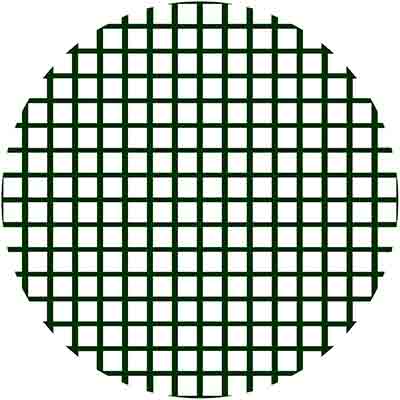
Typical Silicon Chip Layout on a Wafer
After semiconductor fabrication, hundreds or thousands of individual dies may be patterned across a single silicon wafer. The finished chips are then separated through dicing and packaging processes before being incorporated into electronic devices.
Common Uses for Silicon Chips
- Microprocessors and CPUs
- Artificial Intelligence Hardware
- MEMS Devices and Sensors
- Silicon Photonics
- Medical Electronics
- Automotive Control Systems
- Telecommunications Equipment
- Industrial Automation
- Aerospace and Defense Electronics
- Internet of Things (IoT) Devices
Use the Silicon Chip Calculator Below to estimate how many chips can be produced from a wafer diameter and die size. Larger wafer diameters generally provide higher chip yields and lower manufacturing costs.
Silicon Wafers Used for Semiconductor Chip Fabrication
Silicon wafers are the foundation of nearly every modern semiconductor device. From computer processors and memory chips to MEMS sensors and photonic devices, virtually all integrated circuits begin with a high-quality silicon substrate. UniversityWafer supplies silicon wafers and diced silicon chips for research, development, prototyping, and production applications.
The semiconductor industry has continually increased wafer diameters to improve manufacturing efficiency and maximize the number of chips produced per wafer. Larger wafer diameters increase die yield and reduce manufacturing costs per device.
| Wafer Diameter | Thickness | Year Introduced | Weight Per Wafer | 100 mm² Dies Per Wafer |
|---|---|---|---|---|
| 1" (25 mm) | — | 1960 | — | — |
| 2" (51 mm) | 275 µm | 1969 | — | — |
| 3" (76 mm) | 375 µm | 1972 | — | — |
| 4" (100 mm) | 525 µm | 1976 | 10 g | 56 |
| 4.9" (125 mm) | 625 µm | 1981 | — | — |
| 6" (150 mm) | 675 µm | 1983 | — | — |
| 8" (200 mm) | 725 µm | 1992 | 53 g | 269 |
| 12" (300 mm) | 775 µm | 2002 | 125 g | 640 |
| 450 mm (Proposed) | 925 µm | Future | 342 g | 1490 |
| 675 mm (Theoretical) | Unknown | Future | — | — |
What Silicon Wafers Are Used to Fabricate Chips?
Most semiconductor devices are fabricated on single-crystal silicon wafers. These wafers provide the crystal structure required for producing transistors, integrated circuits, sensors, and advanced electronic devices. Silicon remains the dominant semiconductor material because of its excellent electrical properties, thermal stability, abundance, and low manufacturing cost.
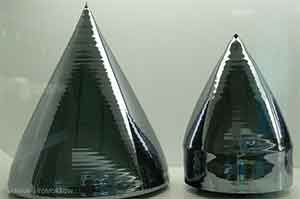
Researchers commonly select silicon wafers based on crystal orientation, resistivity, dopant type, thickness, and surface finish. Popular specifications include <100> and <111> crystal orientations, prime-grade surfaces, and single-side or double-side polished finishes.
How Silicon Chips Are Manufactured
Chip fabrication begins with ultra-pure silicon derived from quartz and silica sand. The silicon is refined and grown into a large single-crystal ingot using the Czochralski process. The ingot is then sliced into thin wafers, polished, cleaned, and prepared for semiconductor processing.
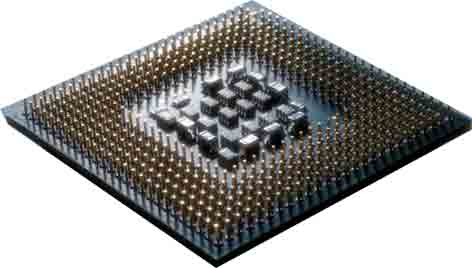
During fabrication, hundreds or even thousands of process steps may be performed, including photolithography, oxidation, ion implantation, deposition, etching, metallization, and packaging. These processes create billions of microscopic transistors on a single silicon wafer.
Common Applications for Silicon Chip Wafers
- Microprocessors and CPUs
- Artificial Intelligence (AI) Hardware
- Memory Devices
- Power Electronics
- MEMS Sensors
- Silicon Photonics
- Automotive Electronics
- Medical Devices
- Telecommunications Equipment
- Internet of Things (IoT) Devices
Silicon Wafers for MEMS and Photonics
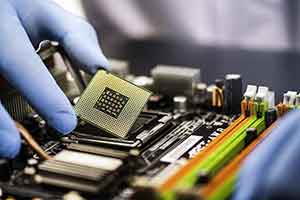
Beyond traditional integrated circuits, silicon wafers are widely used for MEMS fabrication, silicon photonics, optical sensors, photodetectors, microfluidics, and quantum research. Advanced silicon substrates can be customized with thermal oxide, silicon nitride, epitaxial layers, SOI structures, and specialty coatings to support next-generation technologies.
Custom Diced Silicon Chips and Wafer Pieces
UniversityWafer provides custom diced silicon chips, wafer pieces, silicon squares, rectangles, and specialty dimensions for research and production applications. We can supply custom thicknesses, crystal orientations, dopant types, resistivities, and surface finishes in quantities ranging from a single piece to volume production orders.
Why Silicon Remains the Industry Standard
Although materials such as gallium nitride (GaN), silicon carbide (SiC), and gallium arsenide (GaAs) are increasingly used in specialized applications, silicon continues to dominate semiconductor manufacturing because of its mature fabrication ecosystem, excellent material properties, and cost-effective production processes.
Today, silicon wafers remain the essential building block behind the world's computers, smartphones, automobiles, communications networks, AI systems, and advanced electronic devices.