
Get Your Quote FAST! Or, Buy Online and Start Researching Today!
Related Semiconductor Materials for High-Precision Research
UniversityWafer, Inc. provides high-purity substrates for metrology and infrared applications where material isotropy and thermal stability are critical.
- Monocrystalline Silicon Wafers: Prime grade Si substrates available in various crystal orientations including <100> and <111>.
- Silicon Epitaxial Wafers: High-quality epi-layers for advanced semiconductor manufacturing and CVD-grown silicon research.
- Silicon-on-Insulator (SOI): Wafers featuring a buried oxide layer (BOX) for specialized electronic applications.
- Fused Silica Substrates: Amorphous silicon dioxide offering superior UV-grade optical performance and low thermal expansion.
- Single Crystal Quartz: Piezoelectric and optical quartz materials used in high-precision sensing and frequency control.
- Infrared (IR) Optical Materials: Optical grade silicon and other infrared transmittance materials designed for high-stability IR applications.
The Engineering Investigation: Why "Perfect" Sphericity is Physically Impossible
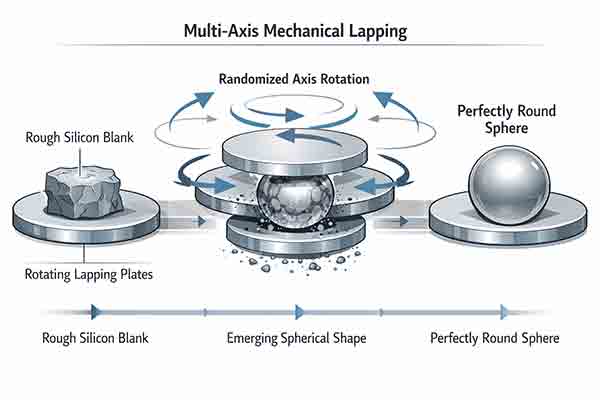
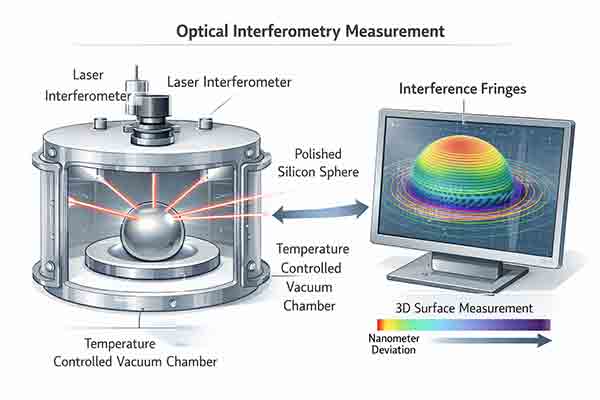
In the world of high-precision metrology, the quest to fabricate a perfectly round sphere is a battle against the fundamental laws of physics. Even the world’s roundest objects—the monocrystalline silicon spheres used to redefine the kilogram—possess microscopic imperfections at the atomic level.
1. Atomic Lattice Anisotropy
The primary hurdle is the internal structure of the material itself. Silicon used for optical grade silicon components is not isotropic; it has a specific crystal lattice (typically <100> or <111>).
- Differential Wear: During the abrasive polishing process, some atomic planes are more resistant to removal than others.
- Microscopic Lobing: This results in "lobing," where the sphere develops minute high and low spots aligned with its crystal orientation rather than a perfectly smooth curve.
2. The Lapping and Polishing Paradox
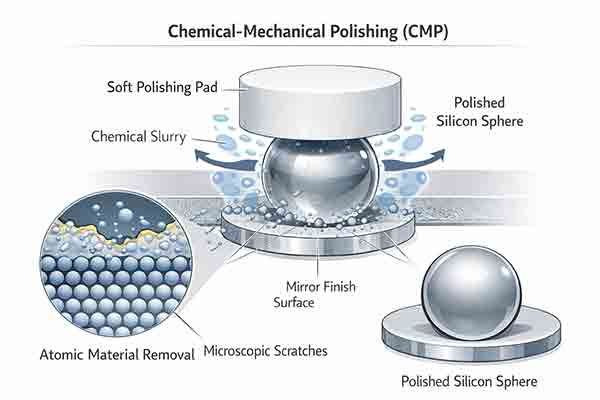
Spheres are typically created using a random-rotation lapping machine. However, the very process used to shape them introduces error:
- Elastic Deformation: The weight of the silicon and the pressure of the polishing plates cause the sphere to "sag" or flatten at contact points.
- Dynamic Shape: Because the material deforms under pressure, the sphere is technically not round while it is being actively shaped.
- Spring-Back Effect: Once pressure is removed, the material "springs back," often revealing irregularities that were compressed during fabrication.
3. Thermal Gradients and Expansion
Friction generates heat. Even in a temperature-controlled lab, polishing the bulk material creates thermal gradients.
- Asymmetric Contraction: If one hemisphere is 0.1°C warmer than the other, it expands more.
- Post-Cooling Distortion: As the sphere reaches thermal equilibrium, it contracts into an asymmetrical shape based on those previous temperature differences.
4. Chemical and Surface Obstacles
Achieving a uniform surface is further complicated by oxidation. On a 3D sphere, ensuring that every single atom of oxygen bonds with the silicon at a uniform thickness is nearly impossible.
| Challenge | Impact | Alternative Materials |
|---|---|---|
| Gravity | Causes "sag" | Single Crystal Quartz |
| Thermal Shift | Asymmetric cooling | Fused Silica |
For researchers requiring high-stability materials for IR applications, visit our infrared materials section.