
VGF Grown Gallium Arsenide (GaAs) Wafers
UniversityWafer supplies high-quality gallium arsenide (GaAs) wafers manufactured using both Vertical Gradient Freeze (VGF) and Liquid Encapsulated Czochralski (LEC) crystal growth methods. These substrates are available in semi-insulating and semiconducting grades for research, development, prototyping, and production applications.
VGF-grown GaAs wafers are widely used throughout the semiconductor industry because of their excellent crystal quality, low dislocation density, high electron mobility, and outstanding electrical uniformity. These characteristics make them ideal for high-frequency electronics, RF devices, optoelectronics, photonics, and advanced communication systems.
Electrical properties are carefully controlled using ultra-high-purity 6N gallium and arsenic source materials. Dopants such as silicon (Si), zinc (Zn), and tellurium (Te) can be introduced to achieve specific conductivity requirements.
Get Your Quote FAST! Or purchase custom GaAs substrates designed to meet your exact research specifications.
What is the Vertical Gradient Freeze (VGF) Process?
The Vertical Gradient Freeze process is one of the most advanced crystal growth techniques used to manufacture compound semiconductor materials. During crystal growth, a carefully controlled temperature gradient allows molten gallium arsenide to solidify slowly from a seed crystal, producing highly uniform single-crystal material.
The VGF process minimizes thermal stress and crystal defects while improving wafer uniformity. Compared to many alternative crystal growth methods, VGF produces substrates with lower dislocation densities and superior electrical characteristics.
Advantages of VGF Crystal Growth
The semiconductor industry relies on VGF-grown gallium arsenide because of the exceptional material quality achieved during crystal growth. The process is particularly valuable for applications requiring high-performance electronic and photonic devices.
Key advantages include:
- Low dislocation density
- Excellent crystal uniformity
- High electrical consistency across the wafer
- Superior thermal stability
- Reduced crystal defects
- Excellent radial resistivity uniformity
- Improved device yields
- Availability of semi-insulating and doped substrates
These benefits make VGF-grown GaAs wafers a preferred substrate for RF, microwave, and optoelectronic applications.
How GaAs Single Crystals Are Grown
Single-crystal gallium arsenide growth begins with ultra-high-purity source materials that are melted within a specialized crystal growth furnace. A carefully controlled cooling profile allows crystal formation to proceed from a seed crystal while maintaining proper stoichiometry and minimizing crystal defects.
Engineers continuously optimize temperature gradients, cooling rates, and dopant concentrations to achieve high-performance substrates suitable for semiconductor fabrication. The resulting wafers exhibit excellent crystal quality and electrical properties required for advanced electronic devices.
VGF-Grown GaAs for Advanced Semiconductor Applications
Gallium arsenide offers significantly higher electron mobility than silicon, enabling devices to operate at much higher frequencies and speeds. As a result, VGF-grown GaAs substrates are widely used in:
- RF and microwave electronics
- 5G communication systems
- Radar technology
- Satellite communications
- Monolithic Microwave Integrated Circuits (MMICs)
- High Electron Mobility Transistors (HEMTs)
- Laser diodes
- Photodetectors
- Photonic integrated circuits
- High-efficiency solar cells
- Aerospace electronics
- Defense applications
Because of its direct bandgap and excellent electrical properties, gallium arsenide remains one of the most important compound semiconductor materials used in modern electronics and photonics research.
Benefits of VGF Grown Gallium Arsenide (GaAs) Wafers
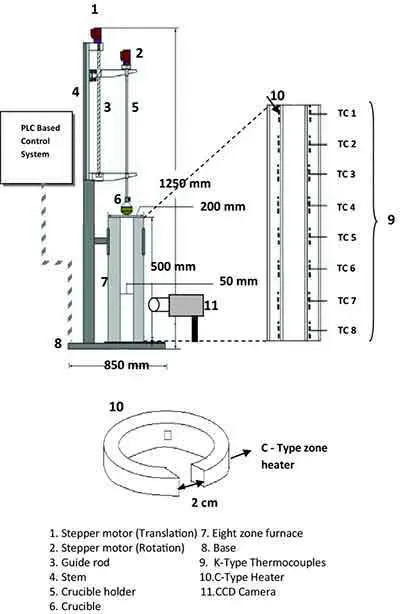 Vertical Gradient Freeze (VGF) is one of the most advanced crystal growth methods used to manufacture high-quality gallium arsenide (GaAs) wafers. Compared to other crystal growth techniques, VGF provides superior crystal uniformity, low dislocation density, improved electrical consistency, and excellent wafer-to-wafer reproducibility.
VGF-grown GaAs substrates are widely used in semiconductor manufacturing because they offer stable electrical properties, excellent thermal performance, and high crystal quality. These characteristics are critical for fabricating advanced electronic, optoelectronic, and photonic devices.
Key advantages of VGF-grown GaAs include:
- Low dislocation density
- Excellent radial and axial uniformity
- High crystal purity
- Stable semi-insulating properties
- Reduced defect concentrations
- Improved wafer yield
- Excellent thermal stability
- High electron mobility
Why Gallium Arsenide is Important for Semiconductor Devices
Gallium arsenide is a III-V compound semiconductor known for its exceptional electron mobility and direct bandgap characteristics. Compared to silicon, electrons travel significantly faster through GaAs, making it an ideal material for high-frequency and high-speed electronic applications.
Because of its direct bandgap, GaAs is also highly efficient at emitting and absorbing light, making it an important substrate for optoelectronic devices such as LEDs, laser diodes, photodetectors, and solar cells.
Researchers and manufacturers select GaAs when device performance requirements exceed the capabilities of conventional silicon-based technologies.
Applications for VGF Grown GaAs Wafers
VGF-grown gallium arsenide wafers are used throughout the semiconductor industry for both research and commercial production. The combination of high electron mobility, low noise characteristics, and excellent crystal quality enables a wide range of advanced device architectures.
Common applications include:
- RF and microwave devices
- 5G communication systems
- Satellite communications
- Radar systems
- High Electron Mobility Transistors (HEMTs)
- Monolithic Microwave Integrated Circuits (MMICs)
- Laser diodes
- Infrared detectors
- Photonic integrated circuits
- Solar cells for aerospace applications
- Quantum well devices
- High-speed digital electronics
VGF vs. LEC Gallium Arsenide Crystal Growth
The two most common methods for manufacturing gallium arsenide crystals are Vertical Gradient Freeze (VGF) and Liquid Encapsulated Czochralski (LEC) growth.
While both methods produce high-quality GaAs substrates, VGF growth is often preferred for applications requiring superior crystal uniformity and lower dislocation densities. The controlled temperature gradients used during VGF crystal growth help reduce thermal stresses and crystal defects that can negatively impact device performance.
As a result, VGF-grown GaAs wafers are frequently selected for demanding RF, photonic, and military-grade semiconductor applications.
Electrical Properties of VGF Grown GaAs
Gallium arsenide exhibits electrical characteristics that make it particularly attractive for next-generation semiconductor devices. Semi-insulating GaAs substrates provide excellent isolation for integrated circuits, while doped GaAs wafers can be tailored for specific electronic and optoelectronic applications.
Common dopants include:
- Silicon (Si)
- Zinc (Zn)
- Tellurium (Te)
- Sulfur (S)
These dopants allow manufacturers to precisely control carrier concentration, conductivity, and device performance.
Research and Development Using VGF GaAs Substrates
Universities, government laboratories, and semiconductor manufacturers utilize VGF-grown gallium arsenide wafers for advanced research involving quantum devices, photonics, high-frequency communications, optoelectronics, and compound semiconductor technologies.
The combination of low defect densities, excellent crystal uniformity, and stable electrical properties makes VGF-grown GaAs an important substrate for emerging technologies that require performance beyond traditional silicon-based materials.
UniversityWafer supplies VGF-grown gallium arsenide wafers in multiple diameters, orientations, doping types, and resistivity ranges for research, development, prototyping, and production applications.