Need Silicon Carbide Wafers?
Get Your Silicon Carbide (SiC) Wafer Quote FAST! Or Buy Online for high-quality SiC substrates used in power electronics, RF devices, epitaxy, and advanced semiconductor research.
Silicon Carbide (SiC) wafers are wide-bandgap semiconductor substrates engineered for high-power, high-voltage, high-frequency, and high-temperature electronic devices. Available in 4H-SiC and 6H-SiC polytypes, SiC wafers are widely used in power MOSFETs, Schottky diodes, RF amplifiers, electric vehicle (EV) power systems, high-temperature sensors, and epitaxial growth. UniversityWafer supplies high-quality silicon carbide substrates in multiple diameters, doping types, and crystal orientations for semiconductor research, device development, and commercial manufacturing.

Silicon Carbide (SiC) is one of the most important wide-bandgap semiconductor materials available today. Compared to conventional silicon, SiC offers a higher breakdown electric field, superior thermal conductivity, faster switching speeds, and excellent performance at elevated temperatures. These advantages make silicon carbide the preferred substrate for next-generation power electronics, RF devices, electric vehicles, renewable energy systems, and aerospace applications.
UniversityWafer supplies premium silicon carbide wafers for university research, prototype development, and commercial semiconductor manufacturing. We also offer related epitaxial wafers, III-V semiconductor wafers, research substrates, and silicon wafers for advanced semiconductor fabrication.
UniversityWafer can source 4H-SiC and 6H-SiC wafers in N-type, semi-insulating, and other custom specifications. Multiple crystal orientations, diameters, thicknesses, polishing options, and epitaxial-ready substrates are available to support research, prototype fabrication, and production-scale semiconductor manufacturing.
Get Your Silicon Carbide (SiC) Wafer Quote FAST! Or Buy Online for high-quality SiC substrates used in power electronics, RF devices, epitaxy, and advanced semiconductor research.
Silicon Carbide (SiC) is a wide-bandgap semiconductor material that combines silicon and carbon to create substrates capable of operating under extreme electrical, thermal, and mechanical conditions. Compared with traditional silicon wafers, SiC offers significantly higher breakdown voltage, greater thermal conductivity, faster switching speeds, and lower power losses. These characteristics have made silicon carbide one of the leading materials for next-generation power electronics, high-frequency communications, and electric transportation.
The two most widely used polytypes are 4H-SiC and 6H-SiC. 4H-SiC is preferred for power devices because of its superior electron mobility and electrical performance, while 6H-SiC continues to be used in RF applications, optoelectronics, and specialized research.
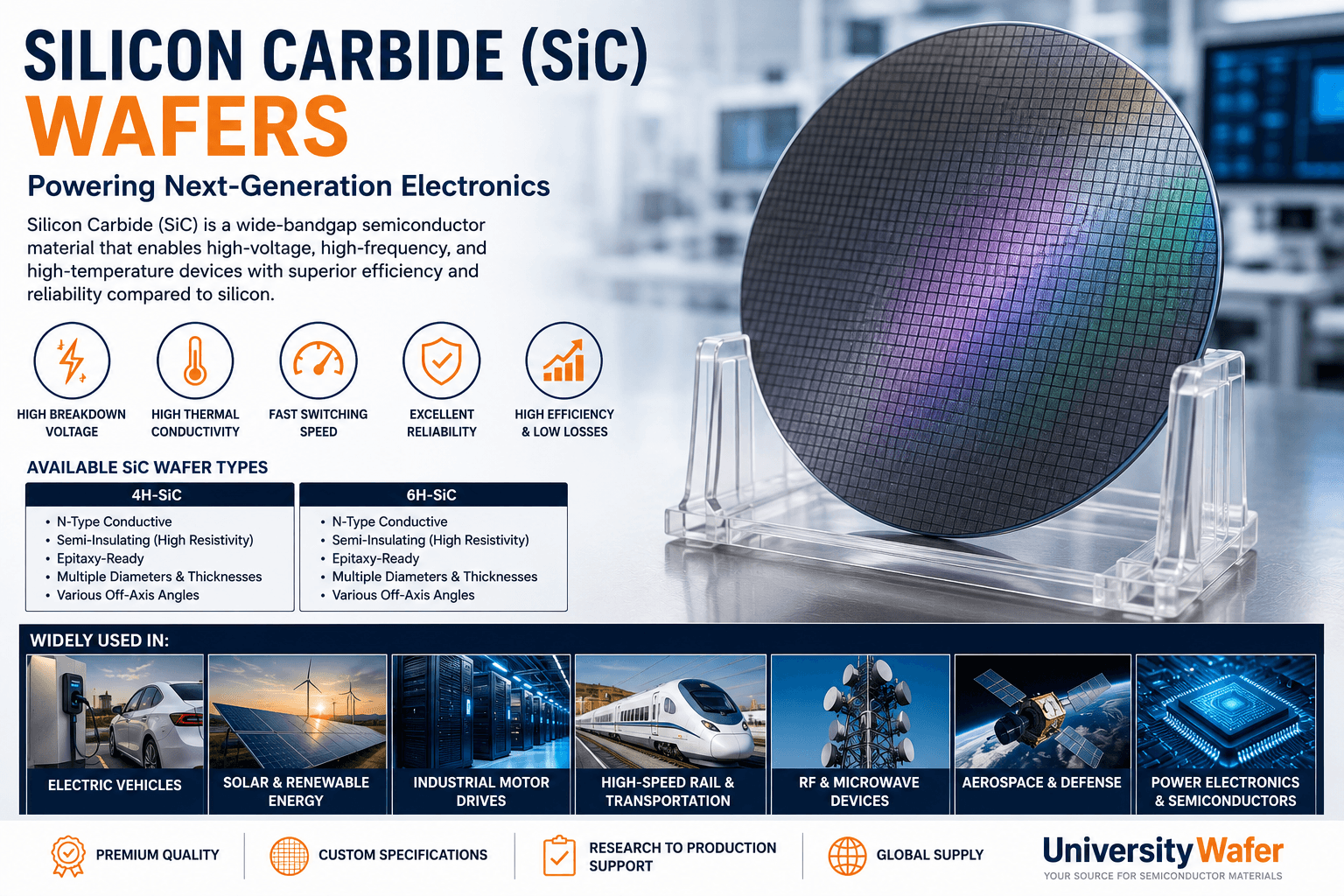
Silicon carbide wafers enable semiconductor devices that operate more efficiently, generate less heat, and perform under conditions where conventional silicon devices cannot. Common applications include:
UniversityWafer supplies silicon carbide wafers in multiple diameters, crystal orientations, doping types, and substrate grades to meet research and production requirements. Available options include 4H-SiC, 6H-SiC, N-type conductive substrates, semi-insulating substrates, and epi-ready wafers for advanced device fabrication.
We also provide epitaxial wafers, III-V semiconductor wafers, research substrates, and silicon wafers to support power electronics, photonics, MEMS, and semiconductor manufacturing.
As demand grows for more energy-efficient electronic systems, silicon carbide has become a foundational material for modern semiconductor technology. SiC-based devices operate at higher voltages, switch faster, and dissipate less heat than conventional silicon components, reducing system size while improving overall efficiency. These advantages make silicon carbide essential for electric vehicles, renewable energy systems, industrial automation, aerospace electronics, and next-generation high-power semiconductor devices.