
Borofloat 33 Wafers for Research
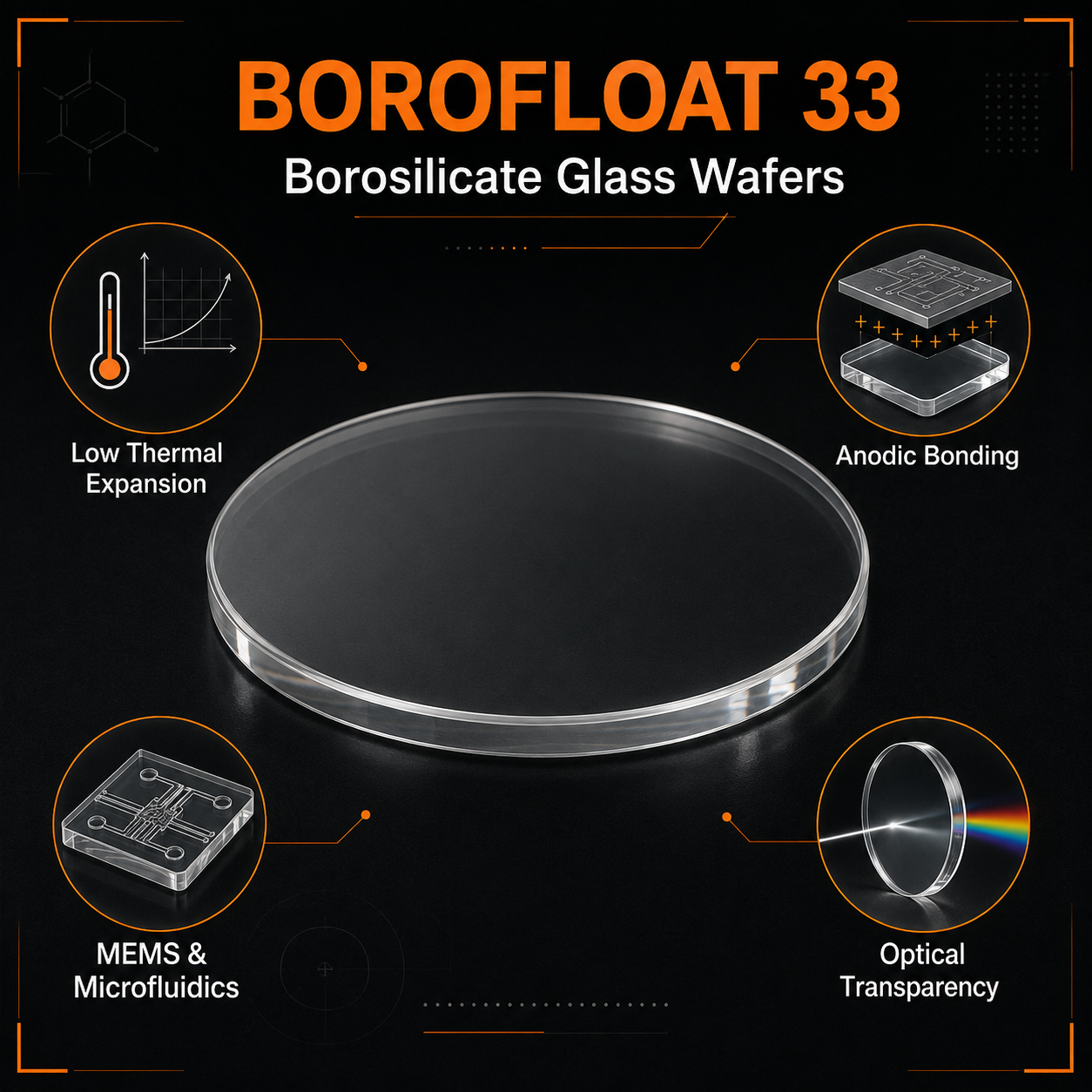
Borofloat 33 is a high-quality borosilicate glass widely used in semiconductor, MEMS, optical, and microfluidic research. Its combination of thermal stability, chemical resistance, and optical transparency makes it an excellent substrate for demanding laboratory and fabrication processes.
Key Borofloat 33 Properties
Borofloat 33 provides several characteristics that make it useful as a glass wafer and substrate material:
- Low thermal expansion for improved dimensional stability
- Excellent thermal resistance for elevated-temperature processing
- High chemical resistance for laboratory and fabrication environments
- Good optical transparency for optical and imaging applications
- Excellent surface quality for precision device fabrication
- Anodic bonding compatibility with silicon
Borofloat 33 for Anodic Bonding
One important application of Borofloat 33 is anodic bonding to silicon. This process can create strong, hermetic glass-to-silicon bonds and is widely used in MEMS devices, pressure sensors, microfluidic systems, and other microsystems.
Research Applications
- MEMS fabrication and packaging
- Microfluidic chips and lab-on-a-chip devices
- Silicon-to-glass anodic bonding
- Optical windows and components
- Sensors and microsystems
- Thin-film deposition research
- Semiconductor processing
Choosing Your Borofloat 33 Substrate
When selecting a Borofloat 33 wafer, researchers should consider specifications such as diameter, thickness, surface finish, flatness, and dimensional tolerances. Choosing the appropriate substrate specifications helps ensure compatibility with bonding, deposition, lithography, etching, and microfabrication processes.
Need Borofloat 33 for Your Research?
Tell us the wafer dimensions, thickness, surface requirements, quantity, and application for your project. UniversityWafer can help you source Borofloat 33 glass substrates suited to your research requirements.
Get Your Borofloat 33 Wafer Quote FAST! Or Buy Online and Start Researching Today!
Why Use Borofloat 33 Glass?
Borofloat 33 is a borosilicate glass valued for its combination of low thermal expansion, thermal stability, chemical resistance, and optical transparency. These characteristics make it suitable for precision research, semiconductor processing, MEMS fabrication, and optical applications.
Borofloat 33 in MEMS Fabrication
Borofloat 33 glass substrates are particularly useful in microelectromechanical systems (MEMS). The glass can serve as a structural substrate, protective cover, or packaging material for sensors, actuators, and other microscale devices.
Its compatibility with silicon anodic bonding makes Borofloat 33 useful for creating sealed cavities and silicon-glass structures used in pressure sensors, accelerometers, microfluidic devices, and other MEMS technologies.
Microfluidics and Lab-on-a-Chip Research
Borofloat 33 is also used in microfluidic and lab-on-a-chip devices. Its transparency allows researchers to visually inspect channels and perform optical measurements, while its chemical resistance supports experiments involving a variety of laboratory chemicals and fluids.
Optical and Thin-Film Applications
The optical properties and surface quality of Borofloat 33 make it useful for optical windows, imaging systems, sensors, and experimental optical components. Its smooth surface can also provide a suitable platform for thin-film deposition, coatings, metallization, and device fabrication.
Common Borofloat 33 Applications
- MEMS devices and microsystem packaging
- Anodic bonding to silicon wafers
- Microfluidic devices and lab-on-a-chip research
- Optical windows and components
- Pressure sensors and sensing devices
- Thin-film deposition and coatings
- Semiconductor and materials research
- Wafer-level packaging and device development
Selecting Borofloat 33 Wafers
Substrate requirements vary by experiment and fabrication process. Researchers should consider wafer diameter, thickness, surface finish, flatness, dimensional tolerances, and quantity when choosing Borofloat 33. Specifications should also be matched to subsequent processes such as bonding, lithography, deposition, etching, and optical characterization.
Borofloat 33 for Research and Prototyping
UniversityWafer supplies Borofloat 33 glass wafers and substrates for universities, laboratories, prototype development, MEMS research, and semiconductor applications. Researchers can request substrate specifications appropriate for their particular fabrication or experimental requirements.