
Soda Lime Glass for Research & Development
Soda lime glass is a versatile and cost-effective transparent material used in optical, microfabrication, microfluidic, sensor, and thin-film research. Its availability in wafers, windows, and flat substrates makes it useful for both experimental device fabrication and general laboratory applications.
UniversityWafer supplies soda lime glass wafers and substrates for universities, research laboratories, and industrial R&D. Researchers can select substrates based on size, thickness, surface finish, and other application requirements.
Why Use Soda Lime Glass Substrates?
Soda lime glass provides a practical combination of transparency, affordability, and ease of processing. It is especially useful when researchers require transparent substrates without the higher cost associated with specialized optical glasses.
- Good transparency throughout much of the visible spectrum
- Cost-effective for prototyping and laboratory research
- Available as wafers, windows, plates, and substrates
- Suitable for thin-film deposition and coating experiments
- Useful for photolithography and microfabrication
- Compatible with many microfluidic and sensor applications
Soda Lime Glass Research Applications
The combination of optical transparency and a smooth glass surface makes soda lime glass useful across a variety of research fields, including:
- Photolithography and mask development
- Microfluidic devices and lab-on-a-chip research
- MEMS fabrication and testing
- Optical windows and transparent components
- Sensor development
- Thin-film deposition and characterization
- Microscopy and imaging experiments
- University teaching laboratories
Glass Substrates for Thin-Film Deposition
Soda lime glass can provide a transparent base for depositing metallic, dielectric, conductive, and other functional thin films. Researchers can use these substrates to study film growth, optical transmission, electrical properties, coatings, and surface interactions.
For experiments requiring different optical or thermal characteristics, researchers can also compare soda lime glass with BK7 glass substrates, fused silica wafers, or Borofloat 33 glass.
Selecting Soda Lime Glass for Your Research
When requesting a soda lime glass substrate, consider the required dimensions, thickness, surface finish, dimensional tolerances, quantity, and intended fabrication or optical process. Providing these specifications can help identify the most appropriate glass for your experiment.
Need Soda Lime Glass Wafers or Windows?
Tell us your required size, thickness, surface specifications, quantity, and research application.
Get Your Soda Lime Glass Quote FAST! Or, Buy Online and Start Researching Today!
What Is Soda Lime Glass?
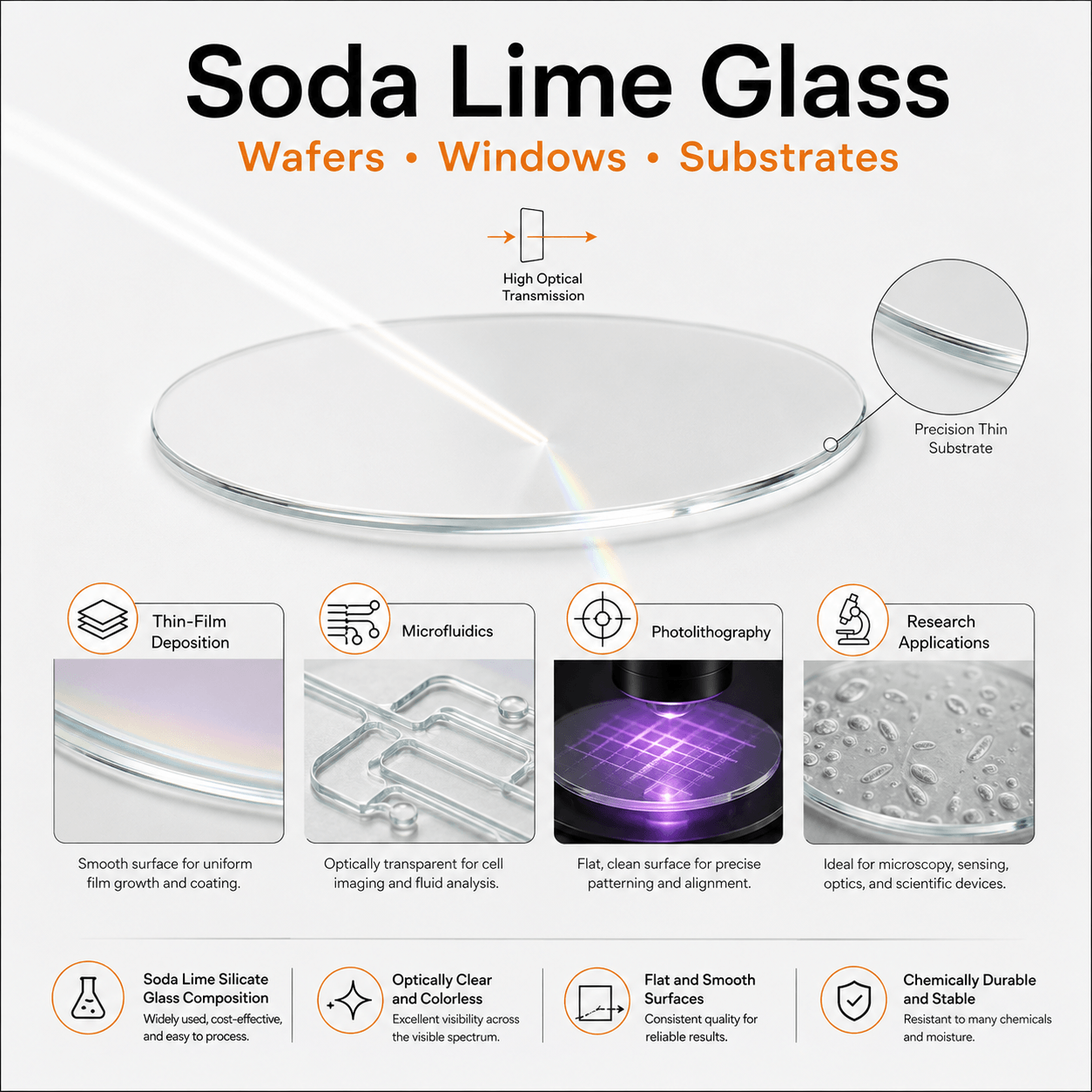
Soda lime glass is one of the most widely used types of glass and is primarily composed of silica (SiO2) with sodium and calcium compounds. For research applications, it provides an economical transparent substrate that can be used for optical experiments, microfabrication, sensors, coatings, and thin-film deposition.
Properties of Soda Lime Glass
Soda lime glass combines visible-light transparency, mechanical stability, and relatively low material cost. Its properties make it especially useful for research projects that require transparent substrates in larger quantities or for repeated experiments and prototypes.
| Property | Research Significance |
|---|---|
| Material Type | Soda-lime-silicate glass |
| Primary Component | Silicon dioxide (SiO2) |
| Transparency | Good transmission through much of the visible spectrum |
| Surface | Suitable for coatings, thin films, and microfabrication research |
| Cost | Economical compared with many specialized optical glasses |
Soda Lime Glass Wafers for Microfabrication
Soda lime glass wafers can provide transparent platforms for photolithography, microfluidics, sensors, and experimental microdevices. Transparent substrates are particularly useful when researchers need optical access through the substrate for imaging, illumination, or device characterization.
Soda Lime Glass for Thin-Film Deposition
The glass surface can be used for depositing metallic, dielectric, conductive, and functional thin films. Researchers can investigate coating adhesion, optical transmission, electrical characteristics, film morphology, and other material properties using soda lime glass as an economical experimental substrate.
- Optical and dielectric coatings
- Conductive thin films
- Sensor layers
- Metal film deposition
- Photolithography experiments
- Surface-treatment studies
Soda Lime Glass for Microfluidics
Transparent glass substrates are useful in microfluidic and lab-on-a-chip research because researchers can visually inspect channels, fluids, particles, and biological samples. Glass can also provide a stable surface for experimental devices that combine optical observation with microfabricated structures.
Soda Lime Glass vs. Other Glass Substrates
Soda lime glass is often selected when affordability and visible transparency are priorities. For applications requiring different optical, thermal, or chemical properties, BK7 glass, fused silica, or Borofloat 33 may be more appropriate.
Choosing Soda Lime Glass Wafers and Windows
When selecting soda lime glass for research, consider substrate dimensions, thickness, surface finish, flatness, optical requirements, and compatibility with your fabrication process. UniversityWafer can help researchers source glass wafers, windows, and substrates based on their experimental requirements.