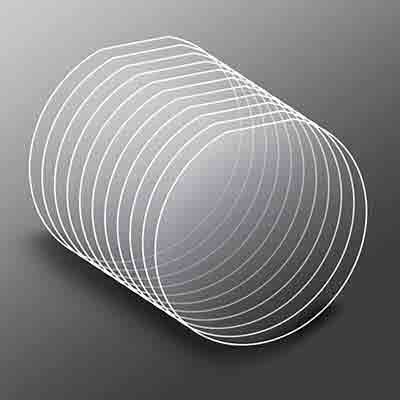
Borofloat 33 Glass Wafers
Borofloat 33 glass wafers, also called BF33 borosilicate glass wafers, are used in microfluidics, MEMS, lab-on-a-chip devices, optics, wafer bonding, sensors, electrophoresis, and semiconductor research. These wafers provide excellent flatness, a smooth mirror-like surface, strong chemical resistance, and high optical transparency.
UniversityWafer supplies Borofloat 33 wafers in multiple diameters, thicknesses, polish options, and custom diced dimensions for research and production applications.
Get Your Borofloat 33 Glass Wafer Quote FAST!
UniversityWafer supplies Borofloat 33 (BF33) glass wafers for microfluidics, MEMS, optics, wafer bonding, capillary electrophoresis, and lab-on-a-chip devices. Available in multiple diameters, thicknesses, polished finishes, and custom diced sizes, our BF33 substrates are ideal for research and production applications.
Need custom dimensions or small quantities? Contact us today or Buy Online and start researching today!
Benefits of Borofloat Glass Wafers
BF33 glass is useful for microfluidic and lab-on-a-chip devices because it is chemically durable, optically transparent, and resistant to many reagents. Compared with polymer materials such as PDMS, Borofloat glass provides a more stable surface for applications requiring low fluorescence background, accurate optical detection, and long-term chemical compatibility.
Borofloat 33 wafers are often selected for capillary electrophoresis, laser-induced fluorescence detection, DNA analysis, clinical diagnostics, pathogen detection, cell sensing, and other analytical devices that require precise glass substrates.
BF33 Wafer Handling
Borofloat glass wafers should be handled carefully to protect the polished surface and wafer edge. Use cleanroom gloves, wafer tweezers, or a vacuum wand when transferring wafers between cassettes, carriers, or process tools.
For best results, avoid touching the polished surface. After cleaning, wafers can be dried using a spin-rinse dryer or filtered nitrogen. Store Borofloat wafers in clean wafer carriers to reduce particles, scratches, and surface contamination.
Common Borofloat 33 Applications
- Microfluidic devices
- Lab-on-a-chip systems
- MEMS fabrication
- Wafer bonding
- Optical windows
- Capillary electrophoresis
- Laser-induced fluorescence detection
- Biomedical diagnostics
- Thin-film deposition
- Sensor substrates
Borofloat 33 Glass Wafers for Research and Production
Borofloat 33 glass wafers, also known as BF33 borosilicate glass wafers, are widely used in microfluidics, MEMS, optics, wafer bonding, lab-on-a-chip devices, electrophoresis, sensors, and semiconductor research. Borofloat offers excellent optical transparency, chemical resistance, thermal stability, and dimensional consistency.
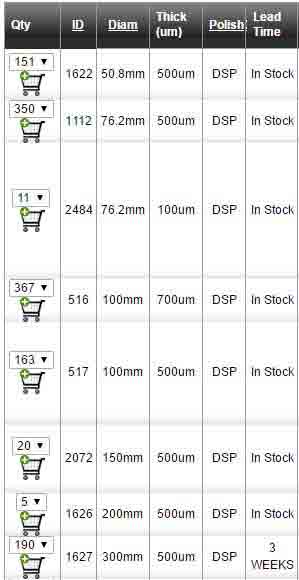
Buy as Few as One Borofloat Wafer
UniversityWafer supplies Borofloat 33 wafers in small and large quantities. Researchers can buy a single wafer, request diced pieces, or order custom dimensions for prototyping, testing, and production. Borofloat wafers are available in multiple diameters, thicknesses, surface finishes, and flat options.
Common Borofloat 33 Wafer Applications
- Microfluidic devices
- Lab-on-a-chip systems
- MEMS fabrication
- Wafer bonding
- Optical windows
- Electrophoresis devices
- Sensor substrates
- Thin-film deposition
- Biomedical research
- Semiconductor process development
Why Researchers Choose BF33 Glass
BF33 glass is often selected because it provides a smooth, mirror-like surface with high flatness and excellent optical properties. Its low thermal expansion and strong chemical durability make it useful for precision devices that require stable glass substrates.
Borofloat 33 is especially useful for microfluidic and lab-on-a-chip devices because it is chemically inert, optically transparent, and compatible with many cleanroom fabrication processes.
BF33 Wafers with Flats and Custom Dicing
Borofloat glass wafers can be supplied with flats, polished surfaces, and custom diced dimensions. Dicing services are available for researchers who need small glass substrates, windows, slides, or device-ready pieces.