
“I’m looking to buy 100mm fused silica wafers with one-side polished surfaces for use as witness wafers during e-beam evaporation of metals. The substrates need to withstand temperatures between 400°C and 500°C while remaining flat and stable.”
E-Beam Evaporated Metals on Silicon, Quartz, and Fused Silica Wafers
UniversityWafer supplies e-beam evaporated metal coatings on silicon wafers, quartz wafers, fused silica substrates, sapphire wafers, and other semiconductor materials for thin film deposition, metallization, MEMS fabrication, photonics, sensors, and advanced research applications.
Our electron beam evaporation services provide high-purity metal films with excellent adhesion, uniform thickness control, and compatibility with semiconductor lift-off processing techniques.
E-Beam Witness Wafer Research Request
A scientist requested a quote for low-cost fused silica witness wafers used to verify metal deposition thickness during electron beam evaporation.
Fused silica wafers are commonly used as witness substrates during thin film deposition because they provide excellent thermal stability, low thermal expansion, smooth surfaces, and strong resistance to high-temperature processing conditions.
Reference #271422 available for specifications and pricing.
Why Researchers Use E-Beam Evaporation
Electron beam evaporation is widely used in semiconductor fabrication because it provides:
- Excellent thin film purity
- High deposition rates
- Precise thickness control
- Strong film adhesion
- Low contamination levels
- Compatibility with high melting point metals
- Uniform thin film deposition
The process is especially useful for depositing precious metals and refractory materials that are difficult to evaporate using conventional thermal evaporation systems.
Low Temperature Lift-Off Metallization Process
Lift-off processing requires careful thermal management during metal deposition to prevent photoresist damage and maintain clean pattern transfer.
UniversityWafer and its deposition partners utilize specialized low-temperature e-beam evaporation processes optimized for:
- MEMS fabrication
- Microelectronics
- Photonic devices
- Patterned wafer metallization
- Lift-off lithography
- Thin film sensor fabrication
These processes help maintain photoresist integrity while improving metal adhesion and thin film quality.
To improve deposition performance, pre-deposition surface preparation steps may include:
- Photoresist baking
- O₂ plasma descum cleaning
- Surface activation
- Substrate dehydration
- Wafer cleaning procedures
Proper surface preparation is especially important for patterned silicon wafers and quartz wafers used in thin film lift-off processes.
Need Custom E-Beam Metal Deposition? UniversityWafer can supply thin film metallization services with custom film thicknesses, multilayer stacks, adhesion layers, and precision wafer coatings for semiconductor and MEMS applications.
Get Your Thin Film Metallization Quote FAST! Or, Buy Online and Start Researching Today!
E-Beam Evaporated Metals Available
UniversityWafer supplies a wide range of evaporated metal films and conductive coatings for semiconductor fabrication, MEMS, optics, and photonics applications.
- Aluminum (Al)
- Chromium (Cr)
- Copper (Cu)
- Gold (Au)
- Indium Tin Oxide (ITO)
- Nickel (Ni)
- Platinum (Pt)
- Silver (Ag)
- Titanium (Ti)
- Titanium Tungsten (TiW)
Custom multilayer metallization stacks and adhesion layer combinations are also available.
What is Electron Beam Deposition?
Electron beam deposition, also called e-beam evaporation, is a highly advanced physical vapor deposition (PVD) process used to deposit thin films of metals and dielectric materials onto semiconductor substrates, optical components, and electronic devices.
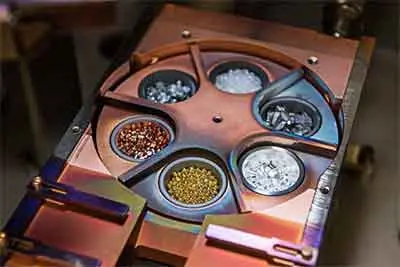
During electron beam evaporation, a focused high-energy electron beam heats a target material inside a vacuum chamber until it vaporizes. The vaporized atoms then travel through the vacuum environment and condense onto a substrate, forming a highly uniform thin film coating.
E-beam evaporation is widely used in semiconductor fabrication, MEMS processing, photonics, optics, sensors, photovoltaics, and advanced materials research because it offers excellent film purity, strong adhesion, and precise thickness control.
How Electron Beam Evaporation Works
The electron beam deposition process begins with a tungsten filament that emits electrons under high voltage conditions. Magnetic and electric fields focus and steer the electron beam toward a source material located inside a water-cooled crucible.
The concentrated electron beam transfers energy directly into the target material, causing it to melt and evaporate at extremely high temperatures. The vaporized material then deposits onto the substrate surface, forming a thin film coating.
This process is particularly useful for depositing:
- High melting point metals
- Precious metals
- Dielectric coatings
- Optical thin films
- Conductive films
- Semiconductor metal contacts
Because the source material is heated locally instead of heating the entire chamber, electron beam evaporation minimizes contamination and improves film purity compared to some traditional thermal evaporation methods.
Applications of E-Beam Evaporated Thin Films
Electron beam evaporation is widely used to create high-quality thin films for semiconductor devices, optical coatings, and microfabrication processes.
Common applications include:
- Thin film metallization
- MEMS device fabrication
- Semiconductor contacts and interconnects
- Optical coatings
- Photovoltaic devices
- Lift-off processing
- Surface modification
- Protective encapsulation layers
- Sensor fabrication
- Photonics and optical devices
E-beam deposition is especially valuable for producing dense films with excellent adhesion and smooth surface morphology.
Why Researchers Use Electron Beam Deposition
Compared to standard thermal evaporation techniques, electron beam deposition offers several important advantages:
- Higher deposition rates
- Improved film purity
- Better thickness uniformity
- Higher density thin films
- Reduced contamination
- Excellent adhesion to substrates
- Ability to evaporate refractory metals
- Precise control of film thickness
These advantages make e-beam evaporation ideal for semiconductor manufacturing, aerospace coatings, automotive electronics, optical systems, and advanced research applications.
Thin Film Materials Available for E-Beam Deposition
UniversityWafer supplies custom e-beam evaporated metal films and thin film coatings on silicon, quartz, fused silica, sapphire, and other semiconductor substrates.
Available materials include:
- Gold (Au)
- Platinum (Pt)
- Titanium (Ti)
- Aluminum (Al)
- Chromium (Cr)
- Nickel (Ni)
- Copper (Cu)
- Silver (Ag)
- Tungsten (W)
- Dielectric oxide films
Custom multilayer stacks, adhesion layers, and patterned metallization structures are also available for semiconductor and MEMS applications.
E-Beam Deposition for Semiconductor Manufacturing
E-beam evaporation is commonly used in semiconductor fabrication because it enables extremely clean and controlled deposition of conductive and dielectric thin films.
Researchers frequently use e-beam deposition for:
- Wafer metallization
- Ohmic contact deposition
- Thin film sensors
- MEMS structures
- Optical mirrors
- Photonic integrated circuits
- Infrared coatings
- Lift-off lithography processes
The process can deposit coatings onto silicon wafers, fused silica, quartz, sapphire, glass, and many other substrate materials used in semiconductor and photonics research.
Advantages of Electron Beam Evaporation
Electron beam evaporation remains one of the most widely used vacuum deposition techniques because of its flexibility and ability to deposit high-purity coatings with excellent control.
Key advantages include:
- High material utilization efficiency
- Fast deposition speeds
- Excellent film adhesion
- Capability to deposit high-temperature materials
- Reduced substrate contamination
- High-quality optical thin films
- Precise deposition control
These characteristics make electron beam deposition an important process in microelectronics, photonics, optical engineering, and advanced semiconductor manufacturing.
Limitations of Electron Beam Evaporation
Although e-beam deposition offers many advantages, researchers should also consider several limitations:
- Higher equipment cost compared to thermal evaporation
- Potential X-ray generation during deposition
- Complex vacuum system requirements
- Cooling requirements for crucibles
- Possible film stress issues in some materials
Despite these challenges, electron beam evaporation remains one of the most effective thin film deposition methods for high-performance semiconductor and optical applications.