
Flexible Substrates for Next-Generation Electronics
Flexible electronics substrates enable electronic devices that can bend, conform, and adapt to surfaces where conventional rigid substrates may not be suitable. These materials are important for research involving wearable electronics, flexible sensors, thin-film devices, flexible displays, and emerging electronic systems.
UniversityWafer supplies substrate materials for universities, laboratories, and industrial R&D teams developing flexible and thin-film electronic technologies.
Flexible Electronics Research Applications
Flexible substrates can support a wide range of experimental devices and emerging technologies, including:
- Wearable electronics and health-monitoring devices
- Flexible and conformable sensors
- Thin-film transistors (TFTs)
- Flexible circuits and electronic interconnects
- Flexible displays and optoelectronics
- Photodetectors and optical sensors
- Flexible solar cells and energy devices
- Internet of Things (IoT) devices
Polyimide for Flexible Electronics
Polyimide substrates are widely investigated for flexible electronics because they combine mechanical flexibility with useful thermal and chemical stability. Polyimide can provide a lightweight foundation for deposited conductors, semiconductors, dielectric layers, sensors, and other thin-film structures.
Silicon Wafers in Flexible Device Research
Although conventional silicon wafers are rigid, silicon remains important in flexible-electronics research. Silicon wafers can serve as temporary carriers, fabrication platforms, or starting substrates for creating thin semiconductor structures that are subsequently integrated into flexible systems.
Choosing a Substrate for Flexible Electronics
The best substrate depends on the fabrication process and final device requirements. Researchers should consider flexibility, thickness, surface roughness, thermal stability, chemical compatibility, electrical properties, and compatibility with deposition or lithography processes.
For thin-film research, a smooth substrate surface can be particularly important for achieving uniform deposited layers and reliable electronic device performance.
From Research to Flexible Devices
Flexible electronics combine materials science, semiconductor processing, thin-film deposition, and device engineering. Selecting the appropriate substrate is an important first step when developing sensors, transistors, wearable devices, and other flexible electronic systems.
Need Substrates for Flexible Electronics Research?
Tell us your required material, dimensions, thickness, quantity, surface specifications, and intended research application.
Get Your Flexible Electronics Substrate Quote FAST! Or, Buy Online and Start Researching Today!
What Are Flexible Electronics Substrates?
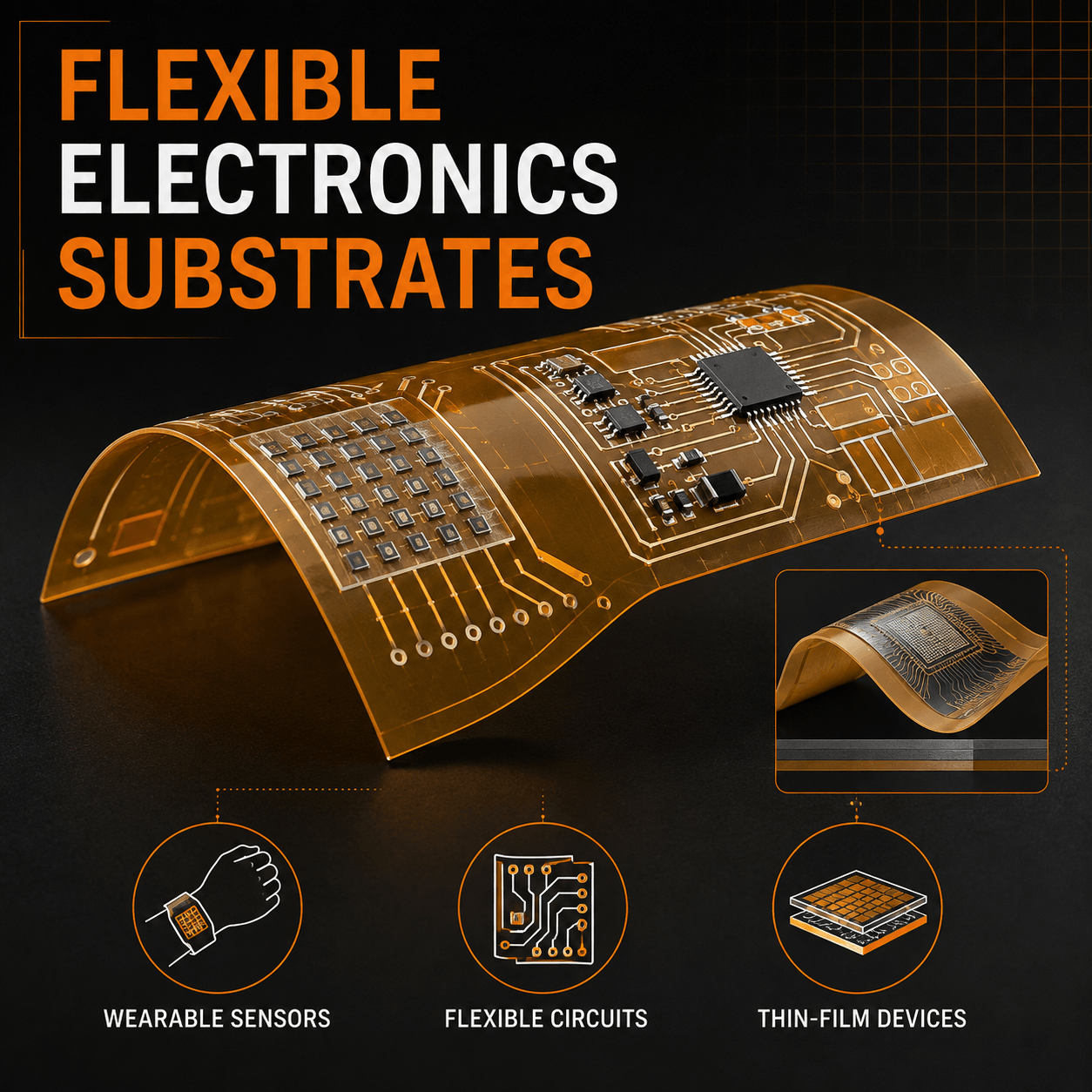
Flexible electronics substrates are materials used as the mechanical foundation for electronic devices designed to bend, flex, or conform to curved surfaces. Unlike conventional rigid substrates, flexible materials can support thin conductive, semiconducting, dielectric, and sensing layers while allowing the completed device to remain lightweight and mechanically adaptable.
Common Substrates for Flexible Electronics
The appropriate substrate depends on the temperature, flexibility, surface quality, and processing requirements of the device. Researchers may investigate polymers, thin glass, metal foils, or semiconductor materials when developing flexible electronic systems.
| Substrate | Potential Research Use |
|---|---|
| Polyimide | Flexible sensors, circuits, thin-film devices, and wearable electronics |
| Thin Glass | Flexible displays, optical devices, coatings, and thin-film research |
| Metal Foils | Flexible electronics requiring conductive or temperature-resistant substrates |
| Thin Silicon | Flexible semiconductor devices, sensors, and advanced device integration |
| Temporary Carrier Wafers | Processing and handling thin or flexible device layers during fabrication |
Important Substrate Properties
Choosing a substrate involves more than simply selecting a flexible material. Processing conditions can place thermal, mechanical, and chemical demands on the substrate. Important considerations include:
- Substrate thickness and flexibility
- Surface roughness and flatness
- Thermal stability
- Chemical resistance
- Electrical insulation or conductivity
- Optical transparency when required
- Compatibility with deposited thin films
- Compatibility with lithography and fabrication processes
Thin-Film Deposition on Flexible Substrates
Flexible electronics frequently rely on thin-film deposition to create conductive traces, semiconductor layers, dielectrics, electrodes, and sensing materials. Surface quality and processing temperature can significantly influence film uniformity, adhesion, and device performance.
Researchers may use techniques such as sputtering, evaporation, chemical vapor deposition, or atomic layer deposition depending on the substrate and material system being investigated.
Flexible Sensors and Wearable Electronics
Flexible substrates are especially valuable for wearable electronics and sensors that must conform to the human body or other non-flat surfaces. Research applications include pressure sensors, strain sensors, biosensors, temperature sensors, flexible electrodes, and health-monitoring devices.
Thin Silicon for Flexible Electronics
Reducing the thickness of silicon can significantly increase its mechanical flexibility. thin silicon wafers and semiconductor layers can therefore be investigated for flexible sensors, electronics, and hybrid systems that combine established silicon technology with mechanically adaptable devices.
Temporary Carrier Wafers
Very thin substrates can be difficult to handle during fabrication. A rigid silicon or glass wafer may therefore be used as a temporary carrier substrate during deposition, lithography, thinning, transfer, or other processing steps before the flexible device is released or transferred to its final substrate.
Developing Flexible Electronic Devices
The ideal substrate depends on both the final application and the complete fabrication process. Researchers should consider the substrate material, dimensions, thickness, surface finish, processing temperatures, deposition methods, bending requirements, and desired electrical or optical properties before selecting a material.