
"I want to quote two-inch fused quartz wafers, 1mm thick, both single-side polished and double-side polished. The fused quartz wafers will be used as substrates for MEMS fabrication."
JGS2 Fused Silica Wafers for Optical and Semiconductor Applications
JGS2 Fused Silica wafers are widely used in optical systems, MEMS fabrication, semiconductor processing, laser optics, sensors, and photonic devices because of their excellent optical transmission, thermal stability, and chemical durability.
These optical grade fused silica substrates are commonly requested for precision optical components including:
- Aspherical lenses
- Optical windows
- Laser mirrors
- Infrared optical systems
- UV transmission optics
- Photonic devices
- Semiconductor substrates
UniversityWafer supplies JGS2 fused silica wafers with custom diameters, thicknesses, scratch/dig specifications, polishing options, and optical tolerances for research and production applications.
Because of their high thermal resistance and low thermal expansion coefficient, JGS2 fused quartz wafers are ideal for high-power laser systems and high-temperature semiconductor environments.
JGS2 Fused Silica for MEMS Devices
JGS2 fused silica is commonly used in Carbon-based Microelectromechanical Systems (C-MEMS) and advanced MEMS fabrication because the material is strong, chemically stable, electrically insulating, and biocompatible.
Researchers use fused silica wafers to fabricate:
- MEMS sensors
- Microfluidic devices
- Biomedical devices
- Optical MEMS structures
- Semiconductor packaging components
- Precision micro devices
Its excellent optical clarity and mechanical stability make JGS2 fused silica an ideal substrate material for precision MEMS and photonics applications.
Need Custom Optical Grade Fused Silica? UniversityWafer supplies JGS2 fused silica wafers with custom polishing, optical surface finishes, wafer thicknesses, and substrate specifications.
Get Your JGS2 Fused Silica Quote FAST! Or, Buy Online and Start Researching Today!
JGS2 Fused Silica Transmission Curve
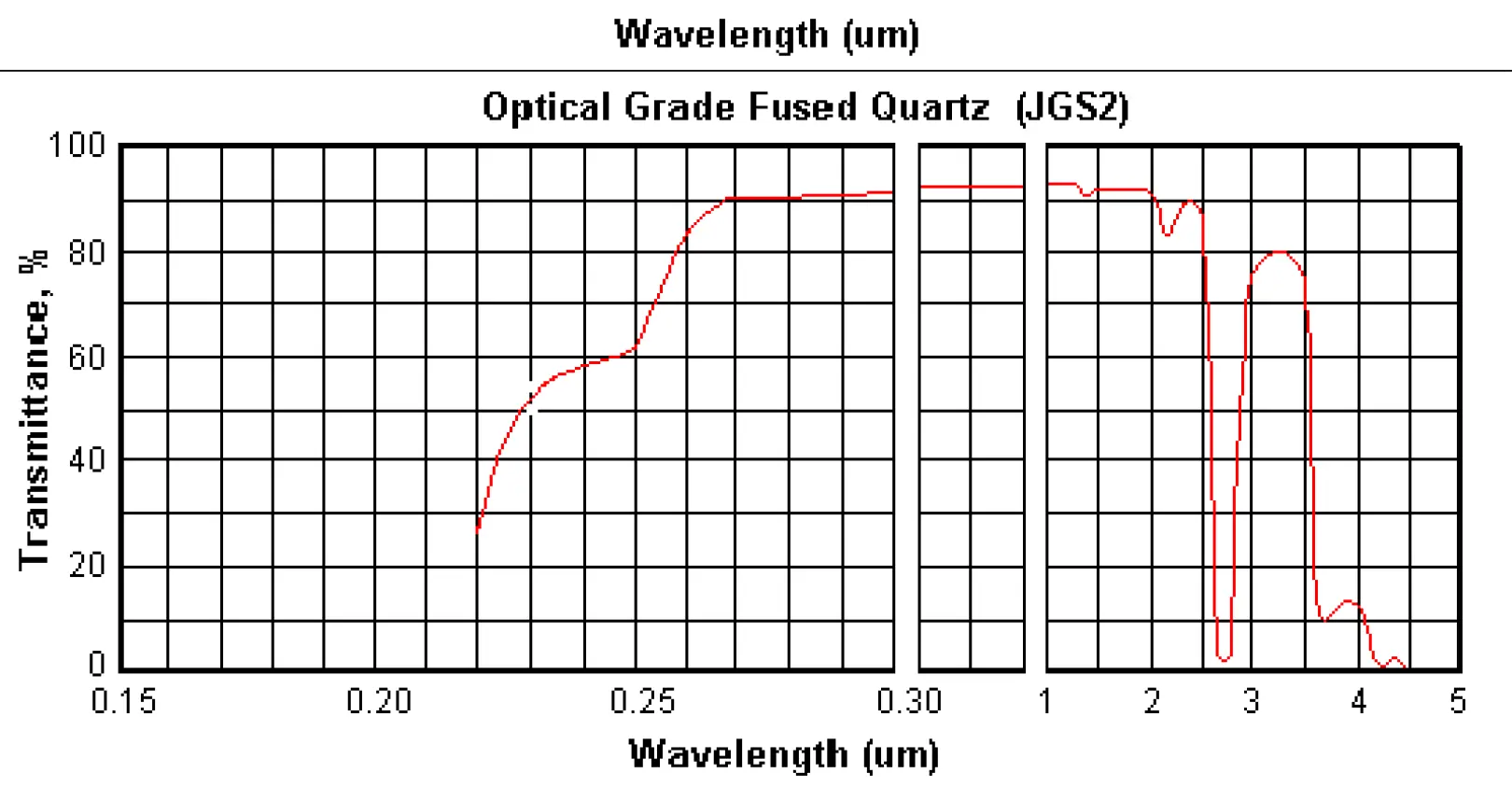
The JGS2 fused silica transmission curve demonstrates excellent optical transmission across ultraviolet, visible, and infrared wavelengths, making this material suitable for laser optics, photonics, semiconductor research, and optical instrumentation.
MEMS Research Example Using Fused Quartz Wafers
A university MEMS researcher requested custom fused quartz wafers for semiconductor and MEMS fabrication applications.
UniversityWafer supplies fused quartz and fused silica substrates for MEMS, photonics, semiconductor processing, sensors, and optical research applications.
Reference #226827 available for pricing and specifications.
What Are JGS2 Fused Silica Wafers Used For?
JGS2 Fused Silica wafers are widely used in optics, MEMS fabrication, semiconductor research, UV transmission systems, infrared optics, laser systems, and precision instrumentation. Their excellent optical transmission, thermal stability, and chemical resistance make them ideal for advanced optical and semiconductor applications.
Compared to many optical materials, JGS2 optical grade fused silica offers excellent ultraviolet and visible light transmission while maintaining relatively low cost. These fused quartz substrates are commonly used for optical windows, laser mirrors, sensors, detectors, semiconductor substrates, and photonic devices.
Optical Properties of JGS2 Fused Silica
JGS2 fused silica wafers are transparent across a wide spectral range and provide excellent transmission in ultraviolet, visible, and infrared wavelengths. These optical properties make JGS2 an excellent material for precision optical systems and semiconductor research.
JGS2 optical quartz is commonly compared to:
- Homosil 1, 2, and 3
- Dynasil 1000, 5000, and 6000
- Suprasil fused silica
- Spectrosil optical quartz
Although JGS2 fused silica has optical properties similar to JGS1 fused silica, larger pieces may contain bubbles or higher impurity levels, making JGS1 preferable for ultra-high-purity optical systems.
Why Use JGS2 Optical Grade Fused Silica?
JGS2 fused silica wafers are ideal for applications requiring:
- High optical transmission
- Thermal shock resistance
- Excellent chemical durability
- Low thermal expansion
- Optical clarity
- UV and IR wavelength compatibility
- Semiconductor insulation properties
Because of these properties, JGS2 fused quartz is widely used in semiconductor fabrication, MEMS devices, laser optics, optical windows, photovoltaic systems, and high-temperature research environments.
JGS2 Fused Silica Transmission Range
JGS2 fused silica works well within a wavelength range of approximately 220nm to 2500nm, making it useful for both ultraviolet and infrared optical systems.
The material is produced using oxy-hydrogen melting methods and typically contains hydroxyl (OH) content around 150ppm. These characteristics influence the optical absorption peaks and infrared transmission behavior of the material.
| JGS2 Fused Silica Parameter | Typical Value |
| Maximum Size | <300mm |
| Transmission Range | 0.26–2.10µm |
| Average Transmission | >85% |
| OH Content | 150ppm |
| Impurity Content | 20–40ppm |
| Birefringence Constant | 4–6 nm/cm |
| Melting Method | Oxy-hydrogen melting |
JGS2 Fused Silica for MEMS and Semiconductor Applications
JGS2 fused silica wafers are frequently used as substrates for MEMS fabrication, semiconductor processing, optical sensors, and microelectromechanical systems because of their dimensional stability and electrical insulation properties.
Researchers commonly use JGS2 quartz wafers in:
- MEMS devices
- Photonic systems
- Optical sensors
- Semiconductor substrates
- Laser optics
- Precision mirrors and lenses
- Window substrates
- Microfluidic devices
The material’s low thermal expansion coefficient and excellent chemical resistance allow it to perform well in demanding semiconductor and optical environments.
JGS1 vs JGS2 Fused Silica
JGS1 fused silica is generally preferred for ultra-high-purity optical applications because it contains lower impurity levels and fewer bubbles.
However, JGS2 fused silica is often selected for applications where cost, durability, optical performance, and thermal stability are more important than ultra-low impurity content.
Both materials are widely used in semiconductor processing, optics, photonics, and research laboratories.