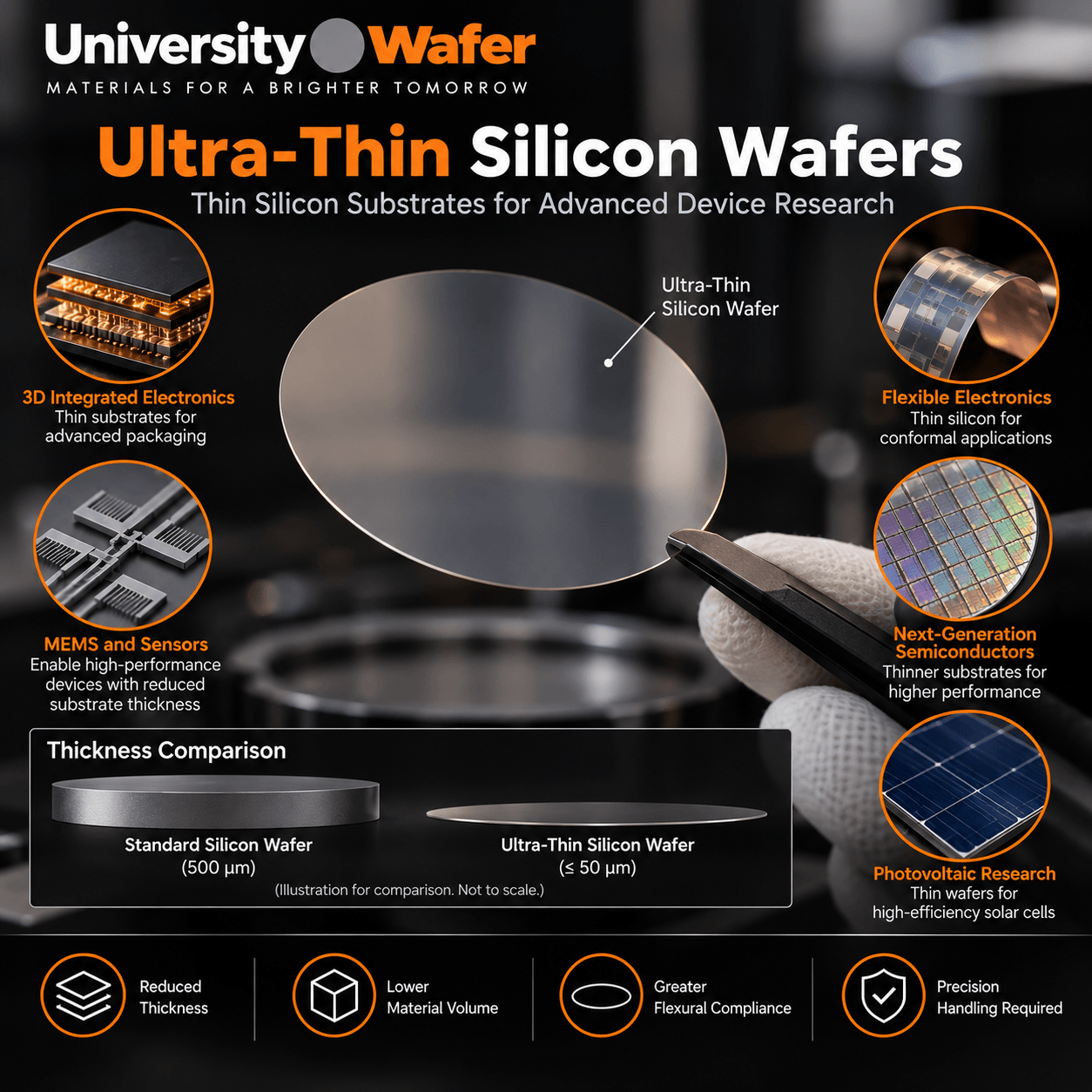
Ultra-Thin Silicon Wafers
Ultra-thin silicon wafers are changing how we make advanced electronics. These wafers, typically less than 200 µm thick and as thin as 5-20 µm in cutting-edge applications, are helping create smaller, more efficient, and more powerful electronic parts. They're important for making new technology in many areas, from AI data centers to solar panels and electric vehicles. Let's explore what makes these wafers special and how they're shaping our future technology.
Key Takeaways |
- Ultra-thin silicon wafers are typically 5-100 micrometers thick, with advanced versions reaching 10-20 µm - They offer 50% lower substrate resistance and 40% lower on-resistance compared to conventional wafers - Applications include AI data centers, automotive power systems, solar technology, and 3D integrated circuits - Manufacturing innovations include plasma-epi growth and reinforced edge designs - Future developments enable 3D stacked architectures and 50% cost reduction in solar cells |
Get Your Quote FAST! Or, Buy Online and Start Researching Today!
What Are Ultra-Thin Silicon Wafers?
Ultra-thin silicon wafers are very thin slices of silicon with precise thickness ranges from 5-100 µm, with advanced manufacturers like Infineon achieving remarkable 20 µm thickness on 300 mm wafers. That's about as thin as a human hair! These wafers are used to make computer chips, solar cells, and sensors with exceptional performance characteristics. They're made by cutting pure silicon into thin discs and polishing them until they achieve mirror finishes with RMS roughness of 1-2 nm and total thickness variation (TTV) less than 1 µm. This precision is critical for making high-performance electronic devices.
Electrical Performance Advantages
Ultra-thin silicon wafers deliver exceptional electrical performance improvements that make them essential for next-generation electronics. These advanced wafers provide measurable benefits that directly translate to better device performance and energy efficiency.
Key electrical performance features include:
-
50% lower substrate resistance compared to conventional 40-60 µm wafers, reducing power losses by over 15% in critical applications like AI data center DC-DC converters
-
40% lower on-resistance (RDS(on)) in 10-12 V power MOSFETs, enabling higher current handling in smaller dies
-
Faster switching frequencies due to reduced distance between the ground plane and MOSFET backside
-
Enhanced power delivery efficiency for high-performance GPUs and CPUs
These performance improvements are particularly valuable in power-sensitive applications where every percentage point of efficiency matters, such as electric vehicle motor control systems and data center power supplies.
Unique Features of Ultra-Thin Silicon Wafers
Ultra-thin silicon wafers have special features that make them different from regular silicon wafers. These features allow us to make new kinds of electronic devices with superior performance and novel form factors.
1. Incredible Flexibility
Ultra-thin silicon wafers can bend without breaking, especially when reinforced with patented edge designs that retain thicker peripheral rims of 500-800 µm to prevent warping and breakage during processing. This means we can make curved or flexible electronic devices. Imagine a phone screen that can wrap around your wrist or electronic parts that can fit into odd shapes. This is really useful for making wearable technology and flexible screens.
2. Enhanced Performance
Ultra-thin silicon wafers can make electronic devices work dramatically better. The reduced thickness enables faster switching frequencies and lower electrical resistance, meaning devices can work quicker and use significantly less power. The 50% reduction in substrate resistance alone can improve system efficiency by over 15%.
3. Superior Heat Dissipation
These thin wafers excel at thermal management due to their reduced thermal mass, which is critical for high-power AI chips and motor control systems. Advanced grinding and etching techniques maintain stability and low warpage even at 10 µm thickness. Being able to cool down quickly means devices can work better and last longer, especially in demanding applications like data centers and automotive systems.
4. Light Weight and Structural Integrity
Ultra-thin wafers are very light while maintaining structural integrity through innovative manufacturing techniques. This is great for making things like smartphones, IoT devices, or parts for airplanes, where every bit of weight matters. The combination of reduced weight and enhanced performance makes them ideal for portable and aerospace applications.
Applications of Ultra-Thin Silicon Wafers
Ultra-thin silicon wafers are revolutionizing multiple industries with their unique capabilities and performance advantages:
1. AI and Data Centers
Ultra-thin silicon wafers are essential for power delivery systems in AI data centers, particularly for 12-V DC-DC converters that supply power to high-performance GPUs and CPUs. The reduced substrate resistance and improved thermal management enable more efficient power conversion in dense server environments, directly supporting the computational demands of artificial intelligence workloads.
2. Automotive Power Systems
In electric vehicles, ultra-thin wafers enhance motor control efficiency and power management systems. The lower on-resistance and faster switching capabilities improve the performance of traction inverters and DC-DC converters, contributing to extended driving range and faster charging capabilities. These wafers are crucial for the automotive industry's transition to electrification.
3. Advanced Solar Technology
South Korean researchers have developed plasma-epi growth methods that produce ultra-thin wafers using waste-free processes, cutting solar cell costs by 50% while maintaining efficiency. The reduced material usage and improved manufacturing techniques make solar panels more cost-effective and environmentally sustainable.
4. 3D Integrated Electronics
Ultra-thin wafers enable revolutionary 3D integration capabilities, allowing stacked architectures for high-density memory and logic chips that dramatically improve data center performance. This 3D stacking approach provides higher computational density and better interconnect efficiency, essential for next-generation computing systems.
5. Consumer Electronics and IoT
The flexibility and reduced thickness of these wafers allow for bendable displays and compact power supplies for smartphones and IoT devices. The improved power efficiency extends battery life while reducing device size, enabling new form factors and enhanced user experiences.
6. MEMS Devices
Ultra-thin silicon wafers are used to make tiny mechanical devices called MEMS with enhanced sensitivity and performance. These are used in things like airbag sensors in cars, accelerometers in smartphones, and precision microphones, where the reduced thickness improves response times and accuracy.
Manufacturing Innovations and Techniques
The production of ultra-thin silicon wafers requires cutting-edge manufacturing innovations that overcome traditional limitations while maintaining high quality and yield rates.
Advanced Processing Methods
-
Plasma-epi growth techniques that eliminate waste and reduce production costs
-
High-precision grinding and etching methods that maintain wafer stability at extreme thinness
-
300 mm compatibility processes that integrate seamlessly into standard fab lines without yield loss
-
Specialized surface finishing achieving mirror-quality results with sub-nanometer roughness
Structural Design Innovations
Modern ultra-thin wafers incorporate patented reinforced edge designs that maintain thicker peripheral rims while achieving ultra-thin cores. This approach prevents warping and breakage during processing while preserving the electrical and thermal benefits of reduced thickness in the active device areas.
Challenges in Manufacturing Ultra-Thin Silicon Wafers
Making ultra-thin silicon wafers isn't easy, but recent innovations are addressing traditional manufacturing challenges with new approaches and technologies.
1. Fragility and Handling
These wafers are very delicate and can break easily, but reinforced edge designs and advanced robotic handling systems now enable reliable processing. Automated systems specifically designed for ultra-thin wafers reduce breakage rates and improve manufacturing yield.
2. Uniformity and Precision
Achieving consistent thickness across large wafers requires precision control, but modern techniques can maintain total thickness variation under 1 µm. Advanced metrology and real-time process control ensure uniformity even at the most extreme thicknesses.
3. Specialized Equipment and Integration
Manufacturing ultra-thin wafers requires specialized tools, but cleaning and handling these delicate wafers has been streamlined through equipment designed specifically for 300 mm wafer compatibility, allowing integration into existing fabrication facilities.
Manufacturing Challenges and Solutions
-
Fragility: Advanced robotic handling and reinforced edge designs prevent breakage
-
Uniformity: Precision control achieving <1 µm total thickness variation across wafers
-
Specialized Equipment: 300 mm compatible processes integrate into existing fab lines
-
Stress Management: Advanced grinding and etching maintain stability at 10 µm thickness
-
Yield Optimization: Improved processes reduce defects while maintaining ultra-thin dimensions
-
Thermal Management: Enhanced heat dissipation through reduced thermal mass design
-
Edge Integrity: Patented reinforced rim designs (500-800 µm) prevent chipping
-
Surface Quality: Mirror finishes with 1-2 nm RMS roughness for optimal performance
-
Process Integration: Seamless compatibility with standard semiconductor manufacturing
-
Cost Efficiency: Plasma-epi growth and waste-free methods reduce production costs by 50%
The Future of Ultra-Thin Silicon Wafers
As technology improves, we can expect to see more exciting developments in ultra-thin silicon wafers that will enable entirely new categories of electronic devices and applications:
1. Even Thinner Wafers and 3D Integration
Scientists are working on making wafers that are even thinner while enabling complex 3D stacked architectures. These developments could lead to high-density memory systems and logic chips with unprecedented computational power density, revolutionizing data center performance and enabling new AI capabilities.
2. Expanded Applications
As manufacturing techniques improve, ultra-thin wafers will find applications in medical implants, advanced automotive systems, and next-generation renewable energy technologies. The combination of flexibility, efficiency, and miniaturization opens possibilities for previously impossible device designs.
3. Revolutionary Manufacturing Techniques
New waste-free production methods and plasma-epi growth techniques are making ultra-thin wafers more cost-effective and environmentally sustainable. These improvements could make advanced electronic devices more affordable while reducing the environmental impact of semiconductor manufacturing.
Conclusion
Ultra-thin silicon wafers are amazing pieces of technology that are enabling breakthrough innovations across multiple industries. With their ability to reduce substrate resistance by 50%, improve switching performance by 40%, and enable new 3D integrated architectures, they're making our AI systems more powerful, our electric vehicles more efficient, and our solar panels more cost-effective. The development of 20 µm thickness capabilities on 300 mm wafers represents a significant manufacturing achievement that opens new possibilities for device miniaturization.
These revolutionary wafers are playing a crucial role in shaping our technological future. From the AI data centers that power modern computing to the electric vehicles that will transform transportation, and from cost-reduced solar cells that accelerate renewable energy adoption to flexible electronics that enable new user experiences, ultra-thin silicon wafers are at the heart of the most important technological advances. As we continue to research and develop this technology, with innovations like plasma-epi growth reducing costs by 50% and 3D integration enabling unprecedented performance density, we can expect to see even more amazing applications that will help create a more connected, efficient, and sustainable world.