
Why is Silicon Bohr Important?
Get Your Quote FAST! Or, Buy Online and Start Researching Today!
1. Understanding Atomic Structure
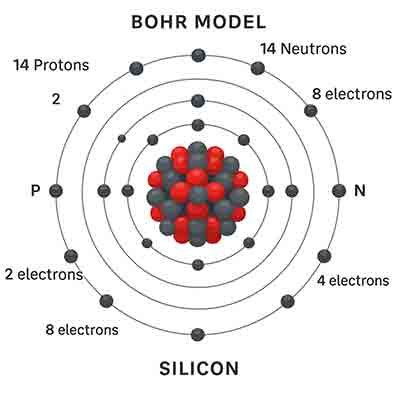
The Bohr model provides a simplified way to visualize the structure of silicon atoms. It shows the nucleus and electron arrangement, which helps in understanding how silicon atoms bond with other elements and how they interact with electric fields or other external factors.
2. Basis for Semiconductor Theory
Silicon is the foundational material for semiconductors, which are essential to modern electronics. The Bohr model helps in understanding the outer electron configuration (4 electrons in the third shell) of silicon, which explains its semiconducting properties. Silicon can easily gain or lose electrons in this outer shell, making it ideal for forming p-n junctions in diodes, transistors, and integrated circuits.
3. Chemical Bonding
The model shows that silicon atoms have 4 valence electrons, which explains why silicon typically forms covalent bonds with four other atoms. This bonding behavior is crucial for silicon’s role in forming crystalline structures and its applications in materials like silicon dioxide (SiO2).
4. Foundation for Quantum Models
While the Bohr model is limited (since it doesn't fully describe electron behavior in complex atoms), it's a stepping stone to more advanced quantum mechanical models. These more sophisticated models are vital for accurately describing how electrons move in silicon crystals, crucial for understanding conductivity, band gaps, and other semiconductor properties.
In summary, the Bohr model of silicon serves as an educational tool that bridges basic atomic theory with more complex semiconductor physics, making it foundational in materials science and electronics.
What Is The Bohr Model for Silicon?
The Bohr model is a simplified representation of atoms where electrons orbit the nucleus in distinct energy levels, much like planets around the sun. While it works well for simple atoms like hydrogen, it has limitations when applied to more complex elements like silicon, but we can still use it to give a rough idea.
Bohr Model for Silicon (Si):
-
Atomic Number of Silicon: 14 (meaning it has 14 protons and, in its neutral state, 14 electrons).
-
Electron Configuration in the Bohr Model: Electrons are arranged in energy levels or shells.
- 1st Shell: 2 electrons
- 2nd Shell: 8 electrons
- 3rd Shell: 4 electrons
Thus, the Bohr model of silicon shows a nucleus with 14 protons (and usually 14 neutrons), surrounded by three shells of electrons. The outermost shell, which has 4 electrons, plays a significant role in chemical bonding and electrical properties.
In reality, the quantum mechanical model provides a much more accurate description for elements like silicon, considering the complex interactions of electrons.
How Many Shells are there in the Bohr Model of a Silicon Atom?
In the Bohr model of a silicon atom, there are three electron shells. These shells contain the following number of electrons:
- First shell: 2 electrons
- Second shell: 8 electrons
- Third shell: 4 electrons
These three shells represent the electron configuration for silicon (atomic number 14), where electrons are arranged in distinct energy levels around the nucleus.
Understanding the Silicon Bohr Model in Modern Semiconductor Physics
The Bohr model is one of the first conceptual tools students encounter when learning atomic structure, and although it is far from a complete description of real electron behavior, it remains extremely useful for building intuition. When applied to silicon—the foundational element of semiconductor technology—the Bohr model provides a simplified but powerful way to understand bonding, doping, and electronic behavior inside modern devices.
Silicon has 14 electrons, which the Bohr model arranges into discrete circular “shells” around the nucleus. The first shell holds two electrons, the second holds eight, and the third begins filling with the remaining four. These four outer electrons form the valence shell, and they are the key to why silicon is such an effective semiconductor. In the Bohr picture, these valence electrons occupy stable energy levels but can be excited into higher states when given sufficient energy, such as thermal energy or absorbed photons.
In reality, electrons do not orbit in neat circular paths, and silicon atoms in a crystal do not behave as isolated spheres. Instead, quantum mechanics tells us that electron energy levels spread into bands when atoms form a solid. However, the Bohr model helps bridge the conceptual gap: those four valence electrons form covalent bonds with neighboring silicon atoms in the crystal lattice, and when enough energy is supplied, an electron can break free from its bond and enter the conduction band, leaving behind a “hole” in the valence band. The Bohr-style view helps new learners understand where these electrons come from and why the valence shell matters.
Understanding this transition from discrete Bohr energy levels to continuous band structures is foundational to semiconductor physics. The valence-band-to-conduction-band energy separation in silicon—its bandgap—is approximately 1.12 eV at room temperature. This is the energetic difference required to excite an electron into a mobile state. The Bohr model does not calculate this bandgap, but it provides a conceptual framework for visualizing why valence electrons are the ones involved in conduction.
The Bohr model is also helpful when explaining doping, the process that turns intrinsic silicon into a controlled semiconductor. Adding phosphorus contributes an extra valence electron, which in the Bohr picture sits just below the conduction band and requires very little energy to ionize. Boron, on the other hand, contains one fewer valence electron, creating an energetically accessible “hole” that enhances conduction in the valence band. These ideas are often first taught using Bohr-style diagrams before transitioning to the full quantum-mechanical treatment.
While the modern semiconductor industry relies on band theory, quantum mechanics, density-of-states calculations, and carrier transport equations, the Bohr model retains its value as a teaching tool. It provides a simple visual language for explaining why silicon has four valence electrons, how covalent bonding forms the crystal lattice, and how small energy inputs liberate charge carriers.
In today’s advanced electronics—from MOSFETs to power devices to photonic integrated circuits—the fundamental behavior of silicon still depends on the same underlying principles first revealed by early atomic models. The Bohr model may be simplified, but its intuitive structure continues to play an important role in helping students, researchers, and engineers understand how silicon atoms give rise to the technologies that power modern life.
How the Bohr Model Helps Explain Semiconductor Behavior
The Bohr model is a simplified representation of the atom, but it plays an important role in helping students understand the foundational behaviors of semiconductors—especially silicon. While modern semiconductor physics relies on quantum mechanics and band theory, the Bohr model provides an intuitive starting point from which these more advanced ideas can be built.
1. It Identifies the Importance of the Valence Electrons
The Bohr model shows electrons arranged in distinct shells with fixed capacities.
For silicon:
-
1st shell: 2 electrons
-
2nd shell: 8 electrons
-
3rd shell (valence shell): 4 electrons
These four valence electrons are the key to semiconductor behavior because:
-
They form covalent bonds with neighboring atoms in the crystal lattice.
-
They can be excited by heat or light, allowing conduction of electricity.
The Bohr model makes it easy to visualize why silicon behaves differently from metals (many free electrons) and insulators (full valence shells).
2. It Provides an Intuitive Path to Understanding Band Theory
Although the Bohr model depicts discrete orbits, it naturally leads to the idea that:
-
Electrons occupy quantized energy levels.
-
Electrons require energy to move from one level to another.
This concept is directly connected to semiconductor band theory, where:
-
The valence band is made of electrons involved in bonding.
-
The conduction band is where electrons move freely and enable electrical conduction.
-
The bandgap (1.12 eV for silicon) is the energy needed to promote an electron into conduction.
The Bohr model is the “stepping stone” that helps students grasp why electrons can jump into a higher-energy state, even though the real physics is more complex.
3. It Helps Explain Why Silicon Can Conduct Sometimes and Insulate Other Times
The Bohr picture makes it clear that:
-
Silicon’s valence electrons are bound in stable shells at low energy.
-
However, these electrons can be excited with a relatively small amount of energy (compared to insulators).
This directly explains the unique property of semiconductors:
they conduct when energized, and insulate when not.
4. It Makes the Concept of Doping Easier to Understand
Using the Bohr model:
-
Phosphorus has 5 valence electrons → contributes an extra electron → n-type silicon
-
Boron has 3 valence electrons → creates a hole → p-type silicon
The Bohr model provides a simple way to visualize:
-
Donor energy levels (electrons close to conduction band)
-
Acceptor energy levels (holes close to valence band)
Even though actual energy levels broaden into bands, this explanation helps new learners understand why doping drastically increases conductivity.
5. It Clarifies Electron-Hole Pair Generation
The Bohr model shows electrons leaving their orbit when excited.
This helps explain:
-
Electron-hole pair formation
-
Recombination
-
Carrier mobility
-
Photoconductivity
All of these are essential behaviors in semiconductor devices such as diodes, MOSFETs, photodiodes, and solar cells.
In Summary
The Bohr model does not accurately represent real atomic physics, but it remains extremely valuable as an educational tool because it gives intuitive insight into:
-
Valence electrons and bonding
-
Energy level transitions
-
Bandgap behavior
-
Doping mechanisms
-
Carrier generation
It simplifies the concepts that ultimately lead to semiconductor device physics, making it easier for students and engineers to understand how silicon behaves and why it forms the foundation of modern electronics.