
Silicon-Germanium (SiGe) Semiconductor Applications
Silicon-germanium (SiGe) semiconductor materials are widely researched for high-speed electronics, RF integrated circuits, photonics, AI accelerator hardware, and next-generation communication systems. By combining the processing advantages of silicon wafers with the enhanced carrier mobility of germanium substrates, SiGe platforms support faster signal transmission and improved high-frequency device performance.
Researchers commonly use SiGe semiconductor wafers for 5G infrastructure, optical transceivers, millimeter-wave electronics, automotive radar systems, and hyperscale data center networking technologies.
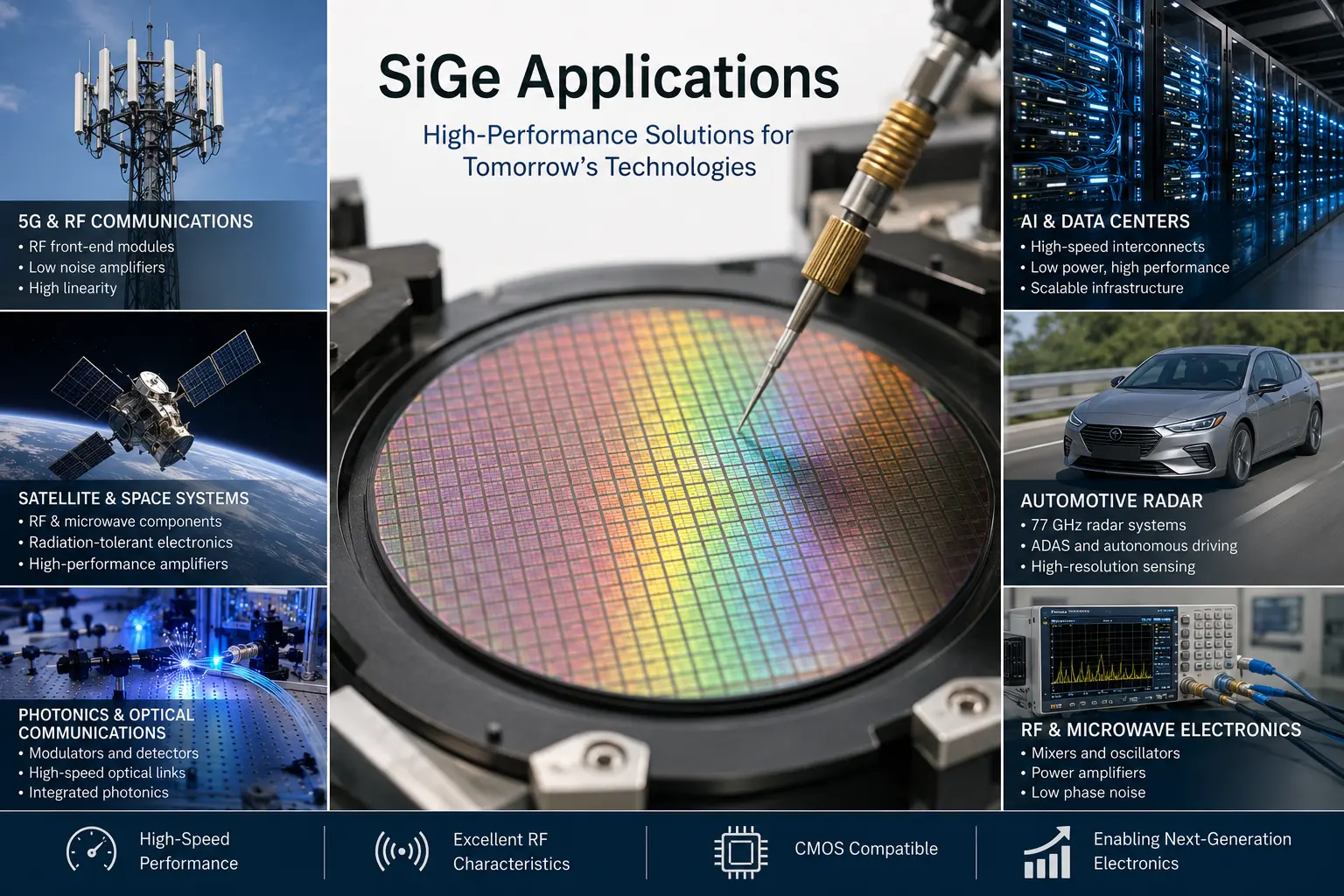
Why SiGe Materials Are Important for High-Speed Electronics
Modern semiconductor devices require materials capable of supporting higher bandwidth, lower latency, and improved power efficiency. SiGe semiconductor structures help improve transistor switching behavior and carrier transport performance for advanced RF and photonic applications.
Compared to traditional silicon-only semiconductor platforms, SiGe technologies are increasingly researched for:
- AI computing infrastructure
- RF microwave electronics
- Optical communication systems
- Terahertz semiconductor devices
- Satellite communication hardware
- High-speed networking equipment
- Automotive radar systems
- Advanced CMOS-compatible semiconductor fabrication
Many researchers also combine SOI wafers with SiGe epitaxial structures to improve electrical isolation and optimize high-frequency integrated circuit performance.
Get Your Quote FAST! Or, Buy Online and Start Researching Today!
Why Silicon Remains the Dominant Semiconductor Material
Although germanium wafers provide higher carrier mobility than traditional silicon substrates, silicon remains the dominant material used in modern semiconductor manufacturing. Silicon offers an ideal balance of electrical performance, thermal stability, cost efficiency, and large-scale fabrication compatibility.
One of silicon’s most important advantages is its ability to form a stable native oxide layer. This silicon dioxide (SiO₂) layer is critical for manufacturing MOSFET devices, CMOS integrated circuits, and advanced microelectronic structures used in modern computing hardware.
Compared to germanium, silicon also provides:
- Lower manufacturing costs
- Higher thermal stability
- Reduced leakage currents
- Better wafer durability
- More mature fabrication infrastructure
- Improved large-scale manufacturing efficiency
Because the semiconductor industry has spent decades optimizing silicon fabrication processes, most commercial chip manufacturing equipment and processing technologies are designed around silicon wafer platforms.
Why Researchers Still Use Germanium and SiGe Materials
While silicon dominates mainstream semiconductor manufacturing, germanium and silicon-germanium (SiGe) materials continue to play an important role in advanced electronic and photonic research.
Germanium offers significantly higher carrier transport performance than silicon, making it attractive for:
- High-frequency electronics
- Infrared photodetectors
- RF communication systems
- Optoelectronic devices
- Terahertz semiconductor research
- Optical communication hardware
SiGe semiconductor structures combine many advantages of both silicon and germanium. Researchers frequently investigate SiGe materials for RF CMOS devices, photonic integrated circuits, millimeter-wave electronics, and ultra-fast communication systems because they can support higher-frequency operation while remaining compatible with conventional CMOS fabrication methods.
Why Researchers Use Silicon-Germanium Wafers for RF and Photonics Applications
Modern SiGe semiconductor platforms are increasingly researched for AI infrastructure, optical networking, high-bandwidth electronics, and next-generation communication systems. Compared to traditional silicon-only semiconductor devices, SiGe materials can improve switching performance, signal integrity, and carrier transport efficiency for advanced semiconductor applications.
Common research areas involving SiGe semiconductor wafers include:
- RF CMOS devices
- Photonic integrated circuits
- Optical transceivers
- AI accelerator hardware
- 5G and 6G semiconductor research
- Millimeter-wave communication systems
- Terahertz electronics
- Advanced semiconductor interconnects
Many semiconductor researchers also use SOI wafers and custom epitaxial wafer structures to optimize device isolation, reduce parasitic capacitance, and improve high-frequency transistor performance.
How Silicon-Germanium (SiGe) Is Advancing Modern Semiconductor Technology
Silicon-germanium (SiGe) materials are increasingly used in advanced semiconductor research involving RF electronics, photonics, AI computing systems, and high-bandwidth communication hardware. By combining the manufacturing advantages of silicon wafers with the enhanced carrier transport properties of germanium substrates, SiGe structures help engineers develop faster and more efficient electronic devices.
Modern SiGe semiconductor platforms are now being explored for:
- AI accelerator hardware
- Optical communication systems
- 5G and 6G networking infrastructure
- Millimeter-wave RF electronics
- Terahertz semiconductor devices
- Hyperscale data center interconnects
- Advanced photonics integration
- High-frequency integrated circuits
Compared to conventional silicon-only semiconductor devices, SiGe structures can support improved switching performance, enhanced carrier transport, and better high-frequency behavior. These advantages make silicon-germanium materials attractive for advanced communication systems, optical transceivers, and low-power integrated circuit design.
Key Differences Between Silicon, Germanium, and SiGe
| Property | Silicon | Germanium | SiGe |
|---|---|---|---|
| Carrier Mobility | Moderate | High | Enhanced |
| Bandgap Energy | 1.12 eV | 0.66 eV | Adjustable |
| Thermal Stability | Excellent | Moderate | Good |
| RF Performance | Good | Very Good | Excellent |
| CMOS Compatibility | Excellent | Limited | Excellent |
| Common Applications | Computer chips | Infrared devices | RF, AI, photonics |
Why Researchers Use SiGe for High-Bandwidth Electronics
One of the primary advantages of SiGe technology is its ability to improve carrier transport and transistor switching performance while remaining compatible with established silicon manufacturing methods. Researchers frequently use epitaxial growth techniques to create strained SiGe layers with optimized germanium concentrations for advanced electronic and photonic devices.
Recent integrated circuit research has demonstrated SiGe chips capable of supporting data transmission speeds exceeding 500 Gbps within a single communication channel. These developments are helping advance:
- Machine learning accelerators
- Optical networking platforms
- AI data center infrastructure
- RF communication systems
- Low-latency computing architectures
- Ultra-fast signal processing hardware
As artificial intelligence platforms and cloud computing systems continue scaling, communication bottlenecks are becoming one of the largest challenges in modern computing infrastructure. SiGe-based integrated circuits are increasingly researched as a practical solution for improving bandwidth, reducing latency, and supporting faster movement of digital information between processors, memory systems, and networking hardware.
Because SiGe alloys can support higher-frequency operation while maintaining relatively low power consumption, they are considered one of the most practical approaches for improving next-generation semiconductor performance.
Strained Silicon-Germanium Epitaxy
In strained SiGe epitaxy, a thin silicon-germanium layer is deposited onto a silicon substrate with carefully engineered lattice mismatch properties. This strain modifies the electronic band structure of the material, allowing carriers to move more efficiently through the device.
Researchers commonly investigate:
- Graded SiGe buffer layers
- Relaxed SiGe virtual substrates
- RF CMOS structures
- Heterojunction bipolar transistors (HBTs)
- Quantum semiconductor devices
- SOI-compatible semiconductor platforms
Custom SOI wafers and epitaxial semiconductor structures are often used to improve isolation, reduce parasitic capacitance, and support high-frequency device operation.
Silicon vs Germanium in Semiconductor Manufacturing
Although germanium offers higher carrier mobility and improved infrared sensitivity, silicon remains the dominant semiconductor material because of its lower cost, strong thermal stability, and ability to form a high-quality native oxide layer. SiGe alloys combine advantages from both material systems, allowing researchers to improve RF and high-frequency device performance while maintaining compatibility with mature silicon manufacturing infrastructure.
Compared to traditional silicon devices, SiGe technologies can provide:
- Higher switching speeds
- Improved RF gain
- Enhanced bandwidth performance
- Better high-frequency response
- Lower operating voltages
- Improved signal processing efficiency
Research Silicon-Germanium Wafers for Advanced Device Development
UniversityWafer supplies SiGe substrates, silicon wafers, germanium wafers, and custom epitaxial structures for university research, RF electronics, MEMS devices, photonics development, and advanced semiconductor fabrication.
- Custom germanium concentrations
- Strained and relaxed SiGe structures
- Epitaxial silicon growth
- Research-grade substrates
- Prime and test-grade wafers
- Custom thickness and doping specifications