
Low Surface Roughness Silicon Wafers
UniversityWafer supplies ultra-smooth silicon wafers with low surface roughness specifications for semiconductor manufacturing, MEMS fabrication, AFM imaging, photonics, nanotechnology, and advanced microfabrication research. Our polished silicon substrates are available in SSP and DSP configurations with low RMS roughness values for demanding surface-sensitive applications.
Researchers and engineers frequently use low-roughness silicon wafers for nanoscale imaging, thin-film deposition, wafer bonding, lithography, and optical device fabrication where extremely smooth surfaces are required for reliable measurements and high-performance device structures.
Request a Silicon Wafer Roughness Quote
Get Your Ultra-Smooth Silicon Wafer Quote FAST! Or, Buy Online and Start Researching Today!
Applications for Ultra-Smooth Silicon Wafers
- Atomic Force Microscopy (AFM)
- Scanning Electron Microscopy (SEM)
- Focused Ion Beam (FIB) analysis
- MEMS fabrication
- Nanotechnology research
- Thin-film deposition
- Photolithography
- Wafer bonding and SOI research
- Photonics and optical devices
- Surface metrology and profilometry
Silicon Wafers for AFM and Nanomaterials Research
Highly polished silicon wafers are commonly used as ultra-flat substrates for nanomaterials, nanosheets, nanoparticles, and AFM imaging applications because of their low background signal and excellent surface uniformity.
Example wafer specification frequently used for AFM and nanoscale imaging research:
Si Item #590
100mm N/P <100> 0–100 ohm-cm 500µm SSP Test Grade Silicon Wafer
What Is Silicon Wafer Surface Roughness?
Silicon wafer surface roughness is a critical parameter in semiconductor manufacturing, MEMS fabrication, nanotechnology, photonics, and microelectronics research. Surface roughness describes the microscopic texture of a wafer’s polished surface and is typically measured in nanometers (nm), angstroms (Å), or root mean square (RMS) roughness values.
Ultra-smooth silicon wafers are commonly used in applications requiring low background noise, high optical quality, precise thin-film deposition, and nanoscale imaging. Surface roughness can significantly affect metal adhesion, lithography performance, thin-film uniformity, and device reliability.
How Surface Roughness Is Measured
Surface roughness measurements are commonly performed using Atomic Force Microscopy (AFM), optical profilometry, interferometry, and scanning electron microscopy (SEM). AFM measurements are especially important for nanotechnology and semiconductor research because they can evaluate nanoscale surface features with extremely high precision.
Micro-roughness on polished silicon wafers is often measured below 1 nm RMS for advanced semiconductor applications. Double side polished (DSP) wafers typically provide lower surface roughness values than standard single side polished (SSP) substrates, making them ideal for precision optical, MEMS, and bonded wafer applications.
Silicon Wafer Polishing and Surface Quality
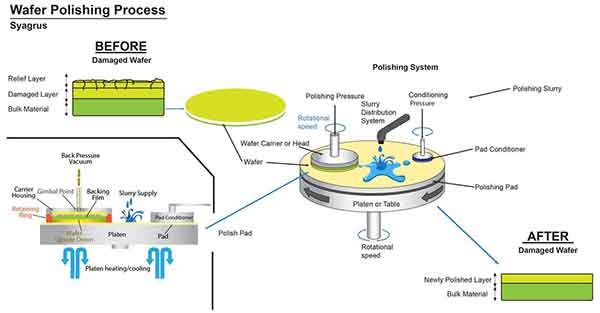
The polishing process has a major impact on wafer flatness, haze, ripple, and overall surface quality. Chemical mechanical polishing (CMP) is commonly used to create ultra-flat and low-roughness silicon surfaces for semiconductor fabrication and advanced microelectronics manufacturing.
Rigid polishing pads are generally preferred when extremely low surface roughness and high flatness are required. Polishing slurry composition, colloidal silica particle size, polishing pressure, and wafer rotation speed can all influence final surface morphology and roughness values.
Low-roughness silicon wafers are widely used in applications involving thin-film deposition, photolithography, epitaxy, wafer bonding, and nanoscale metrology.
Applications of Low Surface Roughness Silicon Wafers
Ultra-smooth polished silicon wafers are used in a wide range of advanced research and semiconductor applications, including:
- Atomic Force Microscopy (AFM)
- MEMS fabrication
- Nanotechnology research
- Photolithography
- Semiconductor device fabrication
- Wafer bonding and SOI fabrication
- Thin-film deposition
- Scanning Electron Microscopy (SEM)
- Focused Ion Beam (FIB) analysis
- Surface metrology and profilometry
- Photonic and optical device development
Researchers frequently select low surface roughness silicon substrates for nanosheet imaging, nanoparticle analysis, and advanced semiconductor process development where ultra-flat surfaces are required for reliable measurements and device performance.
Surface Roughness Specifications for Silicon Wafers
Surface roughness specifications vary depending on wafer diameter, polishing type, substrate grade, and intended application. Prime grade and DSP silicon wafers typically provide the lowest roughness values and highest surface quality.
Common specifications include RMS roughness, Ra roughness, total thickness variation (TTV), bow, warp, flatness, and surface particle counts. Many semiconductor and MEMS applications require surface roughness values below 1 nm RMS to support high-resolution fabrication and nanoscale device structures.
UniversityWafer supplies low surface roughness silicon wafers for semiconductor manufacturing, university laboratories, MEMS development, AFM imaging, photonics, and advanced microfabrication research applications worldwide.