
We are interested in purchasing a small quantity of 128 XY LiNbO3 wafers at 100mm diameter and 250 um thickness for SAW device applications.
Lithium Niobate Wafers Used for SAW Device Applications
An RF engineer requested a quote for the following.
UniversityWafer, Inc. Quoted:
LiNbO3 Wafer 4", 250um, SSP, Y-128 Cut
Reference #205114 for specs and pricing.
ST Cut Quartz SAW Grade for Device Fabrication
An electrical engineering student requested a quote for the following.
I want to buy some quartz wafers for fabricating SAWs delay lines. I have several questions to ask:
- You have several kinds of ST-cut quartz, what are differences among them? One of ST-cut quartz is labelled “SAW grade”. What doses the “SAW Grade” mean? Is there some special treatment making it more suitable for SAW application?
- Could you please tell me how to tell the direction of the wafer? Is the flat side indicating the x-direction?
- I want to make sure the price of them. Ps: I find that you also sell graphene. Could I buy monolayer graphene on ST-cut quartz? If yes, what is the price? Looking forward to your reply. Thank you very much.
UniversityWafer, Inc. Quoted:
Diam 76.2mm
0.5mm thick SSP ST Cut
SAW Grade
TTV: <10um Bow/Warp: <10um
Reference #216308 for specs and pricing.
SAW Substrate Materials and Piezoelectric Wafer Options
What Is A Surface Acoustic Wave Device?
A Surface Acoustic Wave (SAW) device is a type of electronic device that uses acoustic waves traveling along the surface of a material, typically a piezoelectric crystal, to perform signal processing functions such as filtering, sensing, and frequency generation. Here's an overview of its components, operation, and applications:
Key Components
-
Piezoelectric Substrate
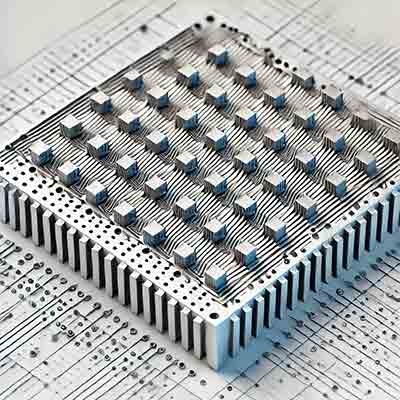
- SAW devices are typically built on piezoelectric materials such as quartz, lithium niobate, or lithium tantalate. These materials convert electrical signals into mechanical vibrations (acoustic waves) and vice versa.
-
Interdigital Transducers (IDTs):
- Metal electrodes arranged in a comb-like pattern on the substrate.
- They generate surface acoustic waves when an electrical signal is applied, or detect waves traveling on the surface.
How It Works
-
Signal Conversion:
- An electrical signal is applied to the input IDT, which creates mechanical vibrations in the substrate due to the piezoelectric effect, commonly using lithium niobate wafers.
-
Wave Propagation:
- The acoustic wave propagates along the surface of the substrate, influenced by the material properties of quartz wafers or sapphire substrates.
-
Signal Processing:
- The wave interacts with the substrate or other components (e.g., reflective gratings) to achieve specific processing effects such as filtering, often designed on precision single crystal quartz.
-
Detection:
- The output IDT converts the acoustic wave back into an electrical signal.
Types of SAW Waves
-
Rayleigh Waves:
- Travel along the surface and decay exponentially with depth, commonly supported by piezoelectric substrates.
-
Love Waves:
- Constrained to the surface with higher sensitivity to surface properties, often used in sensors built on lithium tantalate wafers.
-
Shear Horizontal Waves:
- Travel parallel to the surface and are less sensitive to liquid loading, depending on the choice of substrate material.
Applications
-
Communication Systems:
- RF Filters: SAW devices are widely used in mobile phones and wireless systems to filter radio frequencies, often fabricated on LiNbO₃ wafers.
- Oscillators: Generate precise frequencies for communication devices using stable quartz substrates.
-
Sensors:
- Gas and Liquid Sensors: Measure changes in wave propagation due to environmental changes (e.g., mass loading, viscosity) using sensitive piezoelectric wafers.
- Biosensors: Detect biomolecules in medical diagnostics on specialized substrate materials.
-
Signal Processing:
- Time delay lines and phase shifters built on engineered crystal substrates.
-
Touchscreens:
- Some touch-sensitive displays use SAW technology to detect touch location using durable glass and quartz substrates.
Advantages
- Compact size, especially when fabricated on lithium niobate wafers.
- High precision enabled by advanced single crystal quartz substrates.
- Ability to function across a wide range of frequencies using optimized piezoelectric materials.
- Passive operation (does not require an external power source for the acoustic wave propagation).
Challenges
- Limited power handling capacity compared to bulk acoustic wave (BAW) devices, especially when using standard sapphire substrates.
- Performance can be affected by environmental factors like temperature and surface contamination on sensitive quartz wafers.
SAW devices are critical components in modern electronics due to their efficiency and versatility in signal processing and sensing applications, often built on high-quality piezoelectric wafers.