
Do you sell wafers that have Through Silicon Vias (TSVs) in them? We are looking for up to 5 wafers with TSV structures. The wafers should have a resistivity between 1 and 500 Ohm-cm.
Through Silicon Via (TSV) Wafers for Advanced Semiconductor Packaging
UniversityWafer supplies Through Silicon Via (TSV) wafers and custom silicon wafers used in advanced semiconductor packaging, 3D integrated circuits (3D ICs), MEMS devices, image sensors, and high-performance computing applications. TSV technology enables vertical electrical connections through a silicon substrate, allowing multiple chips to be stacked together while improving bandwidth, reducing power consumption, and minimizing package size.
A PhD candidate recently contacted us with the following request:
Reference #162771 for available specifications, pricing, and delivery options.
Need TSV Wafers for Research or Product Development? Buy Online or request a custom quote today.
What Is the Purpose of Through Silicon Vias (TSVs)?
Through Silicon Vias (TSVs) are one of the most important technologies used in modern semiconductor manufacturing. By creating vertical electrical pathways through a silicon wafer, TSVs enable compact chip stacking, faster signal transmission, and improved power efficiency. They are widely used in advanced packaging, memory devices, artificial intelligence processors, MEMS sensors, and silicon interposer technologies.
1. High-Density Electrical Interconnects
TSVs provide direct electrical connections between multiple layers of semiconductor devices. Compared to traditional wire bonding, TSVs significantly reduce interconnect length and increase connection density.
- Shorter signal paths
- Higher data transfer rates
- Reduced electrical resistance
- Improved device performance
2. Enabling 3D Integrated Circuits (3D ICs)
TSV technology is the foundation of 3D IC packaging, where multiple semiconductor dies are stacked vertically to maximize performance while minimizing package size.
- Logic and memory integration
- High Bandwidth Memory (HBM)
- Processor-memory stacking
- Artificial intelligence accelerators
These advanced architectures provide significantly higher bandwidth while reducing latency and power consumption.
3. Improved Semiconductor Performance
Because TSVs create direct vertical pathways through a silicon substrate, signal transmission is faster and more efficient than conventional package interconnect methods.
- Lower signal delay
- Reduced power consumption
- Higher operating speeds
- Improved signal integrity
This makes TSVs ideal for high-performance computing (HPC), data centers, graphics processors, and machine learning hardware.
4. Advanced Semiconductor Packaging
TSVs are widely used in modern advanced packaging technologies, including System-in-Package (SiP), chiplet architectures, and silicon interposer platforms.
- System-in-Package (SiP) solutions
- 2.5D Silicon Interposers
- Chiplet Integration
- Heterogeneous Semiconductor Integration
These packaging methods allow multiple semiconductor technologies to operate together within a single compact package.
5. Enhanced Thermal Management
Advanced semiconductor devices generate substantial heat during operation. TSV structures can assist with thermal management by creating pathways that help distribute heat away from critical areas within stacked semiconductor devices.
Improved thermal performance helps increase device reliability and lifespan in demanding applications.
6. MEMS, Sensors, and Imaging Devices
TSVs are commonly used in MEMS packaging and sensor applications where compact form factors and high-density electrical routing are required.
- Accelerometers
- Gyroscopes
- Pressure sensors
- CMOS image sensors
- Medical sensor devices
Through Silicon Via technology allows these devices to achieve smaller footprints while maintaining excellent electrical performance.
Common TSV Applications
- Smartphones and Mobile Devices
- Artificial Intelligence Hardware
- High-Performance Computing Systems
- Graphics Processing Units (GPUs)
- High Bandwidth Memory (HBM)
- MEMS and Sensor Packaging
- Data Center Processors
- Internet of Things (IoT) Devices
As semiconductor devices continue to demand higher performance in smaller packages, Through Silicon Vias remain a key enabling technology for advanced semiconductor manufacturing, 3D integration, and next-generation electronic systems.
What Are Through-Silicon Vias (TSVs)?
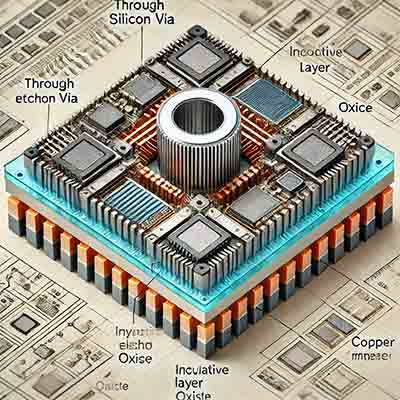
Through-Silicon Vias (TSVs) are vertical electrical interconnects that pass completely through a silicon wafer or semiconductor die, enabling direct communication between stacked devices in 3D integrated circuits (3D ICs). TSV technology has become a critical component of advanced semiconductor packaging because it increases interconnect density, improves signal transmission speeds, and reduces power consumption in next-generation electronic systems.
TSVs are widely used in silicon wafers, memory devices, logic chips, MEMS sensors, image sensors, and high-performance computing platforms where compact design and high bandwidth are essential.
Key Features of Through-Silicon Vias
- Vertical Electrical Connections – TSVs create direct pathways through a silicon substrate, allowing stacked semiconductor devices to communicate efficiently.
- Conductive Fill Materials – After deep etching, TSV structures are typically filled with conductive materials such as copper or tungsten to form low-resistance electrical connections.
- High Aspect Ratios – Modern TSV fabrication processes support via diameters ranging from a few microns to several tens of microns while maintaining excellent electrical performance.
- Wafer-Level Integration – TSVs can be fabricated during wafer processing, enabling scalable manufacturing for high-volume semiconductor production.
Applications of TSV Technology
- 3D Integrated Circuits (3D ICs) – Stack memory, processors, and logic devices to improve performance while reducing package size.
- High Bandwidth Memory (HBM) – Enable extremely fast communication between memory layers in AI accelerators and graphics processors.
- MEMS Packaging – Provide compact electrical routing for accelerometers, gyroscopes, pressure sensors, and other MEMS devices.
- Silicon Interposers – Support advanced 2.5D packaging architectures used in high-performance computing and data-center applications.
- CMOS Image Sensors – Allow sensor arrays and signal-processing circuitry to be stacked vertically for improved imaging performance.
Benefits of Through-Silicon Vias
- Higher Interconnect Density – More connections can be placed in a smaller area compared to traditional wire bonding.
- Improved Signal Integrity – Shorter electrical paths reduce latency and signal degradation.
- Lower Power Consumption – Reduced interconnect length decreases electrical resistance and energy losses.
- Smaller Package Size – Enables compact semiconductor devices for mobile electronics, medical devices, and aerospace systems.
- Greater System Performance – Supports high-speed data transfer and increased bandwidth between stacked components.
Challenges in TSV Manufacturing
- Deep Silicon Etching – Precise via formation requires advanced DRIE (Deep Reactive Ion Etching) processes.
- Thermal Management – Densely stacked devices generate significant heat that must be effectively dissipated.
- Mechanical Stress – Differences in material expansion can impact long-term reliability.
- Production Cost – TSV fabrication adds complexity to wafer processing and semiconductor packaging workflows.
As semiconductor devices continue to shrink while demanding greater performance, TSV technology remains one of the most important innovations enabling advanced packaging, heterogeneous integration, artificial intelligence hardware, and next-generation computing platforms.
What Is a Power Through-Silicon Via (Power TSV)?
A Power Through-Silicon Via (Power TSV) is a specialized TSV designed to distribute power and ground signals through stacked semiconductor devices. Unlike signal TSVs, which primarily carry data, Power TSVs deliver electrical current efficiently across multiple layers within a 3D integrated circuit.
Power TSVs are essential in advanced semiconductor packaging because they reduce voltage drops, improve power integrity, and support the increasing current demands of modern processors, memory devices, and AI accelerators.
Why Power TSVs Are Important
- Efficient Power Distribution – Provide low-resistance pathways for delivering power throughout stacked semiconductor architectures.
- Improved Device Reliability – Maintain stable voltage levels across multiple dies and functional blocks.
- Thermal Performance – Assist with heat transfer and thermal management in dense package structures.
- Enhanced Signal Quality – Reduce electromagnetic interference and electrical noise by separating power and signal pathways.
Power TSV Construction
- Typically larger than signal TSVs to support higher current densities.
- Often filled with copper because of its excellent conductivity.
- Surrounded by insulating layers such as silicon dioxide to prevent leakage current.
- Designed to minimize resistance while maximizing long-term reliability.
Power TSV Applications
- High-Performance Computing (HPC)
- Artificial Intelligence Processors
- High Bandwidth Memory (HBM)
- Advanced System-on-Chip (SoC) Devices
- Mobile and Consumer Electronics
- Data Center Accelerators
Advantages of Power TSVs
- Lower electrical resistance and power losses.
- Improved power density in compact semiconductor packages.
- Greater performance and voltage stability.
- Reduced package size compared to conventional power delivery methods.
- Support for next-generation 3D semiconductor architectures.
Power TSVs and signal TSVs work together to make modern 3D integrated circuits possible, helping semiconductor manufacturers achieve higher performance, increased bandwidth, improved energy efficiency, and smaller device footprints for advanced electronic systems.