
Wafer Cassettes and Semiconductor Wafer Carriers
UniversityWafer, Inc. supplies wafer cassettes, wafer carriers, and semiconductor wafer holders for universities, research laboratories, prototype development, and semiconductor manufacturing. These carriers help organize and protect wafers during storage, handling, transport, inspection, and selected processing steps.
Wafer cassettes can be used with silicon wafers, GaAs wafers, sapphire substrates, SiC wafers, and other semiconductor or specialty substrates when the carrier dimensions and process requirements are compatible.
Wafer Cassette Sizes and Capacities
Different research and manufacturing workflows require different cassette sizes. Important specifications include wafer diameter, wafer thickness, slot spacing, cassette material, and the number of wafers the carrier must hold.
UniversityWafer can help source wafer carriers ranging from individual or low-quantity wafer holders to multi-slot cassettes used for larger wafer batches. Some applications may require up to 25 wafer positions, while research laboratories may need carriers for only a few substrates at a time.
Common Cassette Requirements
- Wafer diameter
- Wafer thickness
- Number of wafer slots
- Slot spacing or pitch
- Cassette or carrier material
- Wet-process or dry-process use
- Storage or transport requirements
- Temperature requirements
- Chemical compatibility
- Manual or automated handling
Wafer Cassettes for Research Laboratories
Research laboratories often work with smaller wafer quantities, multiple substrate materials, and experimental process conditions. A properly selected cassette makes it easier to keep wafers separated, organized, and protected throughout multi-step experiments.
Wafer carriers can also help researchers identify wafers by experiment, substrate type, process stage, or lot while reducing unnecessary direct handling of polished wafer surfaces.
Protecting Semiconductor Wafers During Handling
Semiconductor wafers can be vulnerable to edge damage, scratches, contamination, and breakage during manual handling. A suitable wafer cassette helps maintain separation between substrates and reduces the need for repeated direct contact during transfer or storage.
This is particularly important for fragile, thin, polished, or high-value substrates used in MEMS, photonics, power electronics, and advanced semiconductor research.
Wafer Storage and Transport
Wafer cassettes are frequently used to organize substrates between fabrication steps or during storage. Depending on the carrier design, they may also be used to protect wafers during transport between laboratories, processing tools, inspection stations, or shipping locations.
For long-term storage or shipping, the correct wafer carrier should be selected based on wafer dimensions, substrate fragility, cleanliness requirements, and the intended handling environment.
Applications of Wafer Cassettes
- Semiconductor wafer storage and organization
- Wafer transport between processing steps
- Wet processing and cleaning
- Surface preparation and chemical processing
- Thin-film deposition workflows
- Wafer inspection and metrology
- MEMS fabrication
- Photonics and optoelectronic research
- Solar cell research
- University and industrial semiconductor laboratories
Request a Wafer Cassette Quote
For the fastest quote, include as much information as possible about your wafer and application. Useful details include:
- Wafer material
- Wafer diameter
- Wafer thickness
- Quantity of wafers per cassette
- Preferred cassette material, if known
- Process chemicals or temperature range
- Whether the carrier is for processing, storage, or shipping
Get Your Wafer Cassette Quote FAST! Or, Buy Online and Start Researching Today!
Wafer Cassettes for Semiconductor Processing and Research
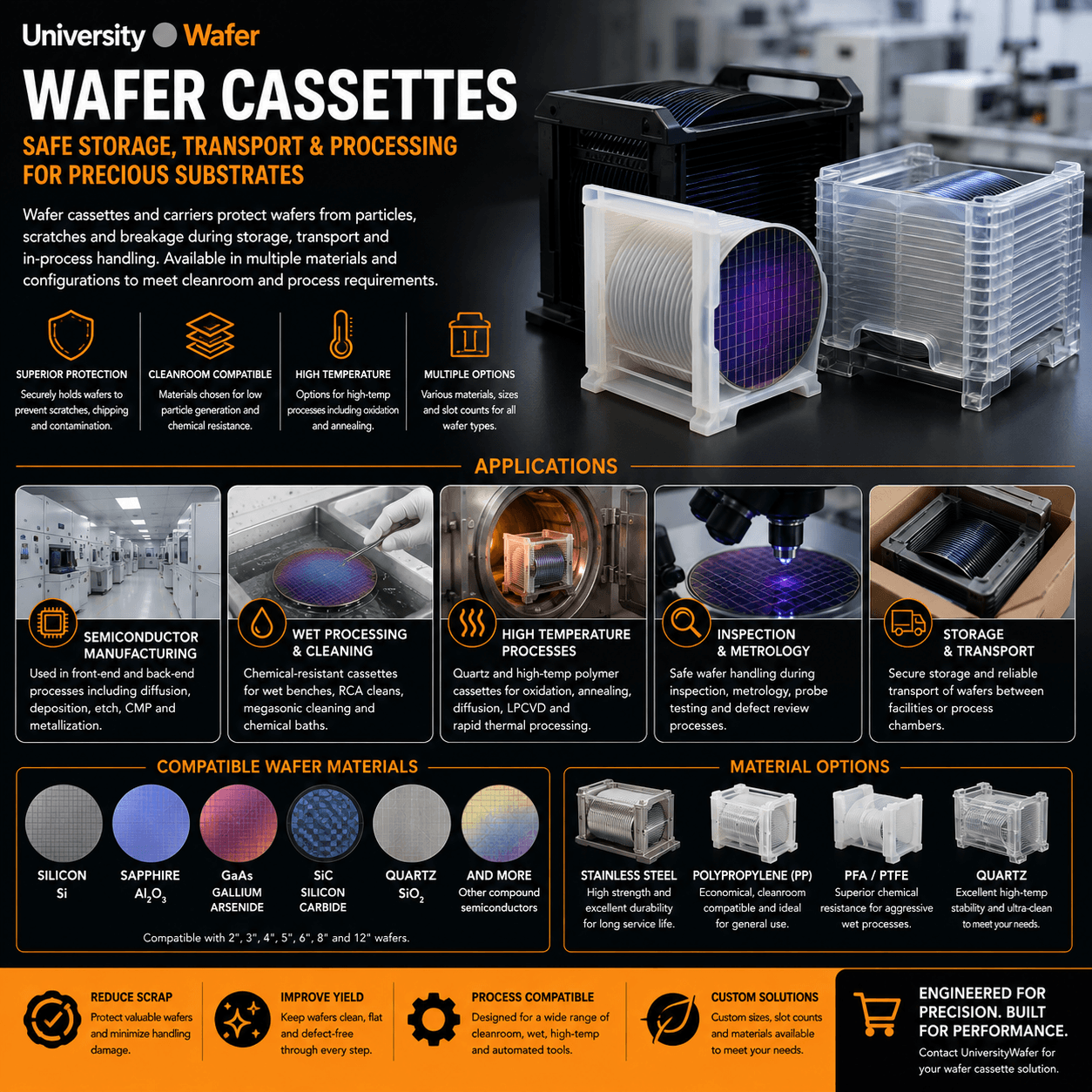
Wafer cassettes are used to safely hold, transport, store, and process semiconductor wafers throughout research and fabrication workflows. They help reduce wafer-to-wafer contact, mechanical damage, particle contamination, and handling errors while maintaining consistent wafer spacing. UniversityWafer supplies wafer carriers for silicon wafers and other semiconductor substrates used in MEMS, photonics, power electronics, solar research, and device fabrication.
The correct cassette depends on the wafer diameter, wafer thickness, number of wafers, process chemistry, operating temperature, and handling method. A cassette intended for wet cleaning, for example, may require different materials and geometry than a carrier used primarily for storage or high-temperature processing.
How to Choose a Wafer Cassette
When selecting a semiconductor wafer cassette, consider the process environment as well as the physical dimensions of the substrate.
| Selection Factor | Why It Matters | Typical Considerations |
|---|---|---|
| Wafer Diameter | The cassette slots and overall geometry must match the wafer size. | Research-size wafers through larger semiconductor wafer formats. |
| Wafer Thickness | Thin or fragile wafers may require appropriate slot spacing and support. | Standard, thin, ultra-thin, or specialty substrates. |
| Capacity | Determines how many wafers can be handled or stored together. | Single-wafer carriers through multi-slot cassettes, including 25-wafer configurations. |
| Cassette Material | Material compatibility affects chemical resistance, cleanliness, and temperature capability. | Polypropylene, PFA, PTFE, stainless steel, quartz, or other specialized materials. |
| Process Environment | Wet chemistry, high temperature, vacuum, and storage environments can require different carrier designs. | Cleaning, etching, deposition, oxidation, inspection, storage, or transport. |
| Automation Compatibility | Production environments may require precise geometry for robotic wafer handling. | Slot pitch, alignment, orientation, and equipment compatibility. |
Common Wafer Cassette Materials
Wafer cassette materials are selected according to chemical exposure, process temperature, cleanliness requirements, and mechanical handling needs.
- Polypropylene (PP): Commonly used in wet processing, rinsing, storage, and general laboratory wafer handling because of its chemical resistance and relatively low cost.
- PFA and PTFE: Fluoropolymer materials used when strong chemical resistance and high cleanliness are important, especially in aggressive wet-process environments.
- Stainless Steel: May be used for selected handling or elevated-temperature applications where mechanical strength and dimensional stability are important. Suitability depends on the specific process and contamination requirements.
- Quartz: Used in selected high-temperature semiconductor processes because of its thermal stability and compatibility with certain furnace environments.
Not every cassette material is suitable for every semiconductor process. Chemical compatibility, maximum operating temperature, contamination limits, and equipment requirements should be evaluated before selecting a carrier.
Wafer Cassette Applications
Wafer carriers are used throughout semiconductor research, wafer processing, and device fabrication. Typical applications include:
- Wafer cleaning, rinsing, and wet processing
- Chemical etching and surface preparation
- Thin-film deposition workflows
- Wafer inspection and metrology
- Photolithography handling
- Thermal processing and selected oxidation workflows
- MEMS fabrication
- Photonic device fabrication
- Solar cell research
- Wafer storage and laboratory organization
- Shipping and transport between processing locations
Wafer Cassettes for Different Substrate Materials
Wafer carriers are not limited to silicon. Depending on wafer dimensions and cassette compatibility, carriers may also be used with:
- Silicon wafers
- Gallium arsenide (GaAs) wafers
- Sapphire wafers
- Silicon carbide (SiC) wafers
- Quartz and glass substrates
- Other compound semiconductor and specialty substrates
For fragile, unusually thin, small-diameter, or non-standard substrates, cassette slot geometry and wafer support become especially important.
Wafer Cassettes for Wet Processing
Wet-process wafer cassettes are commonly used during cleaning, rinsing, chemical treatment, and etching. Their design can allow process liquids to circulate around the wafer surfaces while keeping wafers separated and organized.
Material compatibility is especially important in wet processing. The cassette must be suitable for the specific chemicals, concentrations, temperatures, and cleanliness requirements used in the process.
Wafer Storage and Transport
For storage and transport, wafer cassettes help protect substrates from direct handling, edge damage, and accidental contact. Proper carriers can also make it easier to organize wafers by lot, experiment, substrate type, or processing stage.
Research laboratories may require only a few wafers at a time, while larger manufacturing operations may use full multi-slot carriers for repeated wafer handling and transfer.
Custom Wafer Cassette Requirements
Some research and manufacturing projects require non-standard wafer carriers. Important specifications may include:
- Wafer diameter
- Wafer thickness
- Number of slots
- Slot spacing or pitch
- Cassette material
- Maximum process temperature
- Chemical compatibility
- Required cleanliness level
- Manual or automated handling
- Storage, shipping, or process use
Providing these details when requesting a quote helps identify a cassette that is appropriate for the intended semiconductor process.
Benefits of Proper Wafer Handling
- Reduce the risk of wafer breakage and edge damage
- Limit unnecessary direct contact with wafer surfaces
- Help maintain wafer spacing during processing and transport
- Improve organization during multi-step research workflows
- Support cleaner wafer handling practices
- Protect valuable substrates during storage and shipping
- Provide more consistent handling in laboratory and manufacturing environments
Wafer Cassettes for Universities, Laboratories, and Industry
UniversityWafer, Inc. supplies wafer cassettes and semiconductor wafer carriers for university laboratories, research facilities, prototype development, and industrial semiconductor applications. Options can support quantities ranging from individual research wafers to multi-wafer cassette configurations.
Get Your Wafer Cassette Quote FAST! Or, Buy Online and Start Researching Today!
Related Wafer Handling and Semiconductor Resources
- Silicon Wafers – Silicon substrates for semiconductor processing, MEMS, electronics, and research.
- Silicon Carbide Wafers – SiC substrates for power electronics and advanced semiconductor research.
- Gallium Arsenide Wafers – GaAs substrates for RF, photonics, optoelectronics, and semiconductor devices.
- Sapphire Wafers – Sapphire substrates for optics, LEDs, electronics, and research.
- Thin-Film Deposition – Learn about deposition processes used during semiconductor device fabrication.
- Thermal Oxide Silicon Wafers – Silicon wafers with thermally grown silicon dioxide for research and fabrication.
- MEMS Fabrication – Substrates and processing considerations for microelectromechanical systems.
- Semiconductor Device Manufacturing – Explore wafer processing and semiconductor manufacturing workflows.