
I was wondering if you can give me a more detail information about your piezoelectric thin film substrates. PMN-PT the optical properties and electro-actuation characteristics is of interest of me.
Piezoelectric Wafers
A postdoc fellow requested a quote for the following:
Reference #162410 for specs and pricing.
We have a large selection of wafers in stock for your piezoelectric research.
Get Your Quote FAST! Or, Buy Online and Start Researching Today!
What Are Piezoelectric Effect Applications?
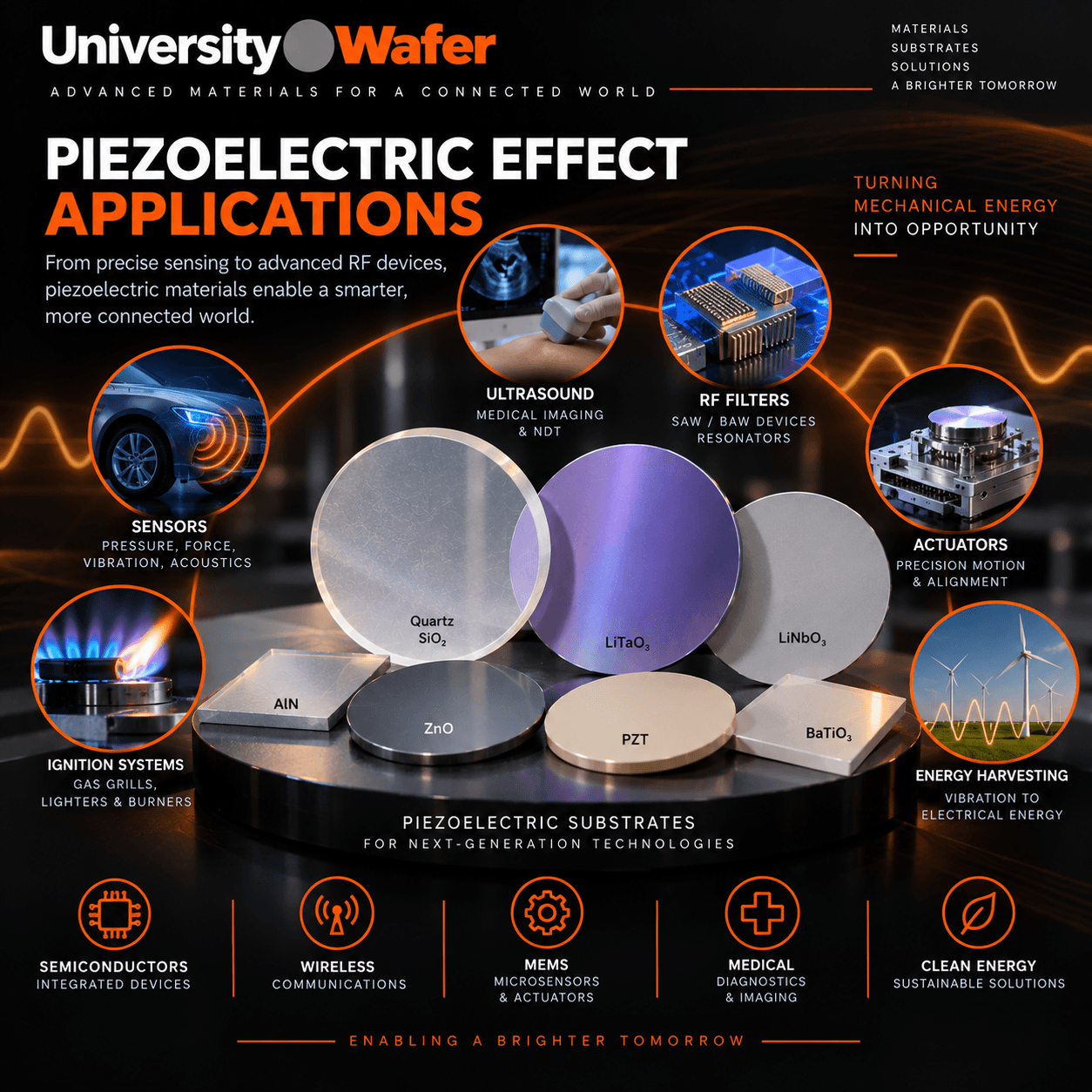
The piezoelectric effect allows certain materials to convert mechanical stress into an electrical charge. This is known as the direct piezoelectric effect. The process also works in reverse: applying an electric field can produce a small mechanical deformation, known as the converse piezoelectric effect. Together, these properties make piezoelectric materials useful in sensors, actuators, acoustic devices, resonators, filters, transducers, and precision positioning systems.
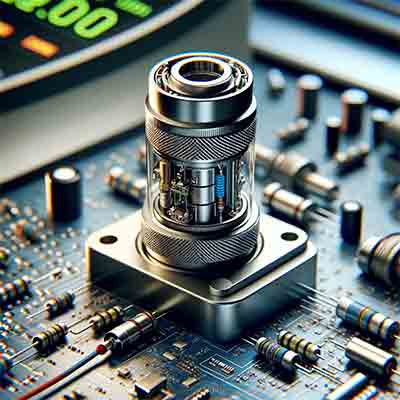
Piezoelectricity occurs in materials whose crystal structures lack certain symmetry, allowing mechanical deformation to shift positive and negative charge centers and create electrical polarization. Not every non-centrosymmetric material exhibits useful piezoelectric behavior, and the strength of the response depends on crystal orientation, composition, temperature, processing, and device geometry.
Sensors and Measurement Systems
Piezoelectric materials are widely used to detect force, pressure, acceleration, vibration, and acoustic waves. When mechanical stress is applied, the material produces an electrical signal that can be measured and analyzed. This principle is used in accelerometers, vibration monitors, microphones, pressure sensors, impact sensors, and industrial condition-monitoring equipment.
Their sensitivity to small mechanical changes also makes piezoelectric transducers valuable for nondestructive testing (NDT). Ultrasonic pulses can be transmitted into a component and reflected from cracks, voids, interfaces, or other defects, allowing structures to be inspected without destroying them.
Ultrasound and Medical Imaging
Piezoelectric transducers are fundamental components of ultrasound systems. An alternating voltage causes the piezoelectric element to vibrate and generate ultrasonic waves. Returning acoustic waves then mechanically deform the material, producing electrical signals that can be processed into an image or measurement.
Similar principles are used in medical ultrasound, ultrasonic cleaning, flow measurement, distance sensing, sonar, and high-frequency acoustic characterization.
RF Filters, Resonators and Acoustic-Wave Devices
Piezoelectric substrates are especially important in radio-frequency electronics. Materials such as lithium tantalate (LiTaO3), lithium niobate (LiNbO3), quartz, aluminum nitride (AlN), and zinc oxide (ZnO) can be used to convert electrical signals into mechanical acoustic waves and back again.
This capability enables surface acoustic wave (SAW) filters, bulk acoustic wave (BAW) devices, resonators, oscillators, and frequency-control components. These technologies are important in wireless communication systems where unwanted frequencies must be rejected while selected frequency bands are transmitted.
Precision Motion and Actuation
The converse piezoelectric effect enables extremely small and precisely controlled mechanical movements. Piezoelectric actuators are therefore used in nanopositioning stages, scanning probe microscopes, optical alignment systems, adaptive optics, precision valves, inkjet printing, and other applications requiring rapid motion with nanometer- or micrometer-scale control.
Piezoelectric Ignition Systems
A familiar application is the piezoelectric igniter used in gas grills, lighters, and other gas-fired equipment. A mechanical impact rapidly compresses a piezoelectric element, generating a high voltage across a small gap. The resulting electrical spark can ignite the fuel-air mixture without requiring a battery.
Energy Harvesting
Piezoelectric materials can also convert vibration or repeated mechanical deformation into small amounts of electrical energy. Researchers investigate piezoelectric energy harvesting for low-power sensors, structural monitoring systems, wearable electronics, and autonomous devices. The available electrical power depends strongly on the material, mechanical excitation, device geometry, and electrical load.
Common Piezoelectric Materials and Substrates
There is no universal ranking from the "strongest" to "weakest" piezoelectric material. Material selection depends on the required piezoelectric coefficient, electromechanical coupling, acoustic velocity, dielectric properties, mechanical quality factor, thermal stability, frequency range, crystal orientation, and fabrication process.
Lead Zirconate Titanate (PZT)
Lead zirconate titanate (PZT) is a widely used piezoelectric ceramic with a strong electromechanical response. PZT is commonly found in actuators, ultrasonic transducers, sensors, precision positioning systems, and vibration-control devices.
Quartz (SiO2)
Single-crystal quartz provides excellent frequency stability and low acoustic loss. It is widely associated with oscillators, resonators, frequency-control devices, and acoustic-wave technologies where stability can be more important than obtaining the largest possible piezoelectric response.
Lithium Niobate and Lithium Tantalate
Lithium niobate (LiNbO3) and lithium tantalate (LiTaO3) are important single-crystal piezoelectric substrates for acoustic-wave and RF devices. Their crystallographic orientation can strongly influence electromechanical coupling, acoustic-wave propagation, temperature behavior, and overall device performance.
Aluminum Nitride (AlN)
Aluminum nitride is particularly important for thin-film piezoelectric devices. AlN combines piezoelectric behavior with high acoustic velocity, electrical insulation, and compatibility with semiconductor processing, making it useful for RF resonators, BAW devices, MEMS, sensors, and integrated acoustic components.
Zinc Oxide (ZnO)
Zinc oxide (ZnO) is a piezoelectric semiconductor used in thin films, acoustic-wave devices, sensors, optoelectronics, and nanostructure research. Its properties can be engineered through deposition conditions, orientation, doping, and device structure.
Barium Titanate (BaTiO3)
Barium titanate is a ferroelectric ceramic that exhibits piezoelectric behavior in its ferroelectric phase. It is important in dielectric, sensing, actuator, and ferroelectric research and is also investigated for lead-free piezoelectric technologies.
PVDF and Piezoelectric Polymers
Polyvinylidene fluoride (PVDF) and related polymers provide flexibility and low weight compared with brittle ceramic or single-crystal materials. These characteristics make piezoelectric polymers attractive for flexible sensors, wearable electronics, microphones, pressure sensing, and energy-harvesting research.
Why Substrate Properties Matter
Piezoelectric device performance depends on more than material composition. Crystal cut, crystallographic orientation, wafer thickness, surface roughness, flatness, dielectric properties, electrode design, and film quality can all affect acoustic propagation, resonant frequency, coupling efficiency, insertion loss, and device reliability.
UniversityWafer supplies substrates for research involving piezoelectric devices, MEMS, RF filters, acoustic-wave devices, sensors, photonics, thin-film deposition, and advanced materials. Researchers can select wafer specifications appropriate for experimental fabrication, material characterization, and device development.
Related Piezoelectric Materials & Applications
- Lithium Tantalate for RF Filters – Learn how piezoelectric LiTaO3 substrates support SAW filters and RF front-end devices.
- Single-Crystal Quartz – Discover quartz substrates for resonators, oscillators, sensors, and frequency-control applications.
- Zinc Oxide (ZnO) – Explore ZnO substrates and materials for piezoelectric, acoustic-wave, sensor, and optoelectronic research.
- Thin-Film Deposition – Learn about thin-film processes used to fabricate piezoelectric, dielectric, electrode, and functional layers.
- MEMS Substrates – Explore wafer materials for microsensors, actuators, resonators, and other MEMS devices.