
“I am looking for a semiconducting Gallium Arsenide wafer without intentional doping. Carrier density lower than 1016 cm-3 is preferred, although <1018 cm-3 is acceptable. I do not require deep-level dopants to make the wafer semi-insulating.”
Low Carrier Density GaAs Wafers for Semiconductor Research
Low carrier density Gallium Arsenide (GaAs) wafers are widely used in high-frequency electronics, photonics, RF devices, optoelectronics, and advanced semiconductor research. Researchers often require undoped or lightly doped GaAs substrates to improve electron mobility and reduce unwanted electrical interference.
A university PhD candidate requested the following substrate specifications for their semiconductor application.
Low carrier density GaAs wafers are commonly selected for:
- High-speed transistor fabrication
- Microwave and RF electronics
- Photonic integrated circuits
- Laser diode research
- Semiconductor characterization
- Quantum device applications
- Advanced optoelectronic devices
Reference #137380 for pricing and wafer specifications.
Get Your Quote FAST! Or, Buy Online and Start Researching Today!
Gallium Antimonide Carrier Density at Room Temperature
Gallium Antimonide (GaSb) wafers are frequently used in infrared detectors, thermophotovoltaics, photonics, and high-speed semiconductor devices. Carrier density measurements at room temperature are critical for accurately characterizing semiconductor performance.
A physics research group requested clarification regarding carrier density measurements for their GaSb substrates.
Research Question:
“Can you confirm that the carrier density values are measured at room temperature (300K)?”
UniversityWafer, Inc. Response:
Yes, the quoted GaSb wafers meet the requested specifications and the carrier density values are measured at room temperature (300K).
Typical GaSb Wafer Specifications:
- 2-inch and custom diameter wafers
- p-type GaSb substrates
- Carrier density: 1×10¹⁶ – 2×1016 cm-3
- Both-side polished surfaces
- Nitrogen-sealed wafer packaging
- [110] orientation
Reference #154906 for pricing and lead times.
Carrier Density Measurement Using van der Pauw Method
The van der Pauw method is one of the most widely used techniques for measuring semiconductor electrical properties, including sheet resistance, mobility, resistivity, and charge carrier density.
A university postdoctoral researcher requested silicon wafers for thin-film and metal evaporation experiments requiring crystallographic orientation identification.
“Please provide a quote for 1-inch silicon wafers, (100) orientation, single-side polished, with orientation marks. Doping and resistivity are not important for our metal evaporation experiments.”
Orientation marks help researchers quickly identify crystal directions during semiconductor processing, lithography, wafer dicing, and thin-film deposition.
Semiconductor Characterization Methods
- Carrier density measurements using van der Pauw techniques
- X-Ray Diffraction (XRD) for crystal quality analysis
- Photoluminescence mapping for semiconductor uniformity
- SEM analysis for layer thickness characterization
- TEM imaging for nanoscale material analysis
Carrier density analysis is essential for semiconductor device optimization, wafer quality control, thin-film deposition, and advanced materials research.
Reference #204586 for specifications and pricing.
Carrier Density in Semiconductor Wafers
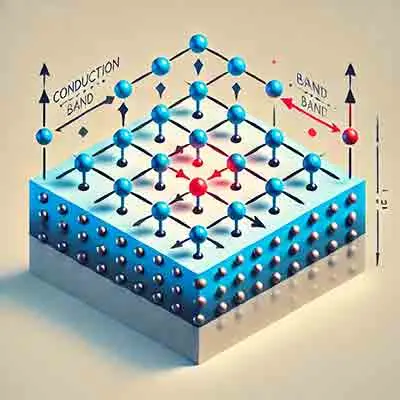
Carrier density is one of the most important electrical properties in semiconductor materials. It describes the concentration of free charge carriers — electrons and holes — available to conduct electricity within a material. Carrier density directly affects conductivity, resistivity, switching performance, and overall semiconductor device behavior.
In semiconductor fabrication, engineers carefully control carrier density through doping processes. The concentration of carriers is typically measured in cm-3 and varies depending on wafer material, crystal orientation, resistivity, temperature, and intended device application.
Types of Charge Carriers
-
Electron Density (n-type) – In n-type silicon wafers, electrons are the majority carriers responsible for electrical conduction. Higher electron concentrations improve conductivity and switching speed in many semiconductor devices.
-
Hole Density (p-type) – In p-type silicon wafers, holes become the dominant carriers. Hole concentration strongly affects transistor operation, carrier mobility, and junction behavior.
-
Intrinsic Carrier Density – Intrinsic semiconductors contain no intentional dopants. In these materials, electron and hole concentrations are equal. Intrinsic carrier density changes with temperature and material purity.
Carrier density is especially important for applications involving microelectronics, MEMS devices, sensors, photonics, RF devices, and thin-film semiconductor research.
Why Carrier Density Matters in Silicon Wafers
Understanding carrier density is essential for selecting the correct silicon wafer for semiconductor research and device fabrication. Carrier concentration directly influences conductivity, leakage current, switching characteristics, optical behavior, and thermal response.
Researchers designing transistors, photodetectors, solar cells, MEMS structures, or integrated circuits must carefully match carrier density specifications to their device requirements.
Benefits of Controlling Carrier Density
- Improves semiconductor device performance
- Controls resistivity and conductivity
- Optimizes p-n junction behavior
- Reduces leakage current in low-power electronics
- Improves optical and photonic device response
- Enhances simulation accuracy for semiconductor design
- Supports precision doping for advanced wafer fabrication
For optoelectronic and sensing applications, intrinsic carrier density plays a major role in determining how semiconductor wafers respond to light exposure and temperature changes.
Free Carrier Density in Semiconductor Materials
Free carrier density refers to the concentration of mobile electrons and holes that can move through a semiconductor and carry electrical current. These free carriers determine how effectively a material conducts electricity under applied voltage or electromagnetic excitation.
In silicon and other semiconductor substrates, free carrier density depends on:
- Doping concentration
- Temperature
- Crystal quality
- Material defects
- Wafer resistivity
- Impurity concentration
As temperature increases, more electrons gain sufficient energy to transition into the conduction band, increasing carrier concentration. Semiconductor doping dramatically increases free carrier density by introducing donor or acceptor atoms into the crystal lattice.
For intrinsic silicon at room temperature, carrier concentration is approximately 1.5×1010 cm-3. Doped wafers can reach carrier concentrations several orders of magnitude higher depending on device requirements.
Graphene Carrier Density for Advanced Electronics
Carrier density is also critical in graphene substrates and 2D material research. Graphene carrier concentration directly affects electron mobility, conductivity, RF performance, and transistor switching behavior.
A university researcher requested information regarding monolayer and bilayer graphene transferred onto custom substrates for advanced semiconductor applications.
Research Inquiry:
“Do you have information regarding carrier density and electron mobility in your graphene samples? We are interested in high-quality monolayer and bilayer graphene for advanced device fabrication.”
UniversityWafer, Inc. Response:
- Graphene carrier density: approximately 3×1013 cm-2
- Growth process: Chemical Vapor Deposition (CVD)
- Transfer method: Wet transfer processing
- Electron mobility on sapphire: 2000 cm2/Vs
- Electron mobility on SiO2/Si: 4000 cm2/Vs
- Available wafer sizes: 3-inch to 4-inch graphene wafers
Graphene carrier density is especially important in RF electronics, quantum devices, flexible electronics, biosensors, and photonic applications.
Low Carrier Density SOI Wafers
Silicon-on-Insulator (SOI) wafers are commonly used when researchers require low carrier density, reduced parasitic capacitance, and improved device isolation.
An assistant professor requested intrinsic SOI wafers with extremely low carrier density for advanced semiconductor experiments.
Research Request:
“For my application, the carrier density should be as low as possible, so intrinsic silicon would be ideal. Low p-type or n-type doping would also be acceptable.”
Low carrier density SOI wafers are widely used in:
- MEMS fabrication
- Photonics
- RF semiconductor devices
- Low-power electronics
- Quantum computing research
- Sensor development
- Advanced transistor design
Researchers often select intrinsic or lightly doped SOI wafers to minimize electrical interference and improve device sensitivity.