
Extreme Ultraviolet Lithography (EUV) and Advanced Semiconductor Manufacturing
Extreme Ultraviolet Lithography (EUV) is one of the most important technologies in modern semiconductor manufacturing. Using light with a wavelength of approximately 13.5 nanometers, EUV enables chipmakers to create smaller transistor structures, higher-density integrated circuits, and more powerful semiconductor devices than conventional lithography methods.
The success of EUV manufacturing depends on high-quality silicon wafers, epitaxial substrates, SOI wafers, and specialty semiconductor materials that support advanced process nodes used in AI processors, memory chips, smartphones, and high-performance computing devices.
Need Semiconductor Substrates for EUV Research? Buy Online or Request a Fast Quote Today!
Does Intel Use EUV Lithography?
Yes. Intel uses EUV lithography for advanced semiconductor fabrication and next-generation processor manufacturing. EUV technology is also used by leading chip manufacturers to produce increasingly complex integrated circuits with improved performance, lower power consumption, and higher transistor density.
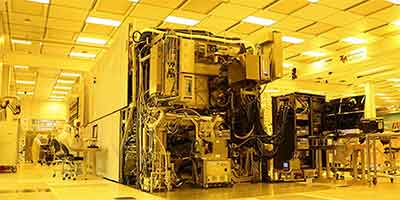
EUV systems, primarily supplied by ASML, are critical tools for producing advanced semiconductor devices. By enabling finer patterning on silicon wafers, EUV supports the continued scaling of semiconductor technology and helps drive innovation in artificial intelligence, data centers, consumer electronics, automotive systems, and communications infrastructure.
Future High-NA EUV systems are expected to further improve manufacturing precision, allowing semiconductor companies to continue developing smaller, faster, and more energy-efficient chips for emerging technologies.
What is Extreme Ultraviolet Lithography (EUV)?
Extreme Ultraviolet Lithography (EUV) is an advanced semiconductor manufacturing process that uses light with a wavelength of approximately 13.5 nanometers to pattern extremely small features onto silicon wafers. EUV technology enables chipmakers to produce smaller transistors, higher-density integrated circuits, and more powerful semiconductor devices than are possible with conventional deep ultraviolet (DUV) lithography.
As semiconductor devices continue to shrink, EUV lithography has become one of the most important technologies for manufacturing advanced microprocessors, memory chips, artificial intelligence hardware, and high-performance computing devices. Leading semiconductor manufacturers rely on EUV systems to produce cutting-edge integrated circuits at advanced process nodes.
How EUV Lithography Works
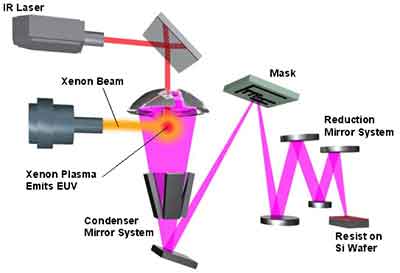
Unlike traditional optical lithography systems, EUV lithography uses extremely short-wavelength light generated by high-energy laser-produced plasma sources. Tiny droplets of molten tin are struck by powerful lasers, creating plasma that emits EUV radiation. This light is then reflected through a series of precision mirrors before exposing photoresist-coated silicon wafers.
Because EUV wavelengths are absorbed by most materials, the entire optical system must operate in a vacuum environment. Specialized multilayer mirrors replace conventional lenses, allowing circuit patterns to be projected with nanometer-scale precision.
Applications of EUV Lithography
EUV lithography is used to manufacture some of the world's most advanced semiconductor devices. Common applications include:
- High-performance microprocessors
- Artificial intelligence accelerators
- Smartphone processors
- Memory chips and storage devices
- Data center and cloud computing hardware
- Automotive semiconductor components
- Advanced RF and communication devices
- Next-generation consumer electronics
The technology enables higher transistor density, improved energy efficiency, increased processing performance, and reduced manufacturing complexity compared to multiple-patterning DUV processes.
Challenges of EUV Semiconductor Manufacturing
Despite its advantages, EUV lithography remains one of the most complex manufacturing technologies ever developed. Producing sufficient EUV light power, maintaining optical precision, controlling photoresist performance, and minimizing contamination are major engineering challenges.
 Even microscopic particles can affect imaging performance, requiring ultra-clean environments and highly sophisticated process controls. The reflective mirrors used in EUV systems must be manufactured with atomic-level precision to achieve acceptable performance.
Researchers continue developing improved photoresists, higher numerical aperture (High-NA) systems, advanced metrology tools, and more efficient light sources to support future semiconductor generations.
EUV Lithography and Advanced Silicon Wafers
The success of EUV lithography depends heavily on the quality of the underlying semiconductor substrates. Advanced silicon wafers, SOI wafers, epitaxial wafers, and specialty semiconductor substrates play a critical role in producing high-performance integrated circuits.
As the semiconductor industry moves toward increasingly advanced process nodes, EUV lithography will continue to drive innovation in chip manufacturing, enabling faster processors, lower power consumption, and more sophisticated electronic systems.
The Future of EUV Technology
Next-generation High-NA EUV systems are expected to further improve resolution and patterning capabilities, allowing semiconductor manufacturers to continue scaling transistor dimensions. Combined with advances in materials science, wafer engineering, and process integration, EUV lithography is expected to remain a foundational technology for future semiconductor manufacturing.