
II-VI Substrates for Advanced Semiconductor Applications
II-VI substrates are compound semiconductor materials formed from elements in Groups II and VI of the periodic table. Common examples include zinc selenide (ZnSe), cadmium selenide (CdSe), cadmium telluride (CdTe), and related wide-bandgap materials used in optoelectronics, photonics, infrared optics, RF devices, and semiconductor research. These substrates are frequently selected for applications that require optical transparency, high electron mobility, radiation resistance, or specialized electronic properties.
Many II-VI materials serve as substrates for epitaxial growth, enabling researchers to deposit thin semiconductor layers with precise crystal alignment and material composition. These structures are used in lasers, photodetectors, LEDs, solar cells, optical sensors, and next-generation communication devices.
Popular II-VI and Wide-Bandgap Substrates
UniversityWafer, Inc. supplies a variety of compound semiconductor and wide-bandgap wafer materials for research, prototyping, and production applications.
- Silicon Carbide (SiC)
- Cubic Boron Nitride (C-BN)
- Gallium Nitride (GaN)
- Aluminum Nitride (AlN)
- Zinc Selenide (ZnSe)
Please provide your required material, diameter, thickness, orientation, polish, and quantity so we can prepare a quotation.
Get Your II-VI Substrate Quote FAST! Or, Buy Online and start researching today.
Ion Implantation and Epitaxial Services
UniversityWafer and its manufacturing partners provide ion implantation, epitaxial growth, and wafer processing services for advanced semiconductor devices. Our capabilities support the development of RF electronics, power semiconductors, optical networking components, sensors, and high-performance communication devices.
We offer heated ion implantation services for 150mm silicon carbide wafers, enabling precise dopant placement and improved device performance. Dynamic annealing processes performed at elevated temperatures help create highly reliable power electronics for automotive, aerospace, industrial, and energy applications.
Custom epitaxial structures are available on a variety of substrate materials, including GaAs, InP, SiC, and other compound semiconductor platforms used for RF, photonic, and power device fabrication.
Why Use II-VI Wafers?
Many II-VI materials possess a wide bandgap, allowing them to absorb, emit, and transmit light across a broad range of wavelengths. This characteristic makes them valuable for lasers, LEDs, optical detectors, infrared imaging systems, and advanced photonic devices.
II-VI materials also offer excellent thermal stability, radiation resistance, and electrical performance. These properties make them suitable for harsh environments where conventional semiconductor materials may not perform reliably.
Beyond optoelectronics, II-VI substrates are widely used for infrared optics, protective optical coatings, microwave-transparent windows, sensing technologies, photovoltaics, and scientific instrumentation.
What Are II-VI Wafers?
 II-VI wafers are compound semiconductor substrates made from elements in groups II and VI of the periodic table. Common II-VI materials include zinc selenide (ZnSe), cadmium selenide (CdSe), cadmium telluride (CdTe), and related wide-bandgap semiconductor materials used for optoelectronics, infrared optics, sensors, lasers, photovoltaics, and advanced research.
These materials are often selected because they can absorb, transmit, or emit light across useful wavelength ranges. II-VI substrates are especially valuable for optical, infrared, photonic, and semiconductor applications where standard silicon wafers may not provide the required bandgap, transparency, or optical performance.
II-VI Substrates for Optoelectronics and Infrared Applications
II-VI compound semiconductor wafers are used in many research and production applications, including infrared windows, laser optics, photodetectors, solar cells, radiation detectors, optical coatings, and thin-film growth. Materials such as zinc selenide wafers are commonly used for infrared optics because of their useful transmission properties.
Researchers may also choose II-VI wafers for epitaxial growth, device testing, and semiconductor film development. The correct substrate depends on the required crystal structure, surface finish, orientation, thickness, diameter, and optical or electrical properties.
Compound Semiconductor Wafers and Epitaxial Growth
Many II-VI wafers are used as substrates for epitaxial growth, where thin semiconductor layers are deposited onto a wafer surface. Epitaxy allows researchers to create controlled crystal layers for optoelectronic devices, RF components, photonics, and power semiconductor structures.
For projects that require non-silicon materials, UniversityWafer, Inc. can help source compound semiconductor substrates such as gallium arsenide, indium phosphide, silicon carbide, and related research-grade wafer materials.
Silicon Carbide and Wide-Bandgap Semiconductor Wafers
Although silicon carbide wafers are not traditional II-VI substrates, they are often requested on the same page because they are used in wide-bandgap semiconductor research. SiC wafers are important for power electronics, high-temperature devices, RF devices, LEDs, electric vehicles, and harsh-environment semiconductor applications.
UniversityWafer, Inc. and partners offer silicon carbide wafers in multiple diameters, including 2 inch, 3 inch, 4 inch, and 6 inch options. Available specifications may include 4H-SiC, 6H-SiC, semi-insulating SiC, conductive SiC, on-axis wafers, off-axis wafers, polished wafers, and epi-ready substrates.
How Are II-VI Wafers Fabricated?
II-VI wafers and related compound semiconductor substrates may be produced using crystal growth, slicing, lapping, polishing, and surface preparation processes. Depending on the material and application, wafers may also undergo epitaxial deposition, ion implantation, annealing, or coating steps.
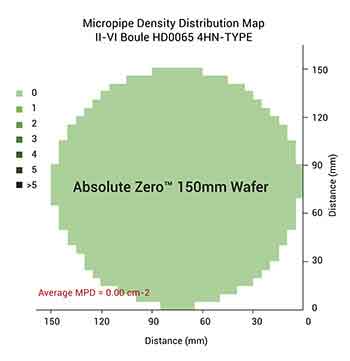
For semiconductor device fabrication, substrate quality is critical. Surface roughness, crystal defects, micropipe density, wafer flatness, thickness tolerance, and contamination control can all affect device yield and performance.
II-VI Wafer Applications
II-VI and related compound semiconductor wafers are used for:
- Infrared optics and IR windows
- Laser and photonics research
- Photodetectors and imaging sensors
- Solar cells and photovoltaic research
- Radiation detectors
- RF and microwave devices
- Power electronics and high-temperature devices
- Epitaxial thin-film growth
- Optical coatings and specialty substrates