
Custom Silicon Wafer Surface Finish Solutions
UniversityWafer supplies custom silicon wafer surface finishes for semiconductor, MEMS, optics, photonics, wafer bonding, and research applications. We provide polished, etched, rough backside, and custom roughness silicon wafers designed to meet specialized substrate requirements.
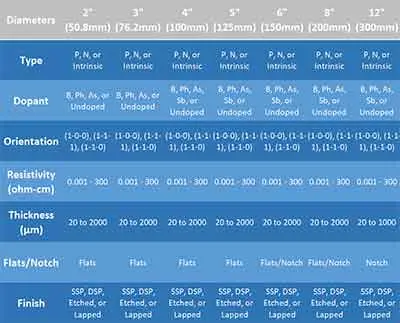
Our silicon substrates are available with custom diameters, thicknesses, orientations, dopants, flats, and surface roughness specifications for advanced semiconductor processing and materials research.
Research Surface Finish Application Example
A research organization requested custom 150mm silicon wafers to be used as flat spacers during a glass annealing process. The application required wafers with controlled surface roughness to help prevent sticking between stacked glass substrates during high-temperature processing.
The researchers originally used single-side polished silicon wafers with the rough backside facing the glass substrate. However, the process required two wafers to be placed back-to-back to achieve the desired rough surface configuration.
The project required:
- 150mm round silicon wafers
- Thickness greater than 0.5 mm
- Double-side rough polished surfaces
- Surface roughness Ra ≥ 10 nm
- Single flat orientation
- Custom flat length specifications
UniversityWafer provided a custom silicon wafer solution with rough polished surfaces and a single flat configuration optimized for thermal annealing and glass spacer applications.
Reference #264002 available for pricing inquiries.
Need Custom Silicon Wafer Surface Finish Specifications? UniversityWafer can supply silicon wafers with custom roughness values, polished surfaces, backside treatments, DSP finishes, SSP finishes, etched surfaces, and wafer flat configurations.
Get Your Silicon Wafer Quote FAST! Or, Buy Online and Start Researching Today!
Important Silicon Wafer Surface Finish Terms
- Polished silicon wafers
- Single side polished wafers (SSP)
- Double side polished wafers (DSP)
- Wafer surface roughness
- Surface roughness Ra
- Chemical mechanical polishing (CMP)
- Backside roughness
- Wafer planarization
- Semiconductor substrate polishing
- Surface quality measurement
- Atomic force microscopy (AFM)
- Silicon wafer processing
- Wafer adhesion surfaces
- Etched silicon wafers
- Semiconductor substrate finish
What is Silicon Wafer Surface Finish?
Silicon wafer surface finish refers to the smoothness, roughness, polish quality, and texture of a semiconductor substrate. Surface finish is an important factor in semiconductor manufacturing because it affects thin film adhesion, photolithography, wafer bonding, optical performance, device yield, and electrical reliability.
The surface finish of a silicon wafer is commonly measured using Ra roughness values, atomic force microscopy (AFM), profilometry, and interferometry techniques. Different semiconductor applications require different levels of wafer smoothness depending on the device structure and fabrication process.
How Is Silicon Wafer Surface Finish Measured?
The surface finish of silicon wafers is evaluated using several semiconductor metrology methods. Common measurements include:
- Ra surface roughness
- Root mean square (RMS) roughness
- Total Thickness Variation (TTV)
- Peak-to-valley measurements
- Atomic force microscopy (AFM)
- Optical interferometry
These measurements help determine whether a silicon substrate is suitable for semiconductor fabrication, MEMS processing, photonics, wafer bonding, epitaxy, or optical applications.
Common Silicon Wafer Surface Finishes
Silicon wafers are available in several surface finish configurations depending on the application requirements.
Single Side Polished (SSP)
Single side polished silicon wafers have one mirror-polished surface and one rough backside. SSP wafers are commonly used in research, semiconductor processing, sensors, and MEMS fabrication.
Double Side Polished (DSP)
Double side polished silicon wafers feature extremely smooth surfaces on both sides of the substrate. DSP wafers are commonly used in photonics, wafer bonding, MEMS devices, optics, and advanced semiconductor applications.
Etched Silicon Wafers
Chemically etched silicon wafers are used to remove surface damage, saw marks, microcracks, and subsurface defects caused by grinding and slicing processes. Etched wafers can also improve backside adhesion and thin film deposition performance.
Chemical Mechanical Polishing (CMP)
Chemical Mechanical Polishing (CMP) is one of the most important finishing techniques used in semiconductor manufacturing. CMP combines chemical reactions and mechanical abrasion to create ultra-flat silicon wafer surfaces with low roughness values.
CMP helps reduce defects, improve surface planarity, and prepare silicon substrates for lithography, deposition, epitaxy, and integrated circuit fabrication.
Why Surface Roughness Matters
Surface roughness directly affects semiconductor device performance. A smoother silicon surface can improve:
- Thin film adhesion
- Optical reflectivity
- Wafer bonding quality
- Photolithography accuracy
- Electrical device reliability
- Semiconductor yield
Rougher backside surfaces are sometimes intentionally used to improve mechanical adhesion or reduce sticking during high-temperature processing.
Low Surface Roughness for Advanced Semiconductor Applications
Advanced semiconductor devices often require ultra-smooth silicon wafer surfaces with roughness values below 1 nm Ra. These low roughness levels are important for:
- MEMS fabrication
- Silicon photonics
- Integrated circuits
- Wafer bonding
- SOI wafer manufacturing
- Thin film deposition
- Quantum device research
Atomic force microscopy and interferometry are commonly used to verify sub-nanometer surface roughness levels in semiconductor substrates.