GaP Wafers for Dielectric Metasurface Fabrication
UniversityWafer supplies gallium phosphide, silicon, silicon dioxide, and custom layered substrates for dielectric metasurfaces, metalenses, nanophotonics, flat optics, beam steering, holography, optical sensing, and integrated photonic device research.
Gallium phosphide (GaP)
is a high-refractive-index semiconductor used in visible and near-infrared photonics. Thin GaP layers can be patterned into nanopillars, nanodisks, nanofins, gratings, and other subwavelength structures designed to control the phase, polarization, intensity, and direction of light.
Researchers may require standalone GaP wafers, GaP films on insulating layers, or multilayer structures such as GaP on SiO₂ on silicon. The most suitable structure depends on the operating wavelength, metasurface geometry, optical simulation, lithography process, etching method, and required refractive-index contrast.
Research Request for GaP on SiO₂ on Silicon
A Ph.D. candidate researching artificial intelligence, robotics, and photonic systems requested pricing for a custom substrate intended for dielectric metasurface fabrication.
I am interested in purchasing a layered wafer with the following specifications:
-
Layer structure:
Silicon
/
SiO₂
/
GaP
-
Wafer diameter: 3 inches or 4 inches
-
Silicon dioxide thickness: 1 µm
-
Gallium phosphide thickness: 110 nm
-
Silicon substrate thickness: Approximately 575 µm
-
Silicon conductivity: Not critical
-
Silicon crystal orientation: Not critical
-
Primary requirement: The fabrication method should provide the highest practical GaP crystalline and surface quality
The substrate will be used to fabricate GaP dielectric metasurfaces for photonic applications.
Reference #323520 for specifications and pricing.
Why Use a GaP/SiO₂/Si Layer Structure?
A GaP/SiO₂/Si substrate combines three materials with different optical and mechanical properties. The high-index GaP layer can form the active metasurface, the lower-index SiO₂ layer can provide optical isolation and refractive-index contrast, and the silicon wafer can provide mechanical support during lithography, etching, handling, and characterization.
-
GaP layer: Provides a high-index material for resonant dielectric nanostructures.
-
SiO₂ layer: Functions as a low-index spacer, optical isolation layer, or etch-stop layer.
-
Silicon substrate: Provides a stable and widely compatible platform for semiconductor processing.
The thickness of the GaP and SiO₂ layers can influence optical confinement, resonance wavelength, transmission, reflection, and coupling between the metasurface and the underlying substrate. Researchers should select these dimensions using electromagnetic simulations and the intended operating wavelength.
Important GaP Metasurface Substrate Specifications
When requesting a GaP substrate for dielectric metasurface fabrication, consider providing the following information:
- Wafer diameter or diced-piece dimensions
- GaP layer thickness and thickness tolerance
- SiO₂ thickness and uniformity
- Silicon substrate thickness
- GaP crystal orientation
- Surface polish and roughness
- Required crystalline quality
- Defect-density requirements
- Layer-stress and bow requirements
- Operating wavelength
- Planned lithography and etching process
- Requested quantity
Choosing the GaP Integration Method
The method used to place GaP on an insulating layer can affect crystal quality, interface quality, surface roughness, stress, wafer bow, layer uniformity, and fabrication cost.
Potential approaches may include:
-
Direct wafer bonding: A thin GaP layer may be transferred and bonded to an oxidized silicon substrate.
-
Layer transfer: A high-quality crystalline GaP layer may be transferred from a donor wafer to another substrate.
-
Epitaxial growth: GaP may be grown on a compatible crystalline surface, although lattice mismatch and defect formation must be considered.
-
Deposition of non-single-crystalline GaP: This may be suitable for some applications but may not provide the same optical or structural quality as single-crystal material.
For high-performance dielectric metasurfaces, researchers commonly prioritize a smooth GaP surface, controlled thickness, low optical absorption, consistent refractive index, and compatibility with nanoscale pattern transfer.
Applications for GaP Dielectric Metasurfaces
GaP-based metasurface substrates may support research involving:
- Visible and near-infrared metalenses
- Flat optical components
- Beam steering and LiDAR
- Optical holography
- Polarization control
- Nonlinear optical devices
- Optical and biological sensors
- Augmented and virtual reality optics
- Quantum photonics
- Integrated photonic circuits
- Compact imaging systems
Learn more about
photonic applications
,
nanostructures
,
and
silicon photonics
.
Request GaP Metasurface Substrate Pricing
Send us your required wafer diameter, GaP thickness, SiO₂ thickness, silicon substrate thickness, surface-finish requirements, crystal orientation, operating wavelength, quantity, and any special optical or fabrication requirements.
Get Your GaP Metasurface Substrate Quote FAST!
Or,
Buy Substrates Online
and start researching today!
What Are Dielectric Metasurfaces?
A dielectric metasurface is an ultrathin optical structure made from a carefully arranged array of nanoscale dielectric elements. These elements are smaller than the wavelength of light and are designed to control how electromagnetic waves are transmitted, reflected, focused, or redirected.
Unlike conventional optical components that rely on curved surfaces and propagation through thick materials, dielectric metasurfaces manipulate light at the surface. This allows researchers to develop compact optical devices with functions similar to lenses, prisms, waveplates, filters, and holographic elements.
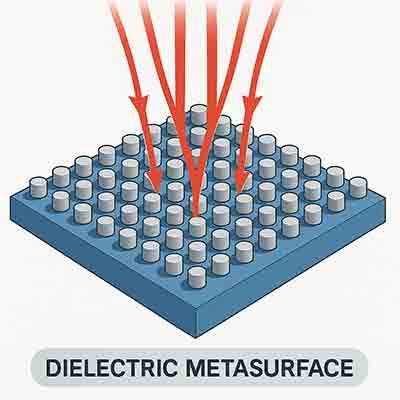 A metasurface is often described as a two-dimensional version of a metamaterial. It consists of patterned nanoscale structures called meta-atoms or nanoresonators. Their size, shape, spacing, orientation, and refractive index determine how the surface interacts with light.
Common dielectric metasurface materials include silicon, gallium phosphide, gallium nitride, titanium dioxide, silicon nitride, and germanium. These high-refractive-index materials can support strong optical resonances while maintaining lower absorption than many metallic alternatives.
How Do Dielectric Metasurfaces Work?
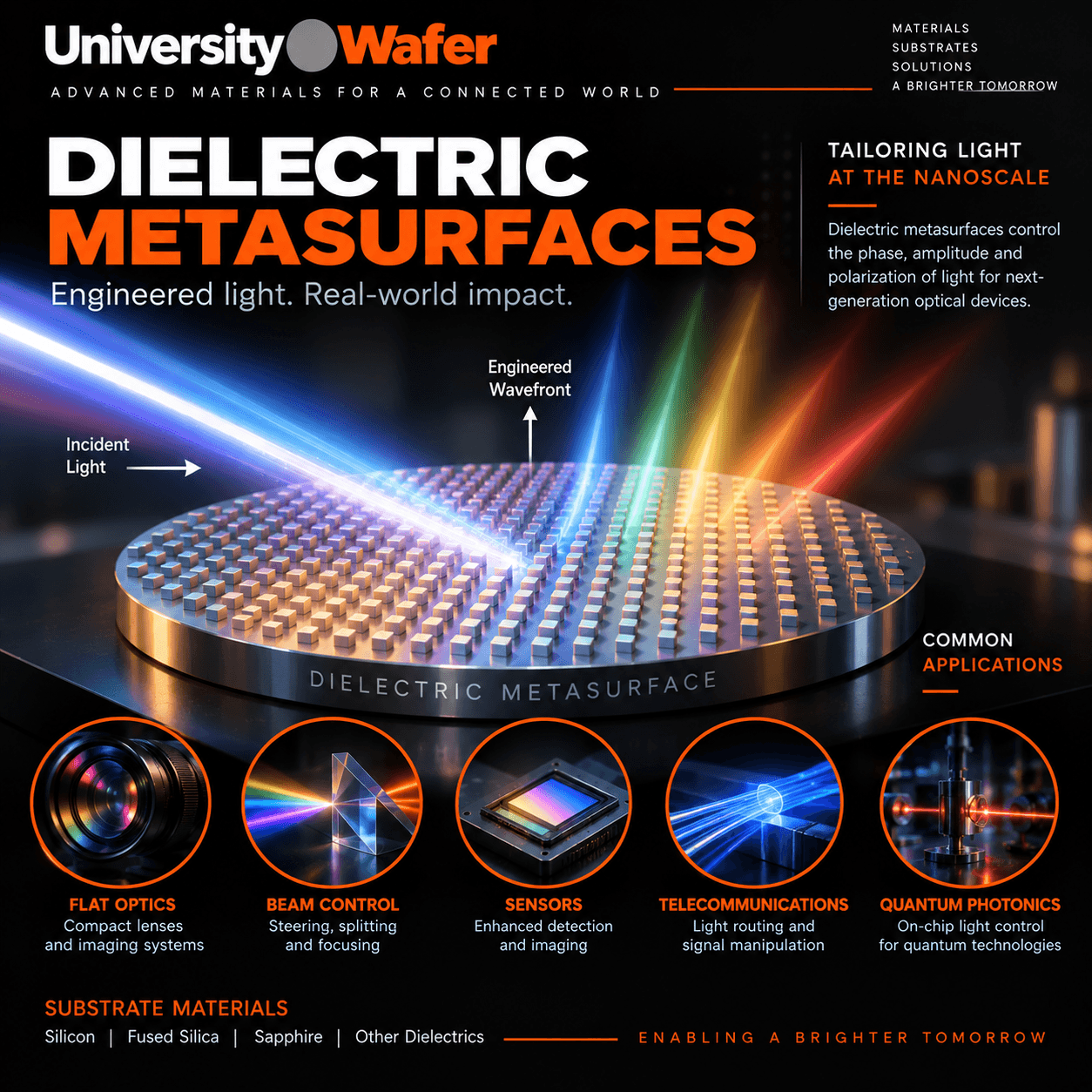
Dielectric metasurfaces control light through interactions between electromagnetic waves and nanoscale resonators. Each resonator introduces a specific change in the phase, amplitude, or polarization of the incident light.
By varying the geometry of the nanostructures across the surface, researchers can create a controlled optical response. For example, the resonators can be arranged so that different parts of an incoming wave are delayed by different amounts, causing the wavefront to bend or focus.
Many dielectric metasurfaces rely on Mie resonances. These occur when light excites electric and magnetic resonant modes within a high-index dielectric nanostructure. By engineering these resonances, metasurfaces can achieve efficient optical control without depending on metallic plasmonic effects.
Properties of Light Controlled by Metasurfaces
-
Phase: Controls the shape and direction of the optical wavefront for focusing, beam steering, and holography.
-
Amplitude: Adjusts the intensity of transmitted or reflected light.
-
Polarization: Rotates polarization or converts light between linear, circular, and elliptical polarization states.
-
Wavelength: Enables selective transmission, reflection, filtering, and spectral separation.
-
Direction: Redirects light into controlled angles or diffraction orders.
Why Use Dielectric Instead of Metallic Metasurfaces?
Early metasurface designs frequently used metallic nanostructures and plasmonic resonances. Although metallic metasurfaces can strongly confine light, metals often absorb part of the optical energy and convert it into heat.
Dielectric metasurfaces can offer lower optical absorption, reduced heat generation, and improved transmission efficiency. High-index dielectric materials also support both electric and magnetic resonances, giving researchers greater control over the optical response.
Important advantages may include:
- Lower absorption than many plasmonic structures
- High transmission and reflection efficiency
- Reduced optical heating
- Precise phase and polarization control
- Compatibility with semiconductor fabrication methods
- Potential integration with photonic and electronic devices
- Operation across visible, near-infrared, and infrared wavelengths
Common Materials for Dielectric Metasurfaces
Material selection depends on the operating wavelength, refractive index, absorption, fabrication process, substrate compatibility, and final device application.
Gallium Phosphide
Gallium phosphide (GaP) has a high refractive index and can provide low optical absorption across portions of the visible and near-infrared spectrum. GaP is investigated for metalenses, nonlinear optics, holography, resonant nanostructures, and integrated photonic devices.
Silicon
Silicon wafers are widely used for near-infrared and infrared metasurfaces because silicon offers a high refractive index and compatibility with established semiconductor processing techniques.
Silicon Dioxide
Silicon dioxide can serve as an optical spacer, buried layer, cladding material, or low-index region beneath a high-index metasurface layer. SiO₂ thickness can affect resonance behavior, optical confinement, and interference.
Gallium Nitride
Gallium nitride is useful for visible and ultraviolet photonics because of its wide bandgap, optical transparency, and compatibility with light-emitting and nonlinear optical devices.
Silicon Nitride
Silicon nitride offers a balance of optical transparency, moderate refractive index, low propagation loss, and compatibility with integrated photonics.
Titanium Dioxide
Titanium dioxide has a high refractive index and can maintain relatively low optical loss in the visible spectrum. It is commonly studied for visible-light metalenses, holograms, polarization optics, and compact imaging systems.
Dielectric Metasurface Applications
Metalenses and Flat Optics
A metalens uses patterned nanoscale resonators to focus light without the curved surfaces found in traditional lenses. Metalenses can reduce the size and weight of optical systems used in cameras, microscopes, sensors, and portable devices.
Beam Steering
Metasurfaces can redirect optical beams by introducing a controlled phase gradient across the device. Potential applications include LiDAR, autonomous sensing, optical communications, laser scanning, and augmented-reality systems.
Holography
Carefully designed metasurfaces can reconstruct complex optical wavefronts and generate high-resolution holographic images. Dielectric materials can improve holographic efficiency by reducing absorption losses.
Optical Sensing
Metasurface resonances can shift when the surrounding refractive index changes. This makes the structures useful for detecting gases, chemicals, biomolecules, temperature changes, and other environmental conditions.
Polarization Control
Anisotropic nanostructures can function as ultrathin waveplates, polarization converters, and polarizers. These devices can be integrated into imaging systems, optical communications, and measurement instruments.
Quantum Photonics
Dielectric metasurfaces are being studied for controlling single photons, tailoring spontaneous emission, generating entangled photon states, and coupling light into integrated photonic circuits.
Nonlinear Optics
Resonant dielectric nanostructures can enhance local electromagnetic fields and support nonlinear optical processes such as harmonic generation, frequency conversion, and all-optical switching.
Fabricating Dielectric Metasurfaces
Dielectric metasurfaces are commonly fabricated using semiconductor and nanofabrication processes. The exact workflow depends on the material, pattern dimensions, wafer structure, and required optical performance.
Typical fabrication steps may include:
- Selecting a suitable wafer or layered substrate
- Depositing or growing the high-index dielectric layer
- Applying an electron-beam or photolithography resist
- Patterning the nanoscale metasurface design
- Transferring the pattern using reactive ion etching
- Removing the remaining resist and cleaning the surface
- Measuring the optical response and comparing it with simulations
Researchers may use nanostructures such as nanopillars, nanodisks, nanofins, gratings, holes, or rectangular resonators. Small changes in dimensions can significantly alter the phase response, resonance wavelength, and polarization behavior.
Important Substrate Considerations
The quality and structure of the starting wafer can directly affect metasurface fabrication and optical performance. Important specifications may include:
- Dielectric layer thickness
- Refractive-index contrast
- Wafer diameter and thickness
- Surface roughness and polish
- Crystal quality and defect density
- Film stress and adhesion
- Layer-thickness uniformity
- Compatibility with lithography and etching
- Optical transparency at the operating wavelength
Structures such as GaP on SiO₂ on silicon can provide a high-index metasurface layer above a low-index optical spacer and mechanically stable silicon substrate. The thickness of each layer should be selected according to the intended wavelength, resonator geometry, fabrication method, and optical simulation results.
Dielectric Metasurfaces for Compact Photonic Devices
Dielectric metasurfaces provide a way to replace or supplement bulky optical components with thin, patterned semiconductor surfaces. By engineering nanoscale resonators, researchers can control phase, intensity, polarization, wavelength, and propagation direction within a compact device.
These capabilities make dielectric metasurfaces valuable for metalenses, flat optics, LiDAR, AR/VR, optical communications, holography, sensing, nonlinear optics, and quantum photonics. Selecting the appropriate wafer material and layer structure is an important first step toward achieving the required optical performance.
Related Dielectric Metasurface Resources
-
Gallium Phosphide (GaP) Wafers – High-refractive-index substrates for dielectric metasurfaces, metalenses, nonlinear optics, and visible photonics.
-
Photonic Applications – Semiconductor substrates used for integrated photonics, optical communications, and advanced photonic devices.
-
Silicon Photonics – Silicon-based platforms for optical interconnects, waveguides, modulators, and photonic integrated circuits.
-
Nanostructures – Learn about nanopillars, nanodisks, gratings, and other structures used in dielectric metasurface fabrication.
-
Silicon Wafers – Prime and research-grade silicon substrates for photonics, MEMS, and nanofabrication.
-
Thermal Oxide Silicon Wafers – Silicon substrates with high-quality SiO₂ layers for optical isolation and dielectric metasurfaces.
-
Silicon Nitride Wafers – LPCVD and PECVD silicon nitride substrates for integrated photonics and optical waveguides.
-
Gallium Nitride (GaN) Wafers – Wide-bandgap semiconductor substrates for visible photonics, LEDs, and metasurface research.
-
Sapphire Wafers – Optical-grade sapphire substrates for photonic devices, epitaxy, and nanostructured optics.
-
Silicon-on-Insulator (SOI) Wafers – High-performance substrates for integrated photonic circuits and optical MEMS.
-
Graphene Substrates – Materials for advanced optoelectronics, photodetectors, and next-generation photonic devices.
-
Research Substrates – Browse semiconductor wafers for photonics, optics, nanotechnology, MEMS, and semiconductor fabrication.
