What is E-Gun Evaporation Deposition?
Electron beam evaporation, also known as e-gun deposition, is a widely used physical vapor deposition (PVD) process for creating high-purity thin films on silicon wafers, sapphire substrates, quartz wafers, fused silica, and other advanced materials. Researchers and engineers use e-beam evaporation to deposit metals, dielectric coatings, optical films, DBR mirrors, anti-reflective coatings, and semiconductor device layers with precise thickness control and excellent film uniformity. This guide explains how electron beam evaporation works, common applications, deposition materials, and substrate selection for research and production environments.
Custom Electron Beam Evaporation for DBR Mirrors and Thin Film Coatings
Researchers developing photonic devices, optical sensors, laser systems, and semiconductor components often require custom electron beam evaporation (e-gun deposition) services to create precision multilayer thin films. One common application is the fabrication of Distributed Bragg Reflectors (DBR mirrors) using alternating dielectric layers with carefully controlled thicknesses.
Researcher Request:
A customer requested custom deposition of dielectric thin films consisting of alternating SiO₂ and HfO₂ layers for a DBR mirror structure. The design required deposition onto a silicon substrate with a 1000nm SiO₂ layer and additional coatings on quartz substrates.
Required structure:
Substrate // (58nm HfO₂ / 81nm SiO₂)10 // Air
The customer also requested a second coating consisting of 5 additional DBR periods after device fabrication.
UniversityWafer, Inc. Quoted:
- E-Gun deposition of 10 alternating layers of HfO₂ and SiO₂.
- E-Gun deposition of 5 alternating layers of HfO₂ and SiO₂.
- Customer-supplied substrates accepted.
- Lot size equivalent to seven 100mm wafers.
- Precision thin film thickness control.
Reference #ONLQ36517 for specifications and pricing.
Get Your Thin Film Deposition Quote FAST! Or, Buy Online and Start Researching Today!
What Is Hafnium Oxide (HfO₂) Used For?
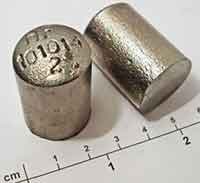 Hafnium oxide (HfO₂) is one of the most important dielectric materials used in modern semiconductor manufacturing, optical coatings, photonics, and microelectronics. Because of its high dielectric constant, excellent thermal stability, and optical properties, HfO₂ is commonly deposited using electron beam evaporation, sputtering, atomic layer deposition (ALD), and other thin film deposition techniques.
In semiconductor devices, hafnium oxide is widely used as a high-k dielectric material in transistors, capacitors, memory devices, and advanced integrated circuits. In optics, HfO₂ is frequently combined with SiO₂ to create high-performance dielectric mirrors, anti-reflection coatings, and optical filters.
Common Applications of Hafnium Oxide Thin Films
- Distributed Bragg Reflectors (DBR Mirrors)
- Laser Optics
- Optical Filters
- High-k Dielectric Layers
- MEMS Devices
- Photonic Components
- Integrated Circuits
- Semiconductor Gate Oxides
- Optical Waveguides
- High-Temperature Coatings
Hafnium is typically found with zirconium-containing minerals and is separated through specialized refining processes. The resulting material exhibits excellent chemical stability, corrosion resistance, and high-temperature performance, making it valuable in both electronic and optical applications.
Video Resource: What is Hafnium Oxide (HfO₂)?
Important Electron Beam Evaporation Terms
- Electron Beam Evaporation
- E-Gun Deposition
- Physical Vapor Deposition (PVD)
- Thin Film Deposition
- Vacuum Vaporization
- Thermal Evaporation
- Dielectric Coatings
- Optical Thin Films
- Deposition Rate Control
- High Vacuum Processing
- Multilayer Coatings
- DBR Mirrors
- Hafnium Oxide (HfO₂)
- Silicon Dioxide (SiO₂)
- Optical Filter Fabrication
- Semiconductor Thin Films
What is Electron Beam Evaporation (E-Beam Deposition)?
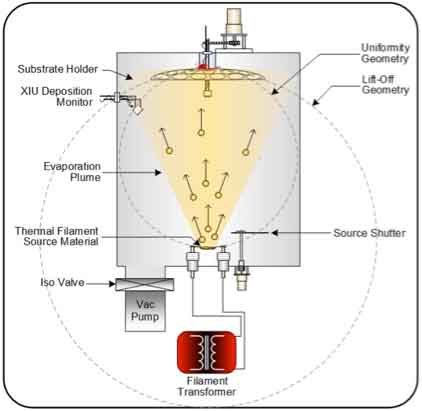 Electron beam evaporation, often called e-gun evaporation or e-beam deposition, is a high-vacuum Physical Vapor Deposition (PVD) process used to deposit thin films onto semiconductor wafers, optical substrates, glass, quartz, sapphire, and other materials. A focused electron beam heats a source material until it evaporates, allowing vaporized atoms to condense onto a substrate and form a highly uniform thin film.
This deposition technique is widely used for optical coatings, dielectric films, semiconductor devices, MEMS fabrication, photonics, sensors, solar cells, and advanced research applications requiring precise film thickness and excellent coating uniformity.
How Does E-Gun Evaporation Work?
In an electron beam evaporation system, electrons are generated from a heated filament and accelerated toward a target material under high vacuum conditions. The kinetic energy of the electrons is converted into thermal energy when they strike the source material, causing it to melt and evaporate.
The vaporized atoms travel through the vacuum chamber and condense onto the substrate surface, creating a controlled thin-film coating. Because the material is heated directly, electron beam evaporation can process materials with extremely high melting points that are difficult to deposit using conventional thermal evaporation.
Key Advantages of Electron Beam Evaporation
- High deposition rates
- Excellent film purity
- Low substrate contamination
- Precise thickness control
- High material utilization efficiency
- Compatible with metals, oxides, and dielectric materials
- Suitable for multilayer optical coatings
- Excellent uniformity across wafer surfaces
E-Beam Evaporation vs. Sputtering
| Feature |
Electron Beam Evaporation |
Sputtering |
| Deposition Method |
Material Evaporation |
Ion Bombardment |
| Deposition Rate |
High |
Moderate |
| Film Purity |
Excellent |
Very Good |
| High Melting Point Materials |
Excellent |
Good |
| Optical Coatings |
Excellent |
Excellent |
| Multilayer Films |
Excellent |
Excellent |
Common Materials Deposited by Electron Beam Evaporation
E-gun deposition systems can deposit a wide range of metals, oxides, and dielectric materials used throughout semiconductor manufacturing and optical engineering.
- Silicon Dioxide (SiO₂)
- Hafnium Oxide (HfO₂)
- Titanium Dioxide (TiO₂)
- Aluminum Oxide (Al₂O₃)
- Gold (Au)
- Platinum (Pt)
- Silver (Ag)
- Aluminum (Al)
- Chromium (Cr)
- Titanium (Ti)
Dielectric Bragg Mirrors (DBR Mirrors)
One of the most common applications of electron beam evaporation is the fabrication of Distributed Bragg Reflectors (DBR mirrors). These optical structures consist of alternating layers of materials with different refractive indices.
Typical DBR mirror designs use alternating SiO₂ and HfO₂ thin films deposited onto silicon, quartz, sapphire, or fused silica substrates. These multilayer coatings provide high reflectivity and are used in:
- Laser systems
- Photonic devices
- Optical resonators
- Waveguides
- Quantum optics research
- Semiconductor lasers
- Telecommunications equipment
Applications of Electron Beam Evaporation
Electron beam evaporation is used across numerous industries and research fields.
- Semiconductor Manufacturing – thin-film electronics and integrated circuits
- Photonics – optical coatings, mirrors, and waveguides
- MEMS Devices – sensors and microstructures
- Solar Cells – conductive and dielectric coatings
- Medical Devices – biocompatible coatings
- Aerospace Components – thermal barrier coatings
- Automotive Electronics – wear-resistant thin films
- Research Laboratories – custom thin-film development
Silicon Substrates for E-Beam Deposition
Silicon wafers are among the most widely used substrates for electron beam evaporation because they offer excellent surface quality, thermal stability, and compatibility with semiconductor processing.
Common thin films deposited onto silicon substrates include SiO₂, HfO₂, TiO₂, aluminum, chromium, gold, platinum, and multilayer dielectric stacks for MEMS, photonics, and microelectronics applications.
Typical Electron Beam Evaporation Process Flow
- Clean the substrate surface.
- Load the substrate into the vacuum chamber.
- Load source material into the crucible.
- Evacuate the chamber to high vacuum.
- Generate and focus the electron beam.
- Evaporate the source material.
- Monitor deposition rate and film thickness.
- Deposit the desired coating.
- Cool the system and unload substrates.
- Inspect the thin-film coating using SEM, AFM, or optical characterization methods.
Related Thin Film Deposition Resources
