
Get Your Silicon Battery Research Substrates FAST!
UniversityWafer, Inc. supplies silicon wafers and substrates for researchers investigating next-generation lithium-ion batteries, silicon anodes, thin-film electrodes, lithiation behavior, interface engineering and advanced energy-storage materials.
Silicon can store substantially more lithium per unit mass than conventional graphite, making it an important candidate for high-energy-density anodes. However, silicon also undergoes major dimensional changes during lithiation, creating challenges involving mechanical stress, cracking, electrical contact and solid-electrolyte interphase (SEI) stability.
Get Your Silicon Battery Research Quote FAST! Or, Buy Online and Start Researching Today!
Silicon Specifications for Battery Research
There is no single silicon specification used for every silicon-anode experiment. Researchers select silicon properties according to the electrode structure, deposition process, electrochemical test and characterization method being investigated.
| Silicon Property | Research Options | Why It Matters |
|---|---|---|
| Crystal Orientation | (100), (110), (111) | Useful for studying orientation-dependent lithiation, expansion, stress and surface reactions in crystalline silicon. |
| Conductivity Type | P-Type or N-Type | Allows researchers to investigate how substrate electrical properties and doping influence silicon electrodes and electrochemical interfaces. |
| Resistivity | Low to High Resistivity | Provides control over substrate conductivity for electrical, electrochemical and materials characterization experiments. |
| Surface Finish | Single-Side or Double-Side Polished | Smooth, controlled surfaces are useful for thin-film deposition, coatings, microscopy, surface analysis and interface studies. |
| Surface Oxide | Bare Silicon or Thermal SiO2 | Enables comparative studies of silicon surfaces, insulating layers, passivation, coatings and engineered interfaces. |
| Wafer Thickness | Standard or Custom Thicknesses | Thickness can be selected for mechanical testing, device fabrication, deposition processes and experimental handling. |
| Wafer Size | Multiple Diameters and Pieces | Researchers can select substrate dimensions appropriate for laboratory-scale experiments, characterization and process development. |
How UniversityWafer Can Help Silicon Battery Researchers
UniversityWafer can provide controlled silicon substrates that give battery researchers a reproducible platform for studying the fundamental behavior of silicon during lithium insertion and extraction. Rather than relying only on complex commercial electrode mixtures, researchers can use well-defined silicon wafers to isolate variables such as crystal orientation, doping, resistivity, surface condition and oxide thickness.
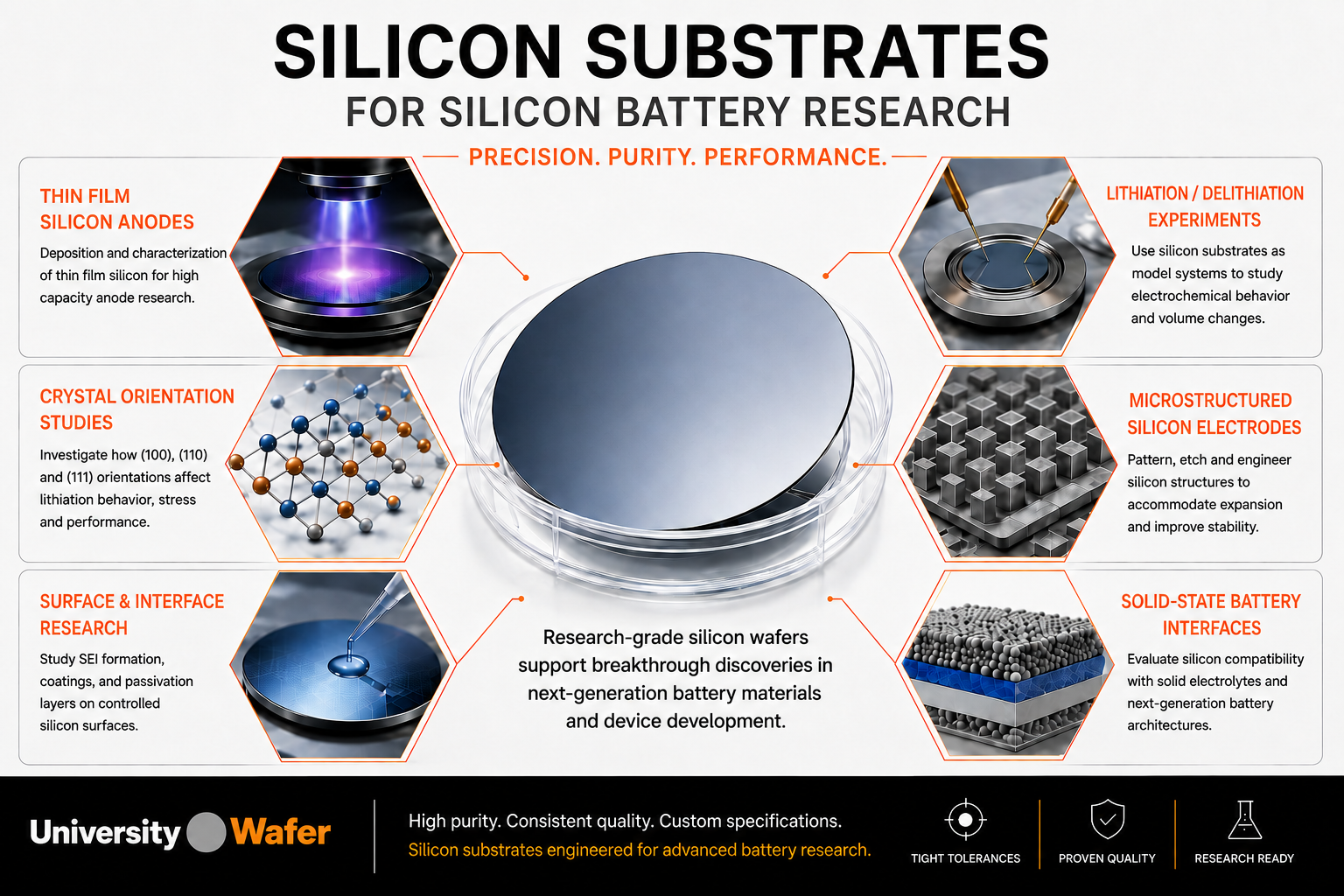
Silicon wafers can serve as research platforms for depositing and characterizing silicon-based electrode films, investigating lithiation-induced stress and cracking, studying SEI formation, evaluating surface treatments and coatings, developing microstructured electrodes, and examining interfaces for conventional and solid-state battery systems.
Research Applications Include:
- Silicon anode and lithium-ion battery research
- Thin-film silicon electrode development
- Lithiation and delithiation studies
- Crystal-orientation comparison studies
- SEI and silicon/electrolyte interface research
- Mechanical stress and fracture characterization
- Surface coatings and passivation experiments
- Microstructured and patterned silicon electrodes
- Solid-state battery interface research
- Electrochemical and materials characterization
Need a specific silicon wafer configuration? Tell us the orientation, conductivity type, resistivity, diameter, thickness, surface finish and oxide requirements for your experiment. UniversityWafer can help identify substrate options for your silicon battery research project.
Why Silicon Is Being Studied for Next-Generation Batteries
Silicon is one of the most promising materials being investigated for next-generation lithium-ion battery anodes. At room temperature, silicon can theoretically store approximately 3,579 mAh/g of charge through the formation of Li15Si4, compared with approximately 372 mAh/g for conventional graphite. This high theoretical capacity makes silicon especially attractive for applications where reducing battery weight while increasing stored energy is important.
Silicon-based anodes are being investigated for electric vehicles, portable electronics, drones, aerospace systems and other applications that benefit from higher specific energy. Researchers are also studying silicon interfaces for emerging solid-state battery architectures.
The Challenge: Silicon Expands During Lithiation
Silicon's high lithium-storage capacity also creates one of its greatest engineering challenges. During lithiation, silicon can undergo volume changes approaching 300%. Repeated expansion and contraction during charge and discharge can generate mechanical stress, fracture silicon structures, disrupt electrical contact and continually expose new surfaces to the electrolyte.
These newly exposed surfaces can promote repeated formation of the solid-electrolyte interphase (SEI). The resulting electrolyte consumption, increasing impedance and loss of electrically connected active material can contribute to capacity fade. Controlling these electrochemical and mechanical effects is therefore a major focus of silicon-anode research.
Why Silicon Crystal Orientation Matters
Single-crystal silicon wafers provide researchers with a controlled platform for studying how crystallographic orientation affects lithiation. Lithium insertion into crystalline silicon is anisotropic, meaning that the reaction and resulting dimensional changes can vary with crystallographic direction.
Research has shown important differences among Si (100), Si (110) and Si (111) surfaces. This makes orientation-controlled silicon wafers useful for experiments investigating lithium transport, phase transformation, stress generation, fracture behavior and silicon-electrolyte interfaces.
Crystalline vs. Amorphous Silicon Anodes
Both crystalline and amorphous silicon are studied as battery electrode materials. Crystalline silicon provides well-defined crystallographic surfaces that are valuable for fundamental studies of orientation-dependent lithiation and mechanical behavior. Amorphous silicon does not exhibit the same crystallographic anisotropy and is frequently investigated in thin-film and engineered electrode structures.
Silicon wafers can also act as starting substrates or experimental platforms for deposition, patterning, etching, coating and microfabrication processes used to investigate advanced silicon electrode architectures.
Silicon Size and Structure Matter
Researchers have investigated silicon across many length scales, including thin films, nanoparticles, microparticles, nanowires, porous structures and microstructured electrodes. Reducing feature dimensions or creating structures that provide room for expansion can help researchers investigate methods of accommodating the large dimensional changes associated with lithiation.
Silicon-carbon and silicon-graphite composite electrodes are another important research direction. Carbon-containing structures can improve electrical connectivity and help accommodate some of the mechanical changes associated with silicon while retaining compatibility with established lithium-ion electrode concepts.
Silicon Wafer Research Platforms
Although commercial silicon-anode batteries do not necessarily use conventional semiconductor wafers as the final active material, research-grade silicon wafers provide a valuable model system for understanding the fundamental behavior of silicon.
A wafer provides researchers with a reproducible surface whose crystal orientation, conductivity type, resistivity, thickness and surface condition can be specified. Researchers can then change one experimental variable at a time and examine how it affects electrochemical, structural or mechanical behavior.
Silicon wafers can support research involving:
- Thin-film silicon anode deposition
- Controlled lithiation and delithiation experiments
- Orientation-dependent expansion studies
- Stress, cracking and fracture characterization
- SEI formation and surface chemistry
- Silicon/electrolyte interface studies
- Surface coatings and passivation layers
- Patterned and microstructured silicon electrodes
- Electrochemical characterization
- Solid-state electrolyte interface research
Silicon Anodes and High-Energy-Density Batteries
Progress in silicon-anode technology is moving beyond laboratory demonstrations toward increasingly practical high-energy cells. In September 2026, Amprius Technologies announced a second-generation SiCore battery cell reaching 500 Wh/kg at a continuous 1C discharge rate. The company states that the cell is designed to be manufactured using conventional lithium-ion battery production equipment.
Developments like these demonstrate why understanding silicon electrochemistry, interfaces, mechanical behavior and material structure remains an important area of battery research. Improvements in silicon-based anodes could help enable lighter batteries with increased energy storage for aviation, electric transportation, robotics and other weight-sensitive applications.
Choosing Silicon for Your Battery Research
There is no single silicon specification that is ideal for every battery experiment. The appropriate substrate depends on the question being investigated. Crystal orientation may be important for lithiation mechanics, while resistivity and doping may be important for electrical studies. Surface finish can influence deposition and interface characterization, while bare silicon and oxidized silicon can provide different starting surfaces for coatings and interface experiments.
UniversityWafer, Inc. helps researchers select silicon substrates according to the requirements of their experiment. When requesting a substrate, consider specifying the desired crystal orientation, conductivity type, resistivity, wafer diameter, thickness, surface finish and whether bare silicon or an oxide surface is required.
From Silicon Research to Better Batteries
Developing practical silicon anodes requires understanding how silicon responds simultaneously to lithium insertion, mechanical stress, electrical transport and changing interfaces. Controlled silicon substrates give researchers a way to isolate these effects and develop experiments that can be reproduced and compared.
Whether your project involves fundamental silicon lithiation, thin-film electrodes, surface modification, microstructured anodes or solid-state battery interfaces, UniversityWafer can provide silicon substrate options for advanced battery materials research.
Related Links
- Silicon Wafers – Research-grade silicon substrates available in a variety of orientations, resistivities, thicknesses and surface finishes.
- Thermal Oxide Silicon Wafers – Explore SiO2-coated silicon substrates for surface, interface, coating and materials research.
- Amorphous Silicon – Learn about amorphous silicon materials and their use in thin-film and advanced materials research.
- Silicon Wafer Dicing – Learn about silicon wafer dicing for researchers requiring smaller substrate dimensions and custom pieces.
- Silicon Wafer Applications – Discover how silicon substrates are used across semiconductor, materials science and advanced research applications.