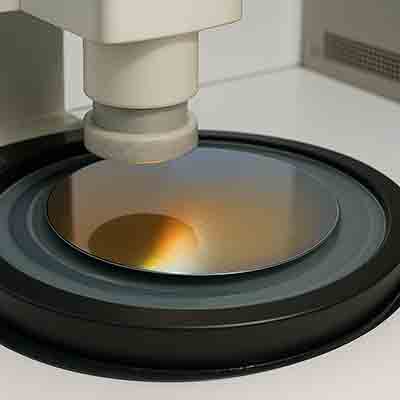
Choose from silicon, sapphire, SiC, LiNbO₃, and GaAs substrates
with flatness down to nanometer precision and verified surface quality.
Get Your Quote FAST! Or, Buy Online and Start Researching Today!
Wafer Polishing — Key Insights
Wafer polishing defines the final quality of semiconductor materials.
It determines flatness, smoothness, and how well thin films adhere during processing.
Core Facts
Goal: Achieve atomic-level flatness and uniform thickness across the wafer.
Main process: Chemical Mechanical Polishing (CMP) combines chemical etching with mechanical removal.
Precision level: Material removal ≈2,000–6,000 Å/min with planarity down to nanometers.
Types of Polishing
SSP (Single-Side): One surface polished—good for moderate accuracy and cost-effective runs.
DSP (Double-Side): Both sides polished simultaneously—improves thickness uniformity, bow, and warp.
Applications
Used for silicon, SiC, sapphire, and LiNbO₃ wafers.
Critical in MEMS, RF, optical, and quantum device fabrication.
Prepares surfaces for thin-film deposition and bonding.
Advantages
Improves device yield and film adhesion.
Reduces defects, stress, and contamination.
Enhances reliability and performance consistency.
Quick Takeaway
Controlled wafer polishing transforms rough substrates into precision optical-grade materials,
ensuring every subsequent layer—from epitaxy to packaging—meets advanced semiconductor standards.
Why Polishing Matters
Mirror-flat, defect-free wafers raise device yield and reliability, enable ultra-thin films,
and support next-gen electronics from smartphones to AI systems. :contentReference[oaicite:0]{index=0} :contentReference[oaicite:1]{index=1}
CMP — What It Is & Why It Wins
Chemical Mechanical Polishing (CMP) blends controlled chemical reactions with gentle
abrasion to remove material efficiently (≈2,000–6,000 Å/min), delivering global
planarization for multilayer chips and enabling copper damascene interconnects. :contentReference[oaicite:2]{index=2} :contentReference[oaicite:3]{index=3}
Flatter surfaces → easier lithography across 15+ interconnect layers. :contentReference[oaicite:4]{index=4}
Fewer defects → higher yield and consistency. :contentReference[oaicite:5]{index=5}
Single- vs Double-Sided Polishing
SSP perfects one face and keeps the backside rougher (simpler, cost-effective),
but thickness variation is higher—fine when only one surface is used. :contentReference[oaicite:6]{index=6}
DSP polishes both faces simultaneously—tightens TTV, reduces bow/warp, and
balances stress for high-precision builds or two-sided processing. :contentReference[oaicite:7]{index=7}
Thin-Film Deposition Depends on Polish
Ultra-thin films (gate oxides, high-k, barriers) demand ultra-smooth, clean, damage-free
and flat substrates; surface energy uniformity improves nucleation for PVD, CVD, and
ALD. Poor polish → discontinuities and catastrophic defects at nanometer scales. :contentReference[oaicite:8]{index=8}
For HEMTs and precision optical coatings, atomic-scale roughness control is critical to
mobility and spectral performance. :contentReference[oaicite:9]{index=9}
Automated inspection + QMS/AI spot patterns and predict issues for proactive fixes. :contentReference[oaicite:16]{index=16}
Trends in Polishing Technology
New selective slurries, better pad conditioning, and adaptive/automated controls with
in-situ sensing improve removal rates and consistency—supporting thinner wafers and
exotic materials with lower environmental impact. :contentReference[oaicite:17]{index=17}
Environmental and Process Innovations
Modern CMP uses low-waste slurries and closed-loop filtration systems
to reduce particle contamination and slurry disposal volumes.
Advanced pad conditioners extend lifetime and improve uniformity,
lowering cost per wafer and minimizing environmental impact.
Some fabs now integrate in-situ sensors that monitor polishing rate in real time,
automatically adjusting pressure and slurry flow for precision consistency.
Key Takeaways
CMP delivers planar, mirror-like surfaces at nanometer precision. :contentReference[oaicite:18]{index=18}
DSP > SSP for uniformity, bow/warp control, and stress balance. :contentReference[oaicite:19]{index=19}
Surface quality directly ties to device reliability, power efficiency, and lifetime. :contentReference[oaicite:20]{index=20}