
Request a Quote or Learn More
Researchers developing MEMS microphones, speakers, or acoustic sensors can use this form to request wafer samples, small lots, or material advice. Our engineering team will help you match substrate specifications to your R&D stage—prototype, validation, or pre-production.
Get wafers engineered for next-generation earbuds, microphones, and acoustic MEMS devices. UniversityWafer helps bridge your design from concept to fabrication—fast.
Get Your Quote FAST! Or, Buy Online and Start Researching Today!
How We Help
UniversityWafer.com supports R&D teams by providing:
- Small-lot orders and custom sizes
- Fast turnaround for prototyping
- Material consultation for MEMS and piezo applications
- Options for bonding, oxide/nitride stacks, and polished surfaces
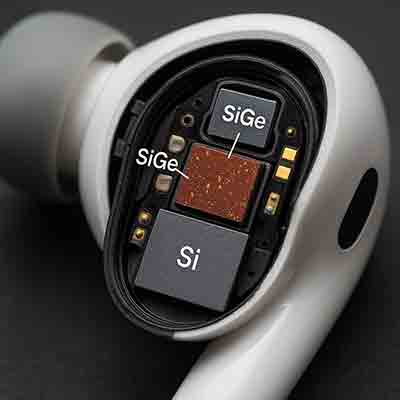
From Audio Myths to Miniaturized Reality: How UniversityWafer Powers Next-Gen Earbuds
In the race to deliver ever-smaller, higher-fidelity earbuds and hearables, researchers face a daunting challenge: prototyping and testing new transducer designs—often involving MEMS, piezoelectric layers, and novel actuation mechanisms—while managing cost, yield, and scalability. This is where a specialized wafer partner like UniversityWafer.com becomes indispensable. By offering custom, small-lot, high-quality wafers with precise specifications, we help bridge the gap between lab concept and manufacturable device.
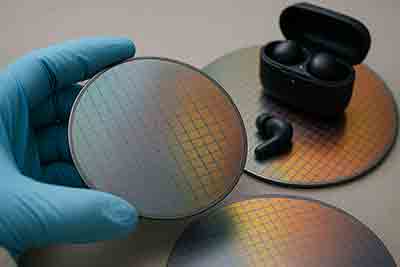
Why Wafer-Level Precision Matters for Earbuds
New approaches—such as high-speed micro-actuators, “pump” speakers, and advanced MEMS structures—are rewriting what’s possible in tiny form factors. These designs live or die on microfabrication details: electrode geometry, membrane thickness, gap control, and film uniformity all need tight tolerances to achieve the required displacement, speed, and acoustic coupling. A wafer stack with high planarity, uniform films, and low defectivity is the foundation for pushing performance in a 3–6 mm package.
Integrating Speaker, Mic, and Sensors—On the Same Stack
Thoughtful stack design can minimize mechanical coupling and enable co-location of speakers, microphones, and environmental sensors within microns. That translates into more compact modules, lower latency, and cleaner phase alignment—key ingredients for wide-band response and more robust ANC/beamforming in an AirPods-class device. UniversityWafer’s layered wafers and bonding options make these integrated layouts more accessible to R&D teams.
Faster Iteration, Smarter Risk
Rapid prototyping with small lots lets you iterate mask sets, evaluate acoustic performance in the chamber, and refine geometry without committing to large foundry runs. Our flexible MOQs, consistent documentation (thickness, Rs, roughness), and expedited lead times shorten your loop from idea → test → improvement.
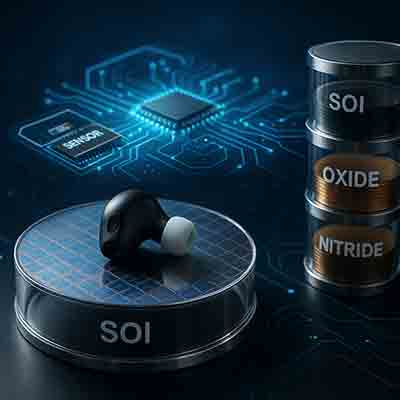
What We Supply for Next-Gen Audio R&D
These stocked and custom substrates/support films map directly to MEMS transducers, diaphragms, acoustic chambers, and integration layers used in earbud-scale devices:
- SOI Wafers (Silicon-on-Insulator) (precise device layer & BOX for membranes and cavities)
- Thermal Oxide Wafers (SiO₂ on Si) — wet/dry oxide from angstroms to microns :contentReference[oaicite:4]{index=4}
- Silicon Nitride Coated Wafers (Si₃N₄ on Si) — LPCVD / PECVD options :contentReference[oaicite:5]{index=5}
- Optical / Coating & Substrate Devices — for optical MEMS, photonic integration, and waveguide stacks :contentReference[oaicite:6]{index=6}
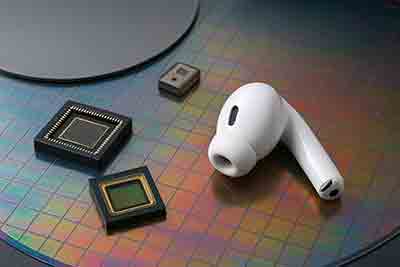
Quick Specs We Commonly Support
- Diameter: 100 mm, 150 mm (200 mm on request)
- Thickness control for membranes/caps; low bow/warp options
- Surface: DSP/SSP, low roughness for bonding and film quality
- Docs on request: thickness maps, Rs, optical/metrology images
Example R&D Workflow
- Select SOI device layer for target diaphragm frequency response and max SPL.
- Add oxide/nitride layers as stress-tuned diaphragm, hard mask, or isolation.
- Deposit patterned electrodes; define acoustic ports and back chambers.
- Bond cap wafer; release membrane; package; run acoustic tests (SPL, THD, bandwidth).
- Iterate mask geometry, confirm reliability & yield; prep pilot lot.
Further Reading
Context on shifting “audio myths” and micro-scale speaker design: Electronic Design: “11 Myths About Audio Tech” .