We need 76.2 mm single crystal quartz substrates with a single-side-polished (SSP) surface to research carbon nanotube growth using chemical vapor deposition (CVD).
Please reference #ONL36704 for specifications and pricing. Or buy Item #916 online.
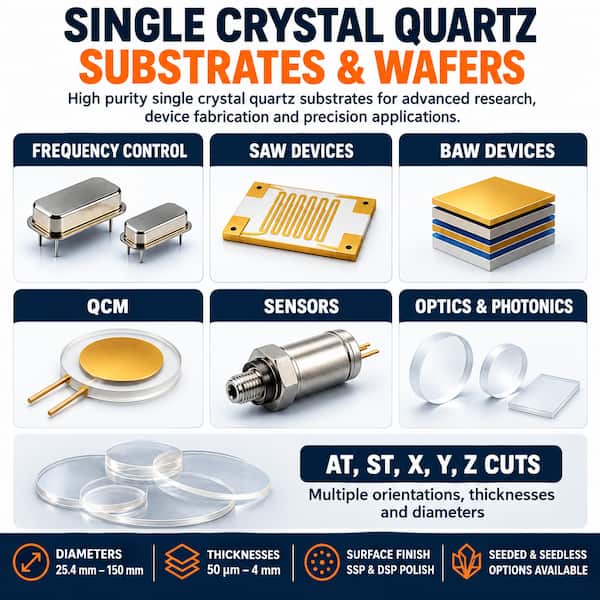
UniversityWafer supplies single crystal quartz wafers and piezoelectric quartz substrates for frequency control, SAW and BAW devices, quartz crystal microbalances (QCM), sensors, MEMS, optical components, and materials research. Available crystal cuts include AT-cut, ST-cut, X-cut, Y-cut, and Z-cut quartz, with multiple diameters, thicknesses, and single-side polished (SSP) or double-side polished (DSP) finishes. Custom quartz substrate specifications are available for research, prototyping, and device fabrication.

Single crystal quartz (SiO2) is a crystalline, piezoelectric material used in frequency-control devices, acoustic-wave components, sensors, quartz crystal microbalances, optics, MEMS, and materials research. Unlike amorphous fused silica, single crystal quartz has an ordered crystal structure and therefore exhibits anisotropic mechanical, electrical, and optical properties.
UniversityWafer supplies single crystal quartz wafers in multiple crystallographic cuts, diameters, thicknesses, and surface finishes. Selecting the appropriate quartz cut is important because the orientation of the wafer relative to the crystallographic axes affects properties such as piezoelectric coupling, acoustic-wave propagation, thermal frequency behavior, and optical response.
Quartz substrates can be used as experimental platforms in chemical vapor deposition (CVD) and other thin-film or nanomaterial research when the substrate properties are compatible with the required process temperature and chemistry.
A postdoctoral researcher requested the following:
We need 76.2 mm single crystal quartz substrates with a single-side-polished (SSP) surface to research carbon nanotube growth using chemical vapor deposition (CVD).
Please reference #ONL36704 for specifications and pricing. Or buy Item #916 online.
When selecting quartz for a CVD experiment, researchers should consider the process temperature, gas chemistry, surface finish, crystal orientation, wafer thickness, and required cleanliness. Suitability should be evaluated for the specific deposition process rather than assuming that every quartz substrate is compatible with every CVD condition.
Single crystal quartz combines several useful properties for scientific and engineering applications:
Depending on the quartz cut, dimensions, surface preparation, and device design, single crystal quartz substrates are used or investigated for:
Get Your Single Crystal Quartz Wafers FAST! Or Buy Online and start researching today!
A quartz wafer's cut describes the orientation of its surface relative to the crystallographic axes of the quartz crystal. Because quartz is anisotropic, changing the cut changes how the material interacts with mechanical strain, acoustic waves, electric fields, and light.
There is therefore no universally "best" quartz orientation. The appropriate cut depends on the intended device or experiment.
AT-cut quartz is a rotated Y-cut widely used in thickness-shear resonators and frequency-control applications. One of its major advantages is that the cut angle can provide favorable frequency-versus-temperature behavior around common operating temperatures.
ST-cut quartz is a rotated cut commonly associated with surface acoustic wave applications. Its orientation can provide useful acoustic propagation characteristics and reduced temperature sensitivity for selected SAW device configurations.
In an X-cut quartz wafer, the wafer surface is oriented perpendicular to the crystallographic X-axis. X-cut material is used in selected piezoelectric, acoustic, electrical, and optical experiments where this orientation provides the desired tensor response.
In a Y-cut quartz wafer, the surface is perpendicular to the crystallographic Y-axis. Y-cut and rotated-Y quartz orientations form the basis of several important acoustic and resonator configurations.
Y-cut quartz is not inherently denser, higher-melting, or more conductive than X-cut quartz simply because of the cut. Both are the same crystalline SiO2 material. The important differences arise from the anisotropic elastic, piezoelectric, dielectric, thermal, and optical properties relative to the crystallographic axes.
For Z-cut quartz, the wafer surface is perpendicular to the crystallographic Z-axis, also called the c-axis or optic axis. Z-cut substrates are used in selected optical, dielectric, materials, microfabrication, and research applications where this orientation is desirable.
Synthetic quartz is commonly produced by hydrothermal crystal growth. Seed crystals are used to initiate and control growth of the synthetic quartz crystal.
In wafer terminology, seeded and seedless specifications can refer to whether the finished wafer contains or intersects the seed-related region of the grown crystal. A seedless wafer may be requested when a researcher wants the usable area free from visible or structural features associated with the seed region.
The choice should not be treated as purely cosmetic for every application. Whether a seed region matters depends on the device, wafer location, acoustic mode, optical path, surface requirements, and other quality specifications. Researchers should specify seed requirements when they are important to device performance or characterization.
For demanding acoustic, optical, or crystallographic work, additional material-quality specifications may be more important than the word "seedless" alone.
Thin, polished single crystal quartz wafers can be useful as reference specimens or experimental substrates in X-ray diffraction and crystallographic studies. Orientation, thickness, surface quality, strain, and crystal quality should be selected according to the measurement geometry.
Researchers have requested the following thin Z-cut quartz specification for diffraction research:
Quartz Item #3064
50.8 mm diameter
Z-cut
50 µm thickness
Double-side polished (DSP)
Seedless
Piezoelectric quartz resonators are widely used in quartz crystal microbalance and deposition-monitoring systems . As material is deposited onto an oscillating quartz crystal, the added mass changes its resonant frequency.
Under the appropriate thin, rigid, and sufficiently uniform film conditions, this frequency shift can be related to deposited mass using the Sauerbrey relationship. This principle is widely used for monitoring thin-film deposition and is also used in QCM-based sensing experiments.
Electrode material, crystal cut, resonant frequency, temperature, film stress, acoustic properties of the deposited layer, and process conditions can all influence monitor performance. Gold-coated quartz crystals are commonly used because gold is conductive and chemically stable, but the appropriate electrode should be selected for the deposition chemistry and measurement environment.
Single crystal quartz can be considered for optical windows and experimental components, but the correct material should be selected according to the required wavelength range, temperature, window thickness, mechanical loading, surface quality, orientation, and optical polarization.
A scientist requested the following:
We would like to use a quartz substrate as a transparency window for a cryogenic chamber. Please provide a quote for 70 mm diameter, 4 mm thick Z-cut quartz.
UniversityWafer quoted the following specification:
| Item | Diameter | Cut | Thickness | Polish | Grade | Seed | Top Ra | Back Ra |
|---|---|---|---|---|---|---|---|---|
| 256845 | 70.0 ± 0.2 mm | Z-cut | 4 ± 0.02 mm | DSP | SAW | Seedless | <1 nm | <1 nm |
Quartz and fused silica are sometimes considered for experiments requiring optical access and elevated temperatures, but they should not be treated as interchangeable.
Single crystal quartz undergoes the α-quartz to β-quartz phase transition near 573 °C at atmospheric pressure. This structural transition is particularly important when evaluating crystalline quartz for high-temperature processes.
Consequently, an experiment approaching temperatures such as 1000 °C requires careful material selection. Fused silica avoids the crystalline α-to-β quartz transition, although its own maximum service temperature depends on duration, mechanical loading, atmosphere, purity, and geometry.
A university researcher requested:
We need optically transparent substrates for a pyrolysis process at approximately 1000 °C and would also prefer low fluorescence. We are considering fused silica and single crystal quartz.
Reference #205196 for specifications and pricing.
Alpha-quartz has a chiral crystal structure and occurs in right-handed and left-handed structural forms. This distinction can matter in optical and crystallographic experiments and should be specified when handedness is important.
A Ph.D. researcher in materials science and engineering asked:
I am interested in the single crystal quartz substrates you offer and would like to inquire about their chirality. Are they left-handed or right-handed?
Additionally, for Z-cut substrates , is the wafer surface perpendicular to the crystallographic c-axis?
UniversityWafer response:
Standard supplied quartz may be right-handed unless otherwise specified; left-handed quartz can also be requested subject to availability. Customers requiring a particular handedness should include it explicitly in the specification.
For a conventional Z-cut quartz wafer, the wafer plane is perpendicular to the crystallographic Z-axis (c-axis).
Reference #320291 for specifications and pricing.
To request the appropriate quartz substrate, provide as many of the following specifications as possible:
Providing the intended application—such as SAW, QCM, optical research, CVD, diffraction, MEMS, or frequency control—can also help identify the most appropriate quartz specification.
UniversityWafer supplies single crystal quartz wafers and substrates in multiple diameters, thicknesses, crystallographic orientations, and surface finishes for research and device fabrication. Available configurations may include AT-cut, ST-cut, X-cut, Y-cut, and Z-cut quartz, as well as seeded and seedless material.
Inventory changes frequently. The table below represents examples of available quartz specifications. Please request a quote if you require a particular cut angle, diameter, thickness tolerance, surface roughness, flatness, handedness, or seed configuration.
| Diameter | Orientation / Cut | Thickness | Polish | Grade | Seed |
|---|---|---|---|---|---|
| 76.2 mm | ST / AT / Z | 0.15 mm | DSP | SAW | With Seed |
| 76.2 mm | 42.75° ST | 0.35 mm | SSP | SAW | With Seed |
| 76.2 mm | X / Y / Z | 0.35 mm | SSP | SAW | With Seed |
| 76.2 mm | 42.75° ST | 0.50 mm | SSP | SAW | With Seed |
| 76.2 mm | X / Y / Z | 0.50 mm | SSP | SAW | With Seed |
| 76.2 mm | 42.75° ST | 0.35 mm | DSP | SAW | With Seed |
| 76.2 mm | X / Y / Z | 0.35 mm | DSP | SAW | With Seed |
| 76.2 mm | 42.75° ST | 0.50 mm | DSP | SAW | With Seed |
| 76.2 mm | X / Y / Z | 0.50 mm | DSP | SAW | With Seed |
| 100 mm | ST / AT / Z | 0.20 mm | DSP | SAW | With Seed |
| 100 mm | ST-Cut | 0.35 mm | SSP | SAW | With Seed |
| 100 mm | X / Y / Z | 0.35 mm | SSP | SAW | With Seed |
| 100 mm | ST-Cut | 0.50 mm | SSP | SAW | With Seed |
| 100 mm | X / Y / Z | 0.50 mm | SSP | SAW | With Seed |
| 100 mm | ST-Cut | 0.35 mm | DSP | SAW | With Seed |
| 100 mm | ST-Cut | 0.50 mm | DSP | SAW | With Seed |
| 100 mm | X / Y / Z | 0.50 mm | DSP | SAW | With Seed |
| 25.4 mm | AT / Z-Cut | 0.05 mm | DSP | SAW | Seedless |
| 50.8 mm | AT / Z-Cut | 0.10 mm | DSP | SAW | With Seed |
| 76.2 mm | ST / AT / Z | 0.15 mm | DSP | SAW | With Seed |
| 150 mm | Z-Cut | 0.675 mm | SSP | SAW | Seedless |
Single crystal quartz is crystalline silicon dioxide (SiO2) in which the crystal lattice maintains a continuous crystallographic orientation through the material. Natural quartz exists, but high-quality quartz used for electronic and acoustic applications is commonly produced synthetically by hydrothermal growth.
Single crystal quartz should not be confused with fused quartz or fused silica. Fused silica is an amorphous form of SiO2 without long-range crystalline order. Single crystal quartz, by contrast, is crystalline and therefore exhibits orientation-dependent, or anisotropic, elastic, dielectric, piezoelectric, thermal, and optical properties.
Quartz is also not a semiconductor substrate in the conventional electronic sense. High-purity quartz is an electrical insulator. Its technological importance comes primarily from its piezoelectric, dielectric, mechanical, acoustic, and optical properties.
Alpha-quartz has a non-centrosymmetric crystal structure. Because the crystal lacks inversion symmetry, mechanical stress can produce electrical polarization, while an applied electric field can produce mechanical strain. This is the piezoelectric effect.
This electromechanical coupling makes quartz particularly useful for resonators, oscillators, acoustic-wave devices, sensors, and quartz crystal microbalances (QCMs).
The magnitude and type of electromechanical response depend on the crystallographic orientation of the quartz plate. For this reason, specifying the correct quartz cut is essential for acoustic and frequency-control applications.
High-quality synthetic quartz is commonly produced using a hydrothermal growth process. This method reproduces, under controlled conditions, the type of high-temperature and high-pressure aqueous environment in which quartz can form naturally.
Quartz nutrient material and crystalline seed plates are placed inside a pressure-resistant autoclave containing an alkaline aqueous solution. The autoclave is operated with a controlled temperature gradient. Quartz dissolves preferentially in the hotter nutrient region and is transported through the solution toward the cooler growth region, where dissolved silica becomes supersaturated and deposits onto the seed.
The process gradually produces a larger synthetic single crystal while maintaining crystallographic continuity with the seed. Growth conditions are carefully controlled because inclusions, dislocations, twinning, impurities, and other defects can influence the electrical, acoustic, mechanical, and optical performance of the finished material.
After growth, the synthetic quartz crystal is inspected, oriented, sectioned, and processed into wafers or blanks according to the required crystallographic cut.
Manufacturing a quartz wafer requires considerably more than simply slicing a quartz crystal. The crystal must first be accurately oriented relative to its crystallographic axes because even small angular deviations can affect acoustic and resonator performance.
For resonant devices, thickness is especially important because the resonance frequency of a thickness-mode quartz resonator is related to the acoustic velocity and thickness of the quartz plate. The exact relationship depends on the cut and vibration mode.
UniversityWafer can supply both single-side polished (SSP) and double-side polished (DSP) quartz substrates, depending on the specification.
SSP wafers provide one polished device surface and may be appropriate when only one side participates in lithography, deposition, bonding, or optical processing. DSP wafers provide polished surfaces on both sides and are useful when backside optical access, transmission, double-sided fabrication, bonding, or tightly controlled surface quality is required.
Polishing improves surface roughness and optical or fabrication quality; it should not be described as a process for reducing the intrinsic electrical resistance of quartz.
Thin quartz substrates are useful for acoustic resonators, sensors, microfabrication, optical experiments, diffraction studies, and other applications requiring reduced substrate thickness.
As quartz becomes thinner, handling and processing become more demanding. Researchers should consider thickness tolerance, TTV, bow, warp, surface roughness, edge condition, and mechanical support when selecting ultra-thin quartz wafers.
Large-diameter 150 mm single crystal quartz wafers are available in selected orientations and surface finishes for acoustic, optical, MEMS, wafer-level processing, and advanced research applications.
Large quartz wafers require careful control of total thickness variation, bow, warp, orientation, edge geometry, and surface roughness. Availability of a particular cut, seed configuration, and thickness should be confirmed for each project.
Quartz wafer specifications should be selected according to the intended device or experiment. Important parameters can include:
The term quartz cut describes the orientation of a quartz plate relative to the crystallographic axes. Because quartz is anisotropic, the cut affects elastic constants, piezoelectric coupling, acoustic-wave velocity, dielectric response, optical behavior, and the frequency-temperature characteristics of resonators.
Some cuts are simple orientations, such as X-, Y-, and Z-cut quartz. Others, including AT-, ST-, and SC-cut quartz, use rotated orientations selected to obtain particular acoustic or temperature-dependent characteristics.
AT-cut quartz is a rotated Y-cut and is one of the most important orientations for thickness-shear resonators. Its frequency-temperature behavior can be optimized around a desired operating range by controlling the cut angle.
AT-cut quartz is widely used in quartz resonators, oscillators, frequency-control devices, and QCM sensors.
ST-cut quartz is a rotated quartz orientation commonly used for surface acoustic wave (SAW) devices. Its acoustic propagation characteristics and temperature behavior make it useful for filters, delay lines, sensors, and other SAW structures.
SC-cut quartz is a doubly rotated orientation developed for high-stability resonator applications. Compared with conventional AT-cut resonators, appropriately designed SC-cut devices can offer reduced sensitivity to certain stresses and improved performance in precision oven-controlled oscillators.
X-, Y-, and Z-cut designations identify wafers whose surfaces have defined relationships to the crystallographic X, Y, and Z axes.
Z-cut quartz has its wafer surface perpendicular to the crystallographic Z-axis (c-axis/optic axis). It is used in selected optical, dielectric, microfabrication, and research applications.
X-cut and Y-cut quartz provide different orientations of the piezoelectric, elastic, dielectric, and optical tensors and are selected when those orientation-dependent properties are important.
A quartz crystal microbalance (QCM) uses the resonance of a piezoelectric quartz crystal to detect changes in mass coupled to its surface. AT-cut quartz is widely used for QCM resonators because it provides useful thickness-shear behavior and favorable frequency stability near typical operating temperatures.
When a sufficiently thin, rigid, and uniformly coupled film is added to the resonator, the resonance frequency decreases. Under conditions where the Sauerbrey approximation is valid, the frequency change can be related to the change in mass per unit area.
In liquids, soft films, polymers, biological layers, or other viscoelastic systems, the relationship becomes more complex because the resonator also interacts mechanically with the surrounding medium.
Quartz crystal microbalance with dissipation monitoring (QCM-D) measures both resonance-frequency changes and changes in energy dissipation. This makes QCM-D particularly useful for studying hydrated, soft, or viscoelastic films where a simple rigid-mass model may not adequately describe the response.
Sensor compatibility depends on more than crystal diameter and nominal frequency. Researchers should verify the resonant frequency, crystal cut, electrode geometry, electrode material, crystal contour, dimensions, surface coating, and mechanical compatibility with the specific QCM-D instrument.
Room-temperature single crystal quartz is normally α-quartz. Several of its physical properties are anisotropic, so values such as dielectric constant, thermal conductivity, elastic modulus, refractive index, and thermal expansion depend on crystallographic direction and measurement conditions.
Quartz has a density of approximately 2.65 g/cm³ and a Mohs hardness of approximately 7. It is an electrical insulator and a piezoelectric crystal.
A particularly important thermal property is the reversible α-quartz to β-quartz transition near 573 °C at atmospheric pressure. This transition must be considered when crystalline quartz is proposed for high-temperature processing.
Because quartz properties depend on direction, temperature, frequency, purity, and measurement method, precise numerical values should always be associated with the relevant conditions rather than presented as universal constants.
Crystalline quartz can be used in selected terahertz (THz) spectroscopy and optical experiments, but its suitability depends strongly on frequency, orientation, polarization, thickness, temperature, and absorption.
Quartz is anisotropic and birefringent, so the relationship between the propagation direction and the optic axis is important. A Z-cut geometry, in which the surface normal is parallel to the optic axis, can simplify polarization behavior for propagation close to that axis. However, Z-cut quartz is not automatically the best window material for every THz experiment.
Researchers should evaluate the complex refractive index, absorption coefficient, reflection losses, etalon effects, birefringence, sample thickness, and operating frequency before choosing quartz for a THz system.
Polymer materials such as TPX (polymethylpentene) and cyclic olefin polymers may also be used for THz windows and optical components. These are distinct materials and should not be described as "TPX-cut quartz."
Although both materials consist primarily of SiO2, single crystal quartz and fused silica are structurally different materials.
| Property | Single Crystal Quartz | Fused Silica |
|---|---|---|
| Structure | Crystalline | Amorphous |
| Composition | SiO2 | SiO2 |
| Piezoelectric | Yes | No |
| Optical anisotropy | Yes | Essentially isotropic |
| Birefringence | Yes | No intrinsic crystalline birefringence |
| Crystal cut required | Often important | Not applicable |
| α-β quartz transition | Yes, near 573 °C | No |
| Typical strengths | Piezoelectric, acoustic and polarization-sensitive applications | Optical, thermal and general insulating substrate applications |
This distinction is important when selecting substrates for optical, microfabrication, acoustic, or high-temperature research. The terms quartz, fused quartz, and fused silica should not be used interchangeably when crystallographic properties matter.
Alpha-quartz is chiral. Its crystal structure occurs in two enantiomorphic forms that are mirror images of one another: right-handed and left-handed quartz.
The two forms have the same basic chemical composition, SiO2, but opposite structural handedness. This handedness is associated with opposite signs of optical rotation along the optic axis and can be important in crystallographic, optical, and specialized piezoelectric experiments.
Handedness should therefore be specified when it matters to the application rather than assuming that all synthetic quartz has one particular handedness.
Quartz handedness is fundamentally a property of the crystal structure, not simply the external appearance of a wafer. Depending on the sample geometry and available instrumentation, handedness can be determined using crystallographic or optical methods.
Optical rotation measurements along the appropriate crystallographic direction can distinguish the two enantiomorphic forms because they rotate the polarization direction with opposite signs. X-ray diffraction methods can also be used to establish absolute crystal structure and handedness.
For precision research, customers should request certified or supplier-specified handedness rather than attempting to infer it solely from the macroscopic appearance of a processed wafer.
The best quartz wafer depends on the intended experiment or device. When requesting a quote, specify:
Providing the intended operating frequency, wavelength, temperature, acoustic mode, or fabrication process can help determine which quartz specification is most appropriate.
UniversityWafer supplies research quantities and custom specifications of single crystal quartz substrates for universities, laboratories, semiconductor research, photonics, acoustic devices, MEMS, sensors, and materials science.