
What Is RCA Cleaning?
RCA cleaning is a wet-chemical surface preparation method commonly used with silicon wafers before semiconductor fabrication and materials research. The process is designed to address several forms of surface contamination that may interfere with subsequent processing.
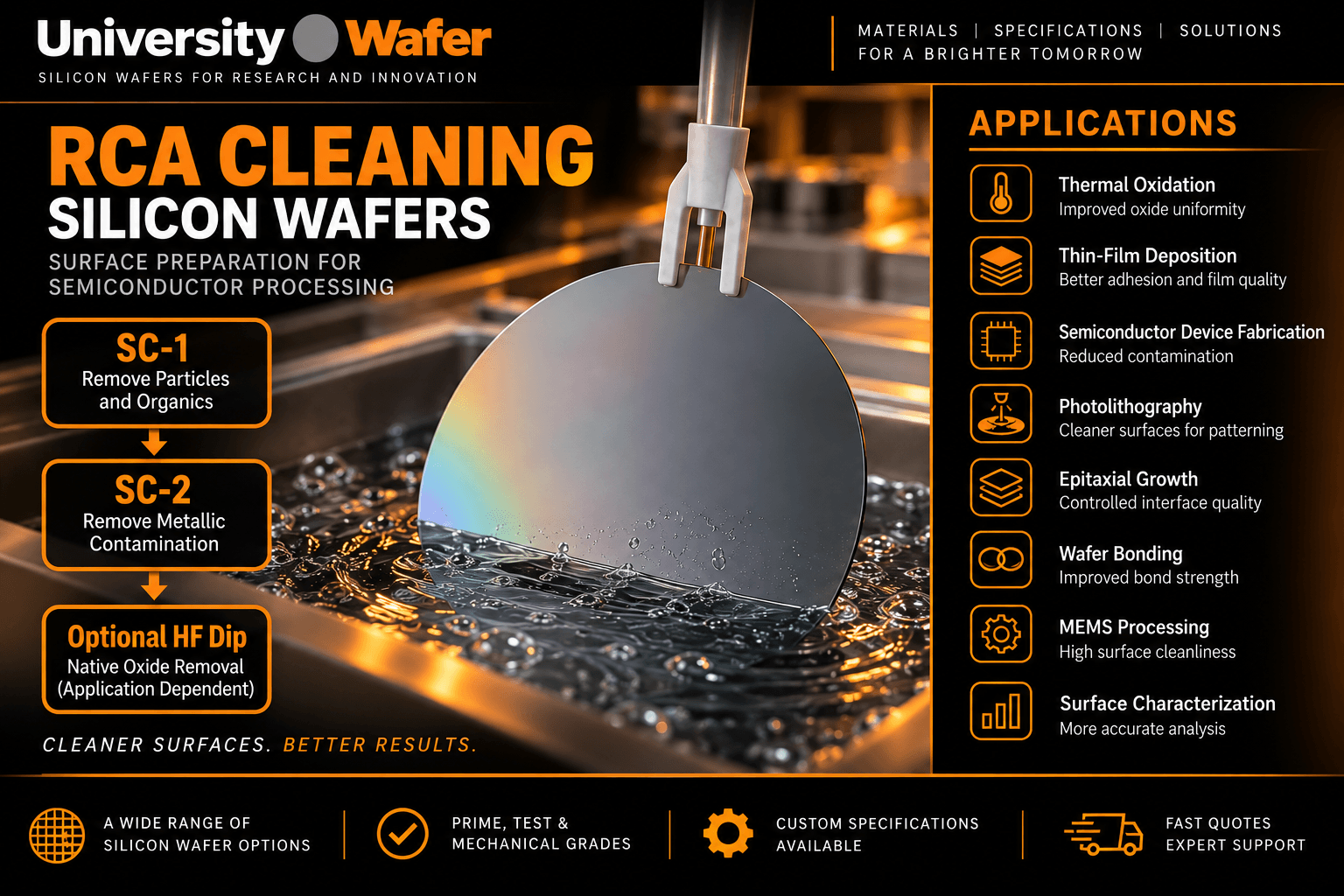
RCA cleaning is generally discussed as two complementary stages: SC-1 and SC-2. These stages target different classes of contamination and may be incorporated into a larger wafer preparation sequence depending on the application.
What Is SC-1 Cleaning?
SC-1, or Standard Clean 1, is primarily associated with particle and organic contamination removal. It is commonly used during silicon wafer preparation when researchers need to reduce surface residues before lithography, oxidation, deposition, bonding, or other fabrication steps.
SC-1 can also alter the condition of the silicon surface, so the process should be selected according to the material already present on the wafer and the surface required afterward.
What Is SC-2 Cleaning?
SC-2, or Standard Clean 2, is primarily used to reduce metallic contamination from semiconductor surfaces. Trace metals can be undesirable in processes where electrical properties, oxide interfaces, thin-film quality, or device reliability are sensitive to contamination.
SC-2 is therefore often discussed as a complementary step to SC-1 rather than as a replacement for it.
Does RCA Cleaning Remove Native Oxide?
RCA cleaning and native oxide removal are related but separate surface-preparation goals. RCA cleaning is primarily used for contamination control, while an HF-based treatment may be used when removal of silicon dioxide or native oxide is required.
Whether native oxide should be removed depends on the next fabrication step. Some processes require an oxide-free silicon surface, while others intentionally use an oxidized or dielectric-coated surface.
Learn more about silicon wafer cleaning methods and surface preparation options.
RCA Cleaning Before Thermal Oxidation
RCA cleaning is commonly considered before thermal oxidation because particles, organics, and metallic contamination present on the silicon surface can affect the silicon/silicon-dioxide interface and process repeatability.
The exact pre-oxidation preparation sequence depends on the desired oxide, starting wafer condition, furnace process, and laboratory protocol. Researchers should therefore match the cleaning procedure to the specific oxidation process rather than assuming that every wafer requires the same preparation.
RCA Cleaning Before Thin-Film Deposition
Surface condition can influence film adhesion, nucleation, thickness uniformity, electrical characteristics, and interface quality. For this reason, RCA cleaning may be considered before thin-film deposition when contamination control is important.
The appropriate pre-deposition cleaning process depends on the film being deposited, deposition technique, existing surface chemistry, and whether an oxide-free, oxidized, or otherwise modified silicon surface is desired.
Do New Silicon Wafers Need RCA Cleaning?
Whether a new silicon wafer should be RCA cleaned before use depends on its supplied condition and the requirements of the experiment. A wafer may arrive clean and packaged for handling, but that does not automatically mean its surface condition is appropriate for every contamination-sensitive process.
Researchers should consider:
- How the wafer was supplied and packaged
- How long it has been stored
- Whether it has been handled after opening
- The sensitivity of the next fabrication step
- Whether native oxide should remain or be removed
- Whether the wafer contains deposited films or patterned structures
Selecting Silicon Wafers for RCA Cleaning Research
The cleaning process is only one part of wafer preparation. Researchers should also specify the starting silicon substrate according to the experiment.
- Diameter: 50.8 mm, 76.2 mm, 100 mm, 150 mm, 200 mm, 300 mm, or other sizes
- Crystal orientation: commonly <100>, <111>, or application-specific orientations
- Conductivity type: p-type or n-type
- Dopant: boron, phosphorus, arsenic, or other specifications
- Resistivity: selected according to electrical or device requirements
- Surface finish: SSP, DSP, or other polished configurations
- Thickness: standard or custom thickness depending on handling and device design
- Existing films: bare silicon, thermal oxide, dielectric films, or deposited layers
Prime, Test, and Mechanical Grade Wafers
Wafer grade should be selected according to the surface quality required by the research project.
- Prime grade silicon wafers are generally preferred for applications requiring high surface quality, tighter specifications, and semiconductor processing.
- Test grade wafers may be appropriate for process development, coating experiments, equipment testing, and research where prime-grade specifications are not required.
- Mechanical grade wafers are generally better suited to mechanical handling, fixtures, educational use, or experiments where semiconductor-grade surface quality is not essential.
Research Example: RCA Cleaning Before Film Deposition
A research engineer asked UniversityWafer whether double-side polished silicon wafers needed additional RCA cleaning before film deposition. Questions like this are common because the correct answer depends on the supplied wafer condition and the requirements of the deposition process.
For contamination-sensitive deposition work, researchers should define the required surface condition immediately before processing rather than relying only on the wafer's original packaged condition.
Reference #135626 for related specifications and pricing.
Need Silicon Wafers for RCA Cleaning, Oxidation, Deposition, or Surface Preparation? Or, Buy Online and Start Researching Today!
Applications for RCA-Prepared Silicon Wafers
- Thermal oxidation
- Thin-film deposition
- Semiconductor device fabrication
- Photolithography
- MEMS processing
- Epitaxial growth
- Wafer bonding
- Dielectric research
- Surface characterization
- University semiconductor research
RCA Cleaning for Silicon Wafer Surface Preparation
RCA cleaning is a widely used wet-chemical surface preparation method for silicon wafers. The process is commonly associated with two cleaning stages, SC-1 (Standard Clean 1) and SC-2 (Standard Clean 2), which target different classes of surface contamination.
RCA cleaning may be used during semiconductor research before processes such as thermal oxidation, thin-film deposition, epitaxial growth, wafer bonding, photolithography, dielectric formation, and device fabrication. The appropriate cleaning sequence depends on the starting wafer, existing films, contamination concerns, and the surface condition required by the next process.
What Do SC-1 and SC-2 Remove?
| Cleaning Stage | Primary Purpose | Surface Preparation Goal |
|---|---|---|
| SC-1 | Particle and organic contamination control | Reduce particles and organic residues before subsequent processing |
| SC-2 | Metallic contamination control | Reduce trace metallic contamination remaining on the silicon surface |
| HF Treatment | Silicon dioxide and native oxide removal | Produce an oxide-free, hydrogen-terminated silicon surface when required by the next process |
SC-1 Cleaning: Particle and Organic Contamination Control
SC-1 is commonly associated with an aqueous cleaning chemistry containing ammonium hydroxide and hydrogen peroxide. Its primary role is to help remove particles and organic contamination from silicon surfaces.
Particle control can be particularly important before lithography, deposition, bonding, oxidation, and other processes in which small surface defects may affect film uniformity, interfaces, patterning, or device performance.
SC-2 Cleaning: Metallic Contamination Control
SC-2 is commonly associated with an aqueous hydrochloric acid and hydrogen peroxide chemistry. It is used primarily to reduce metallic contamination on semiconductor surfaces.
Trace metals can be undesirable in semiconductor processing because contamination may influence electrical behavior, interfaces, oxidation, and other contamination-sensitive fabrication steps.
Does RCA Cleaning Remove Native Oxide?
RCA cleaning and native oxide removal should be treated as related but distinct surface-preparation objectives. The RCA sequence is primarily used for contamination control, while an HF-based treatment may be used separately when removal of silicon dioxide or native oxide is required.
Whether oxide should be removed depends on the process. Some applications require an oxide-free silicon surface, while others intentionally use silicon dioxide or require an oxidized starting surface. Researchers should therefore define the desired final surface condition before selecting a cleaning sequence.
RCA Cleaning Before Thermal Oxidation
Surface preparation is especially important before thermal oxidation . Particles, organic residues, and metallic contamination present before oxidation can affect the silicon/silicon-dioxide interface and the repeatability of the resulting oxide process.
A process may also incorporate native oxide removal before oxidation when the experiment requires tighter control of the initial silicon surface. However, the exact preparation sequence should be matched to the oxidation process and laboratory protocol rather than assuming that an HF treatment is required in every case.
RCA Cleaning Before Thin-Film Deposition
Researchers frequently ask whether a new silicon wafer should be RCA cleaned before film deposition. The answer depends on the wafer's supplied condition, handling history, storage, deposition material, and required interface quality.
Surface contamination can affect film adhesion, nucleation, uniformity, electrical properties, and interface quality. For contamination-sensitive deposition research, a controlled pre-deposition cleaning procedure can help establish a more repeatable starting surface.
Learn more about thin-film deposition and selecting substrates for deposition research.
RCA Cleaning and Pre-Cleaned Silicon Wafers
A common question is whether silicon wafers arrive ready for immediate processing. The answer depends on the specific wafer, supplier preparation, packaging, storage, handling, and the cleanliness requirements of the customer's process.
A wafer that is suitable for one research application may still require additional preparation for a contamination-sensitive process. Researchers should therefore distinguish between the supplied wafer condition and the process-specific cleaning required immediately before fabrication.
What Silicon Wafer Grades Can Be RCA Cleaned?
RCA cleaning can be considered for different silicon wafer configurations, but the appropriate starting wafer should be selected according to the experiment. Wafer grade and surface finish can be especially important when surface roughness, defect density, film quality, bonding, or electrical performance are critical.
- Prime grade wafers are generally selected when high surface quality and tighter specifications are important.
- Test grade wafers can be useful for process development, equipment testing, coating experiments, and less demanding research.
- Mechanical grade wafers may be appropriate for handling, mechanical testing, fixtures, and applications where semiconductor-grade surface quality is not required.
- Double-side polished (DSP) wafers can be useful when both surfaces are involved in optical, bonding, MEMS, or other processing steps.
Chemical compatibility and required surface quality should be evaluated before applying RCA, HF, piranha, plasma, or other treatments to a particular wafer or deposited film.
RCA Cleaned Wafers for Low Surface Roughness Research
Researchers working in power electronics, epitaxy, wafer bonding, thin films, and surface science may require silicon wafers with tightly controlled surface roughness in addition to cleaning requirements.
Important specifications can include wafer diameter, crystal orientation, offcut angle, dopant, resistivity, thickness, SSP or DSP finish, surface roughness, and cleaning requirements. These parameters should be specified separately because an RCA cleaning requirement does not by itself define the wafer's surface roughness or crystallographic properties.
RCA Cleaning Applications
RCA-cleaned or otherwise carefully prepared silicon surfaces are commonly relevant to research involving:
- Thermal oxidation
- Thin-film deposition
- Epitaxial growth
- Photolithography
- Wafer bonding
- MEMS fabrication
- Dielectric research
- Surface characterization
- Electronic device fabrication
- University semiconductor research
Silicon Wafers for RCA Cleaning Research
UniversityWafer supplies silicon wafers for semiconductor processing, surface preparation, oxidation, deposition, MEMS, photonics, electronics, and university research.
Researchers can specify parameters such as diameter, thickness, orientation, dopant, resistivity, polish, surface roughness, oxide thickness, and quantity when requesting wafers for a particular process.
Research Example: RCA Cleaning Before Oxidation
UniversityWafer has received requests from researchers developing silicon-dioxide dielectric layers for back-gated electronic devices. These projects illustrate why both the starting silicon wafer and its surface preparation matter when the oxide will function as an electrical dielectric.
Depending on the experiment, researchers may need to consider the silicon dopant and resistivity, crystal orientation, oxide thickness, oxide uniformity, surface quality, and whether purchasing a pre-oxidized silicon wafer is preferable to growing the dielectric in-house.
Reference #129593 for related specifications and pricing.