
Understanding RF & mmWave Substrates
Substrate selection is an important part of RF, microwave, and millimeter-wave device design. Electrical properties such as relative permittivity, dielectric loss, and resistivity influence transmission-line behavior and parasitic loss, while thermal conductivity, thickness, flatness, and surface quality affect fabrication and device reliability.
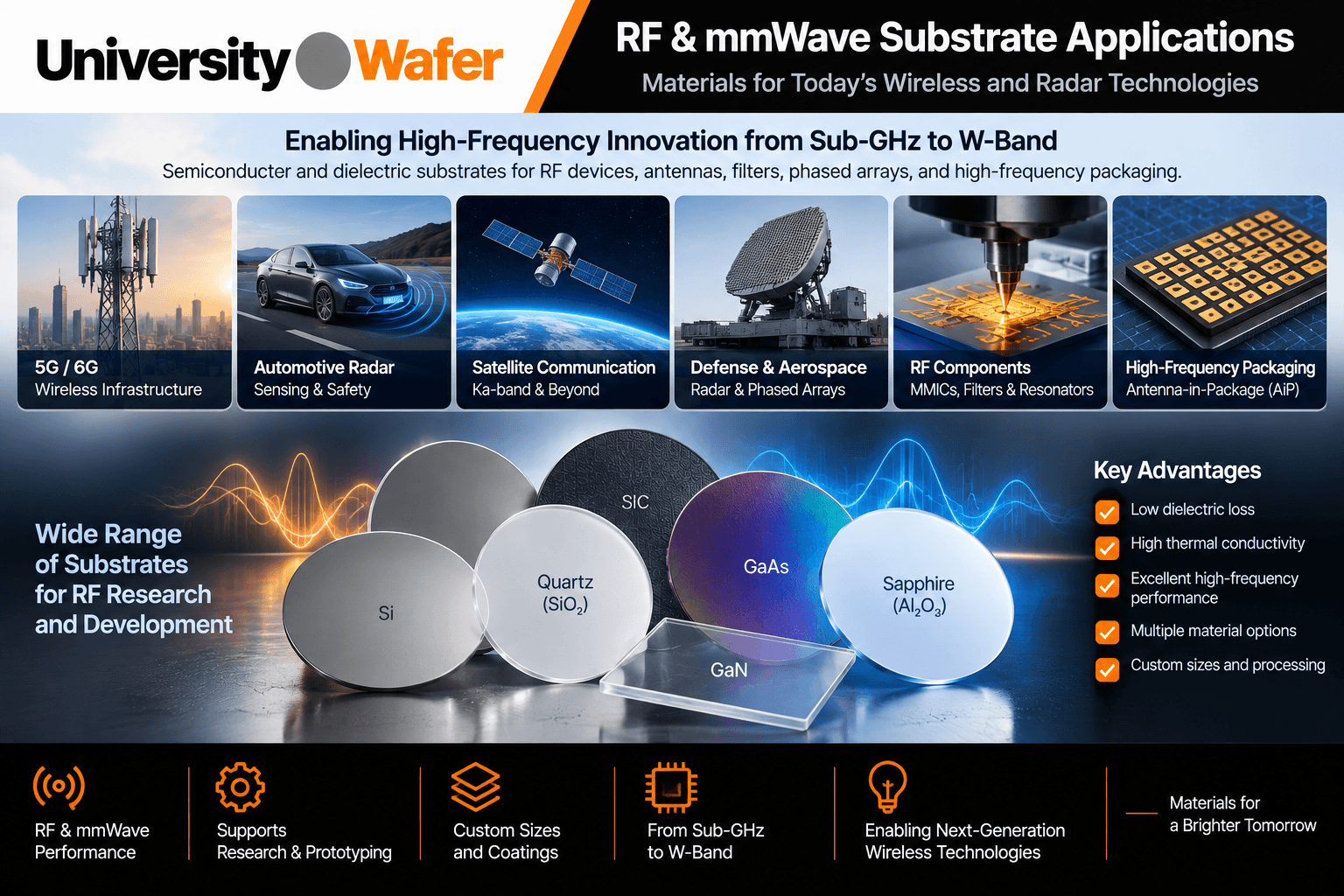
UniversityWafer supplies semiconductor and dielectric materials for research involving RF amplifiers, MMICs, filters, resonators, antennas, phased arrays, radar, microwave photonics, and high-frequency packaging. Available materials include GaAs, GaN-related structures, SiC, high-resistivity silicon, quartz, fused silica, and sapphire.
Request RF & mmWave Wafers
Researchers can request wafers and substrates based on material, diameter, thickness, resistivity, crystal orientation, surface finish, coatings, and quantity.
- Gallium Arsenide (GaAs) – for microwave and millimeter-wave semiconductor device research.
- Gallium Nitride (GaN) – for high-power and high-frequency electronic research.
- Silicon Carbide (SiC) – for wide-bandgap devices and GaN epitaxial platforms requiring effective heat removal.
- High-Resistivity Silicon – for RF passives, interposers, antennas, and integrated silicon platforms.
- Quartz & Fused Silica – electrically insulating dielectric substrates for low-loss RF and microwave structures.
- Sapphire – crystalline dielectric substrates for microwave, optical, and hybrid device research.
Get Your RF & mmWave Substrate Quote FAST! Or, Buy Wafers Online and Start Your Research Today!
Electrical Properties That Matter at RF Frequencies
Relative Permittivity
The relative permittivity (εr) of a substrate affects electromagnetic wavelength, field confinement, characteristic impedance, and the physical dimensions of transmission lines and resonators.
Higher-permittivity substrates can enable more compact structures, but the best value depends on the circuit geometry, operating frequency, bandwidth, and electromagnetic design. Permittivity alone does not determine whether a material is suitable for an RF application.
Dielectric Loss
Loss tangent (tan δ) describes dielectric energy dissipation. Lower dielectric loss is generally desirable for transmission lines, resonators, filters, and other structures where high Q or low insertion loss is important.
Dielectric properties should be evaluated at the intended operating frequency and temperature, because measured values can vary with material grade, crystal orientation, purity, and test method.
Substrate Resistivity
Resistivity is especially important in silicon RF platforms. Conventional conductive silicon can introduce substrate coupling and loss, while high-resistivity silicon can reduce these effects when used with an appropriate device and interface design.
High-resistivity silicon should not be treated as a true electrical insulator; it remains a semiconductor, and its RF behavior can also be affected by surface charge, oxide interfaces, and processing.
Conductor & Surface Loss at High Frequencies
As frequency increases, current becomes increasingly concentrated near the surface of conductors because of the skin effect. Consequently, conductor conductivity, metal thickness, surface roughness, and line geometry become increasingly important in microwave and mmWave circuits.
- Metal conductivity: Au, Cu, and Al are commonly used for RF transmission structures.
- Surface roughness: rough conductor interfaces can increase effective conductor loss, particularly as the skin depth becomes small.
- Metallization thickness: should be selected according to frequency, process limits, current density, and transmission-line design.
- Dielectric loss: becomes especially important in resonators, filters, and long transmission paths.
Thermal Management in RF Power Devices
High-power RF transistors generate significant heat in relatively small active regions. Excess junction temperature can reduce performance and accelerate degradation, making the thermal path from the active device to the package an important design consideration.
GaN is widely used for high-power RF electronics because of its wide bandgap and high critical electric field. When GaN is grown on SiC , the high thermal conductivity of the SiC substrate can provide an effective route for heat removal.
GaAs remains important for high-frequency and low-noise semiconductor devices because of its favorable carrier-transport properties.
RF Transmission Lines & Integration
RF substrates support structures such as microstrip, coplanar waveguide (CPW), stripline, resonators, antennas, and impedance-matching networks. Their dimensions are designed together with the substrate's dielectric properties and thickness.
- Microstrip: uses a signal conductor above a dielectric substrate with a ground plane on the opposite side.
- Coplanar waveguide: places the signal and ground conductors on the same surface and is widely used for on-wafer RF structures.
- Wafer bonding: can support heterogeneous integration of semiconductor, dielectric, optical, and packaging layers.
- TGVs and TSVs: through-glass and through-silicon vias can provide vertical electrical routing in compact RF packages and interposers.
RF & mmWave Frequency Ranges
Material choice should not be based on frequency alone. Device type, required output power, thermal loading, bandwidth, line geometry, packaging, and fabrication process all influence substrate selection.
- Microwave frequencies: amplifiers, mixers, filters, radar, communication circuits, and RF sensors.
- Ka-band and mmWave: phased arrays, satellite communications, radar, and high-capacity wireless links.
- V- and W-band: automotive radar, imaging, spectroscopy, sensing, and experimental high-data-rate systems.
- Sub-THz research: requires increasingly careful control of conductor loss, dielectric loss, transitions, surface quality, and packaging parasitics.
Testing RF Substrates & Devices
Electrical characterization is necessary because material and device performance can vary with frequency and fabrication process. Common techniques include:
- Vector network analyzers (VNAs): measure scattering parameters such as S11 and S21.
- On-wafer probing: allows direct RF characterization of fabricated test structures and devices.
- Resonator techniques: can be used to characterize dielectric properties and microwave loss.
- Thermal characterization: helps evaluate heat generation and thermal spreading in high-power devices.
Choosing the Right RF Substrate
Start with the requirements of the device and evaluate the substrate as part of the complete RF system.
- Define the frequency range and bandwidth.
- Determine the required RF power and thermal path.
- Evaluate εr, tan δ, and electrical resistivity.
- Select substrate thickness, flatness, and surface finish for the fabrication process.
- Consider metal thickness and conductor roughness for microwave and mmWave transmission lines.
- Include vias, interposers, bonding, and packaging early in the design process.
- Use material-property data measured near the intended operating frequency whenever accurate RF modeling is required.
RF & mmWave Materials for High-Frequency Devices
UniversityWafer supplies semiconductor wafers, low-loss dielectric substrates, optical materials, and wafer-processing options for RF, microwave, and millimeter-wave research. These materials are used in applications such as amplifiers, mixers, filters, resonators, phased arrays, radar modules, antenna-in-package structures, and high-frequency interconnects.
Substrate selection depends on the electrical, thermal, mechanical, and fabrication requirements of the device. Important parameters include relative permittivity (εr), dielectric loss tangent (tan δ), resistivity, thermal conductivity, thickness, surface roughness, and dimensional uniformity.

Core Materials for RF & mmWave Research
Gallium Arsenide (GaAs)
Gallium arsenide (GaAs) is a III-V semiconductor valued for its high electron mobility and high-frequency electronic performance. GaAs is widely used in microwave and millimeter-wave integrated circuits, including low-noise amplifiers, mixers, switches, and other MMIC devices.
Gallium Nitride (GaN)
Gallium nitride (GaN) is a wide-bandgap semiconductor used where high electric fields, high power density, and high-frequency operation are required. RF GaN devices are commonly grown on substrates such as silicon carbide, silicon, or sapphire depending on the performance and manufacturing requirements.
GaN on SiC is particularly attractive for high-power RF devices because SiC provides high thermal conductivity and helps remove heat from the active GaN device layer. GaN on Si can offer compatibility with larger-diameter silicon manufacturing infrastructure.
Silicon Carbide (SiC)
Silicon carbide (SiC) combines wide-bandgap behavior with high thermal conductivity and strong electrical breakdown performance. In RF technology, semi-insulating SiC is especially important as a substrate for GaN epitaxy and high-power microwave devices.
High-Resistivity Silicon
High-resistivity silicon (HR-Si) is used for RF passive components, transmission lines, interposers, integrated antennas, and RF-compatible silicon platforms. Higher substrate resistivity can reduce substrate-related conductive losses compared with conventional low-resistivity silicon.
The actual RF loss of HR-Si structures also depends on oxide interfaces, surface charge, device geometry, frequency, and processing history, so resistivity alone does not determine high-frequency performance.
Quartz & Fused Silica
Quartz and fused silica are useful for RF and microwave structures requiring electrically insulating, low-loss dielectric substrates. They are often considered for transmission lines, resonators, filters, interposers, and microwave-photonic structures.
Sapphire
Sapphire is an electrically insulating crystalline oxide with good thermal stability, chemical durability, and optical transparency over a broad spectral range. It is used in microwave, RF, optical, and hybrid photonic structures where a stable crystalline dielectric substrate is required.
Key RF Substrate Properties
Relative Permittivity
The relative permittivity (εr) of a substrate influences electromagnetic field confinement, wavelength within the material, transmission-line dimensions, impedance, and resonator size.
Higher-permittivity materials can allow more compact RF structures, while lower-permittivity substrates can be useful where lower field confinement, wider transmission structures, or specific propagation characteristics are desired.
Dielectric Loss Tangent
The dielectric loss tangent (tan δ) describes dielectric energy dissipation. Lower dielectric loss is generally desirable for high-Q resonators, filters, transmission lines, and other structures where insertion loss must be minimized.
Loss tangent is not necessarily a single fixed value for a material. Published values can depend on frequency, temperature, crystal orientation, purity, processing, and measurement method.
Electrical Resistivity
Substrate resistivity is especially important for silicon-based RF structures. Conductive substrates can couple electromagnetic energy into the wafer, producing substrate losses and parasitic effects. High-resistivity or trap-rich silicon platforms can help reduce these effects in appropriately designed RF circuits.
Surface Roughness & Metallization
At microwave and millimeter-wave frequencies, conductor loss becomes increasingly important because current is concentrated near the metal surface by the skin effect. Surface roughness, metal conductivity, line geometry, and metallization thickness can therefore influence transmission loss and resonator Q.
The required surface finish should be selected according to the fabrication process rather than assigning one universal roughness requirement to all RF devices.
RF Metallization & Interfaces
RF circuits commonly use highly conductive metals such as gold (Au), copper (Cu), and aluminum (Al). Adhesion, diffusion-barrier, seed, and contact layers may also be incorporated depending on the substrate and fabrication process.
- Transmission-line metal: Conductivity, thickness, surface condition, and geometry affect conductor loss.
- Ohmic contacts: Contact metallurgy is selected according to the semiconductor, doping, device architecture, and thermal process.
- Passivation: Dielectric layers such as SiNx and Al2O3 may be used for surface protection, interface engineering, and device stability.
- Thin-film dielectrics: SiO2, SiNx, and other dielectric films may be incorporated into capacitors, passivation layers, isolation structures, and RF interconnects.
RF Interposers, Vias & Packaging
High-frequency packaging can contribute substantial parasitic inductance, capacitance, and signal loss. For this reason, substrate and package design should be considered together.
- Through-Glass Vias (TGVs): provide vertical electrical routing through glass interposers and can be useful in RF and antenna-in-package structures.
- Through-Silicon Vias (TSVs): provide vertical connections through silicon and can support compact three-dimensional RF integration.
- Interposers: glass, silicon, ceramic, and other materials may be used to route signals between dies, antennas, and package interfaces.
- Windows and lids: sapphire, quartz, fused silica, and other dielectric materials may be used where electrical insulation, optical access, or environmental protection is required.
RF Applications by Frequency Range
No single substrate is inherently the best choice for an entire frequency band. Material selection depends on the specific circuit topology, power level, loss budget, package, thermal requirements, and manufacturing process. Typical research applications include:
- Sub-GHz through microwave: RF switches, amplifiers, filters, matching networks, and wireless communication circuits.
- X- and Ku-band: radar, satellite communication, microwave sensing, and GaAs/GaN MMIC research.
- Ka-band: phased arrays, satellite links, high-capacity wireless systems, and radar.
- V- and W-band: millimeter-wave imaging, radar, spectroscopy, sensing, and high-data-rate communication.
- Sub-THz research: increasingly sensitive to conductor loss, surface quality, dielectric loss, transitions, packaging parasitics, and fabrication tolerances.

RF Wafer Specifications to Consider
Substrate specifications should be matched to both the electrical design and the intended wafer-processing sequence.
- Diameter and format: full wafers, diced pieces, rectangular substrates, and research coupons.
- Thickness: affects mechanical rigidity, electromagnetic behavior, and compatibility with lithography, bonding, and packaging.
- TTV, bow, and warp: important for lithography, wafer bonding, probing, and automated processing.
- Surface finish: SSP, DSP, optical polish, or application-specific surface preparation.
- Electrical properties: resistivity, dielectric behavior, crystal orientation, doping, and semi-insulating characteristics where applicable.
- Coatings: metals, dielectric films, transparent conductive coatings, or optical coatings can be specified for appropriate research applications.
Choosing a Substrate for RF Research
Begin with the electrical and thermal requirements of the device rather than selecting a material solely by frequency.
- Define the operating frequency and bandwidth.
- Determine the required RF power and thermal dissipation.
- Evaluate εr, tan δ, and substrate resistivity.
- Select substrate thickness and transmission-line geometry together.
- Account for surface roughness and conductor loss at mmWave frequencies.
- Plan metallization, vias, bonding, and packaging early to minimize unwanted parasitics.
- Verify material-property data at the frequency and temperature relevant to the intended device whenever possible.
RF & mmWave Research Applications
- 5G and emerging wireless communication research
- Automotive and industrial radar
- Satellite and aerospace communications
- Phased-array antennas
- GaAs and GaN MMIC development
- RF MEMS and microwave sensors
- Millimeter-wave imaging and spectroscopy
- Microwave photonics and electro-optic systems
- High-frequency packaging and interposer development
Request RF & mmWave Substrates
UniversityWafer can help researchers source substrates based on material, diameter, thickness, orientation, resistivity, surface finish, coatings, and quantity.
Related RF & mmWave Substrates
Explore semiconductor and dielectric substrates commonly used in RF, microwave, millimeter-wave, radar, phased-array, and high-frequency packaging research.
- GaN on Silicon Carbide – High-power RF substrate platform combining GaN device layers with the thermal advantages of SiC.
- Gallium Arsenide (GaAs) Wafers – III-V semiconductor wafers for MMICs, low-noise amplifiers, mixers, switches, and microwave devices.
- Silicon Carbide (SiC) Wafers – Wide-bandgap substrates for high-power electronics, GaN epitaxy, and demanding RF applications.
- High-Resistivity Silicon – Silicon substrates for RF passives, interposers, integrated antennas, and high-frequency silicon platforms.
- Quartz & Fused Silica Substrates – Low-loss dielectric materials for resonators, transmission lines, filters, interposers, and microwave-photonic devices.
- Sapphire Wafers – Electrically insulating crystalline substrates for RF, microwave, optical, and hybrid device research.
- GaN on Silicon – GaN-on-Si structures for RF power device research and compatibility with larger-diameter silicon processing.
- CMOS Substrates – Silicon platforms relevant to integrated RF circuits, mixed-signal electronics, and RF-CMOS research.
- Wafer Bonding – Bonding approaches for heterogeneous integration, RF interposers, MEMS, and multi-material device stacks.