
Order Silicon Wafers by Crystal Orientation
Choosing the correct silicon wafer orientation is critical for semiconductor fabrication, MEMS manufacturing, anisotropic etching, integrated circuits, sensors, photonics, and research applications. The most common crystal orientations are (100) silicon wafers and (111) silicon wafers, each offering unique electrical, mechanical, and etching characteristics.
UniversityWafer supplies silicon wafers in multiple orientations, diameters, thicknesses, doping types, and surface finishes for academic, industrial, and government research projects.
Get Your Silicon Wafer Quote FAST! Or, Buy Online and Start Researching Today!
Common Silicon Wafer Orientations
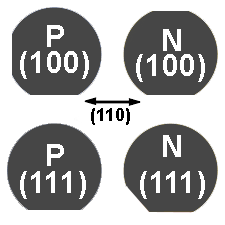
Crystal orientation is defined using the Miller Index, a notation system that describes the arrangement of atoms within a single crystal silicon wafer. The most frequently used orientations in semiconductor manufacturing are (100) and (111), although specialized orientations are available for advanced applications.
- (100) Silicon Wafers – Preferred for integrated circuits, CMOS devices, MEMS fabrication, and anisotropic etching.
- (111) Silicon Wafers – Commonly used for power devices, sensors, advanced crystal growth, and research applications.
- Custom Orientations – Available for specialized semiconductor, optical, and materials science projects.
Why Silicon Crystal Orientation Matters
The crystal orientation affects wafer cleavage, etching behavior, surface structure, carrier mobility, mechanical strength, and device performance. Engineers often select a specific orientation to optimize manufacturing yields and achieve desired electrical or mechanical properties.
If a wafer specification sheet is unavailable, crystal orientation can often be identified through cleavage patterns, wafer flats, notches, X-ray diffraction analysis, or crystal characterization methods.
Understanding Silicon Wafer Orientation
Silicon wafer orientation is one of the most important crystal properties in semiconductor manufacturing, MEMS fabrication, anisotropic etching, solar cell production, and integrated circuit development. Silicon wafers are grown from a single crystal silicon boule and sliced along specific crystal planes identified by their Miller Index, such as (100) and (111).
Crystal orientation directly affects etching behavior, carrier mobility, mechanical properties, cleavage planes, and device performance. For this reason, selecting the correct silicon orientation is critical when designing semiconductor devices and research experiments.
How to Identify Silicon Wafer Orientation
In most cases, the primary flat or notch on a silicon wafer provides information about the crystal orientation and dopant type. However, older wafers, reclaimed wafers, or wafers that have been processed may not always retain accurate orientation markings.
A traditional method used to verify wafer orientation involves cleaving or scribing the wafer. Silicon naturally fractures along specific crystal planes, making the fracture pattern a useful indicator of crystal orientation.
(100) vs. (111) Silicon Wafers
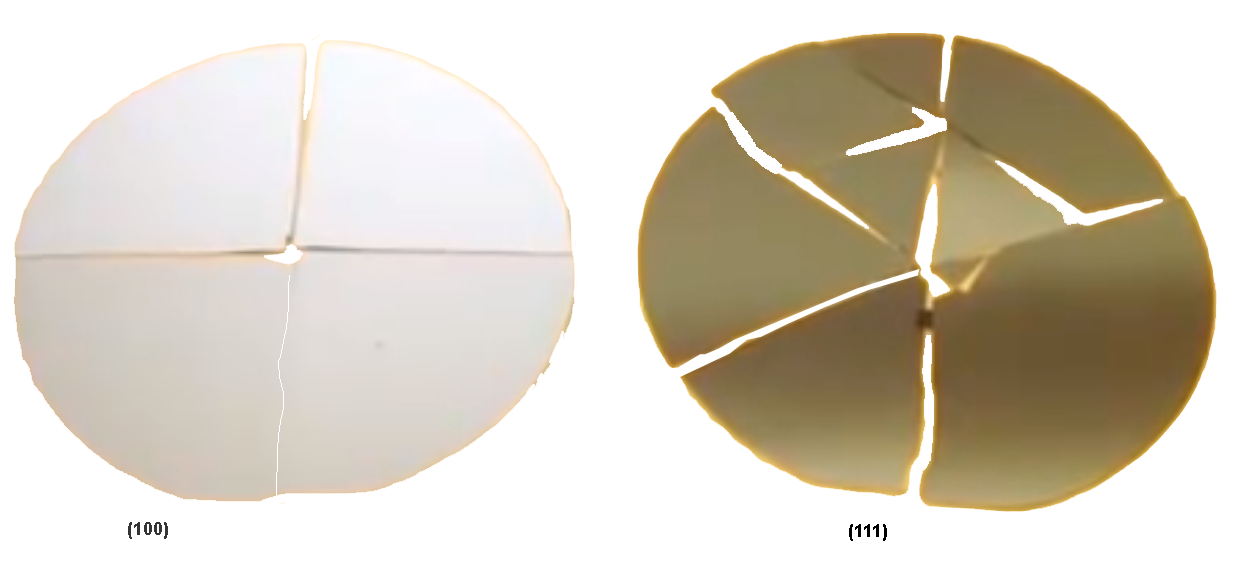
When a force is applied to the center of a silicon wafer, the fracture pattern can reveal its crystal orientation.
(100) Silicon Wafers typically cleave into four symmetrical sections because the crystal structure contains predictable cleavage planes. If the resulting pieces are fractured again, they continue to divide into similarly shaped sections. This predictable behavior is one reason why (100) silicon wafers are the preferred substrate for many integrated circuits, MEMS devices, and semiconductor manufacturing processes.
(111) Silicon Wafers, by contrast, tend to fracture into irregular pieces because of their different atomic arrangement and cleavage geometry. This characteristic can help researchers distinguish between (111) and (100) oriented wafers when specifications are unavailable.
Why Crystal Orientation Matters
- Influences anisotropic silicon etching rates
- Affects semiconductor device performance
- Determines wafer cleavage behavior
- Impacts MEMS fabrication processes
- Changes surface atomic structure and crystal properties
- Affects integrated circuit manufacturing yields
- Plays a role in photovoltaic and solar cell efficiency
How Silicon Wafer Orientation is Created
The orientation of a silicon wafer is established during the crystal growth process. As the single crystal silicon boule is pulled and grown, manufacturers precisely control the crystal direction. The boule is then sliced into wafers along the desired crystal plane, creating standard orientations such as (100), (111), and other specialized orientations used for advanced semiconductor applications.
Understanding crystal orientation helps engineers, researchers, and manufacturers select the optimal wafer for etching, photolithography, integrated circuits, sensors, MEMS devices, and other microelectronic technologies.
Related Silicon Wafer Resources
- Silicon Wafers
- (100) Orientation Silicon Wafers
- (111) Orientation Silicon Wafers
- Silicon Substrates
- Double Side Polished Silicon Wafers
- Single Side Polished Silicon Wafers
- Silicon Etching
- Chemical Mechanical Polishing (CMP)
- MEMS Substrates
- Silicon-on-Insulator (SOI) Wafers
- Thermal Oxide Silicon Wafers
- Silicon Epitaxy Wafers