
“Would it be possible for UniversityWafer to source SOITEC wafers? I need 225nm Si / 2.0µm BOX, which is a very common specification for silicon photonics research.”
What Substrates Are Used to Fabricate Silicon Photonic Devices?
Silicon-on-Insulator (SOI) wafers are among the most widely used substrates for silicon photonics, optical waveguides, photonic integrated circuits (PICs), and optical communication devices. Researchers frequently select SOI wafers because the buried oxide (BOX) layer improves optical confinement while reducing signal loss.
A research scientist requested the following SOI wafer specification for silicon photonics applications:
Typical SOI wafer structures used in silicon photonics include:
- 220nm–250nm top silicon device layer
- 1µm–3µm buried oxide (BOX) layer
- Low-loss monocrystalline silicon substrate
- Single-side polished or double-side polished surfaces
These substrates are commonly used for:
- Photonic integrated circuits
- Optical modulators
- Waveguide fabrication
- Optical interconnects
- Quantum photonic devices
- Silicon photonic sensors
Reference #222904 for wafer specifications and pricing.
SOI Wafers Used for Silicon Photonic Waveguides
Researchers developing silicon photonic waveguides often require precise SOI wafer thicknesses to optimize optical confinement and wavelength performance.
A PhD researcher in photonics engineering requested the following wafer specifications:
“I would like to purchase prime-grade SOI wafers for silicon photonic waveguides with a 220nm silicon layer, 2µm BOX layer, and 725µm substrate thickness.”
Waveguide fabrication typically requires:
- Low surface roughness
- Uniform silicon thickness
- Precise buried oxide thickness
- Excellent wafer flatness
- High optical quality silicon
Researchers frequently select 150mm SOI wafers with <100> orientation because they are compatible with standard semiconductor photolithography and CMOS fabrication equipment.
Reference #222228 for pricing and specifications.
Get Your Quote FAST! Or, Buy Online and Start Researching Today!
Fused Quartz for Photonic Crystal Research
Fused quartz substrates are widely used in photonic crystal devices, fluorescence sensing, optical biosensors, and low-autofluorescence optical systems.
Reducing background fluorescence is critical when detecting weak fluorescent signals in photonic sensor applications. Flame-fused quartz provides excellent optical transmission and extremely low autofluorescence under laser excitation.
A published research paper studying evanescent field enhanced fluorescence on photonic crystal surfaces used fused quartz substrates supplied by UniversityWafer, Inc.
Typical Quartz Wafer Specifications:
Fused Quartz Item #518
100mm (4-inch) fused quartz wafers
550µm thickness
Double-side polished (DSP)
Low autofluorescence optical substrate
Reference #93968 for specifications and pricing.
SOI Wafers Used to Fabricate Photonic Devices
A graduate researcher working on passive SOI photonic devices requested custom wafer fabrication support for photonic integrated circuits.
“Our laboratory is developing SOI photonic devices and we are looking for a supplier capable of fabricating SOI passive devices with a 0.5µm device layer.”
Passive photonic devices fabricated on SOI wafers include:
- Optical splitters
- Waveguides
- Ring resonators
- Photonic sensors
- Optical filters
- Mach-Zehnder interferometers
Reference #237913 for wafer specifications and pricing.
Monocrystalline Silicon Used in Silicon Photonics
Monocrystalline silicon is one of the most important materials used in semiconductor manufacturing, silicon photonics, solar cells, and integrated optical devices.
Unlike polycrystalline silicon, monocrystalline silicon contains a continuous crystal lattice with very few defects or grain boundaries. This improves carrier mobility, optical performance, and semiconductor device reliability.
Monocrystalline silicon is widely used for:
- Silicon photonic integrated circuits
- CMOS fabrication
- Solar cells
- Optical modulators
- MEMS devices
- Waveguide substrates
- Semiconductor sensors
The most common manufacturing method is the Czochralski (CZ) process, where large silicon ingots are grown and sliced into precision wafers for semiconductor fabrication.
Modern semiconductor manufacturers continue improving monocrystalline silicon production to support advanced photonic devices, AI processors, optical communication systems, and next-generation semiconductor technologies.
Why Silicon Photonics Research Continues Growing
Silicon photonics combines the scalability of semiconductor manufacturing with the speed of optical communication. As demand for AI computing, cloud infrastructure, and high-speed optical networking continues increasing, silicon photonics is becoming a critical technology for the future semiconductor industry.
Researchers worldwide continue developing advanced SOI wafers, silicon nitride waveguides, photonic crystals, and optical interconnect technologies to improve device performance and reduce manufacturing costs.
What is Silicon Photonics?
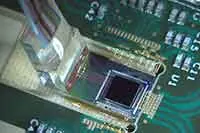 Silicon photonics is a semiconductor technology that uses light instead of electricity to transmit data through integrated optical circuits. By combining photonic components with traditional CMOS semiconductor fabrication methods, silicon photonics enables ultra-fast data transfer, lower power consumption, and higher bandwidth for modern communication systems.
Researchers use SOI wafers, silicon nitride waveguides, silicon germanium materials, and optical modulators to fabricate photonic integrated circuits (PICs) used in telecommunications, datacom, AI infrastructure, biosensors, and quantum computing applications.
Silicon photonics technology is increasingly important for:
- Data centers
- High-performance computing
- Optical interconnects
- 5G communication systems
- Artificial intelligence hardware
- Quantum photonic research
- Biomedical sensing devices
What is a Silicon Photonic Device?
Silicon photonic devices use optical waveguides and semiconductor materials to manipulate, transmit, detect, or process light signals directly on a silicon chip. These devices replace conventional copper interconnects with optical communication pathways that offer significantly higher bandwidth and lower signal loss.
Common silicon photonic devices include:
- Optical modulators
- Photodetectors
- Waveguides
- Optical switches
- Ring resonators
- Photonic integrated circuits (PICs)
- Dense wavelength division multiplexing (DWDM) devices
The thermo-optic properties of silicon allow researchers to control optical signals with high precision. Silicon photonic devices are often fabricated on monocrystalline silicon wafers and integrated with standard CMOS semiconductor processes.
Why Silicon Photonics is Important
Traditional electronic interconnects face bandwidth and energy limitations as computing systems become more advanced. Silicon photonics solves many of these challenges by transmitting data using photons rather than electrons.
Key advantages of silicon photonics include:
- Higher data transfer speeds
- Reduced energy consumption
- Lower heat generation
- Compact photonic integrated circuits
- Compatibility with CMOS manufacturing
- Improved scalability for data centers
Because silicon photonics can be fabricated using existing semiconductor manufacturing infrastructure, it offers a cost-effective path for scaling optical communication technologies.
Silicon Photonics Applications
Silicon photonics has become a critical technology for optical communication and advanced semiconductor research. Modern photonic chips are used in a wide range of industries and applications.
Common Silicon Photonics Applications
- Cloud computing infrastructure
- Telecommunications
- Optical networking
- LiDAR systems
- Autonomous vehicle sensors
- Biomedical imaging
- Quantum computing
- Machine learning hardware
- Optical sensing systems
Universities and semiconductor manufacturers continue developing new silicon photonic architectures to increase optical performance while reducing device size and manufacturing costs.
Challenges in Silicon Photonics Manufacturing
Although silicon photonics offers major performance advantages, fabricating and testing silicon photonic devices remains technically challenging.
Key manufacturing challenges include:
- Optical alignment precision
- Waveguide coupling losses
- Thermal expansion mismatch
- High port-count device testing
- Polarization-dependent behavior
- Photonic packaging complexity
Unlike traditional semiconductor electronics, photonic devices require extremely precise optical alignment because photons do not behave like electrons. Small fabrication variations can significantly affect optical performance.
Testing and Characterizing Silicon Photonic Devices
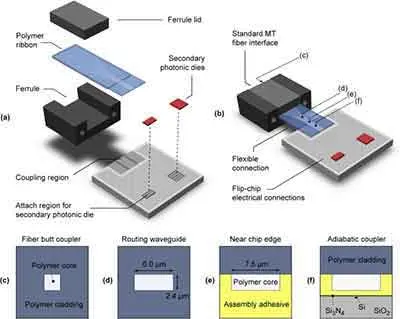 Testing silicon photonic devices requires advanced wafer-scale optical characterization systems capable of measuring insertion loss, optical return loss, waveguide performance, and photonic coupling efficiency.
Researchers commonly use:
- Tunable laser systems
- Multiport optical analyzers
- Optical spectrum analyzers
- Grating couplers
- Single-mode interferometers
- Wafer-scale photonic testing platforms
One major challenge in silicon photonics testing is coupling light efficiently into planar photonic chips. Grating couplers are frequently used to direct light into waveguides at specific angles while minimizing signal loss.
Wafer-scale testing is essential because photonic integrated circuits often contain hundreds of optical components on a single wafer.
Silicon Nitride Waveguides for Photonics
Silicon nitride (Si3N4) waveguides are widely used in photonic integrated circuits because they provide low optical loss and excellent compatibility with CMOS fabrication processes.
A university researcher requested the following waveguide wafer structure for photonic applications:
- 330nm LPCVD Si3N4 waveguide layer
- 3µm thermal oxide insulating layer
- Monocrystalline silicon substrate
- SSP or DSP polished surface
- 3-inch and 4-inch wafer formats
Silicon nitride waveguides are commonly used for:
- Optical communications
- Frequency comb generation
- Quantum photonics
- Integrated lasers
- Optical biosensors
- Mid-infrared photonics
Reference #266490 for wafer specifications and pricing.
The Growing Silicon Photonics Market
The global silicon photonics market continues growing rapidly due to increasing demand for high-speed optical communication, AI computing infrastructure, and cloud data centers.
Major technology companies including Intel, IBM, Cisco, and other semiconductor manufacturers continue investing heavily in silicon photonics research and wafer-scale photonic integration technologies.
As demand for bandwidth and energy-efficient computing increases, silicon photonics is expected to become one of the most important technologies in future semiconductor manufacturing.
Video: Silicon Photonics Explained