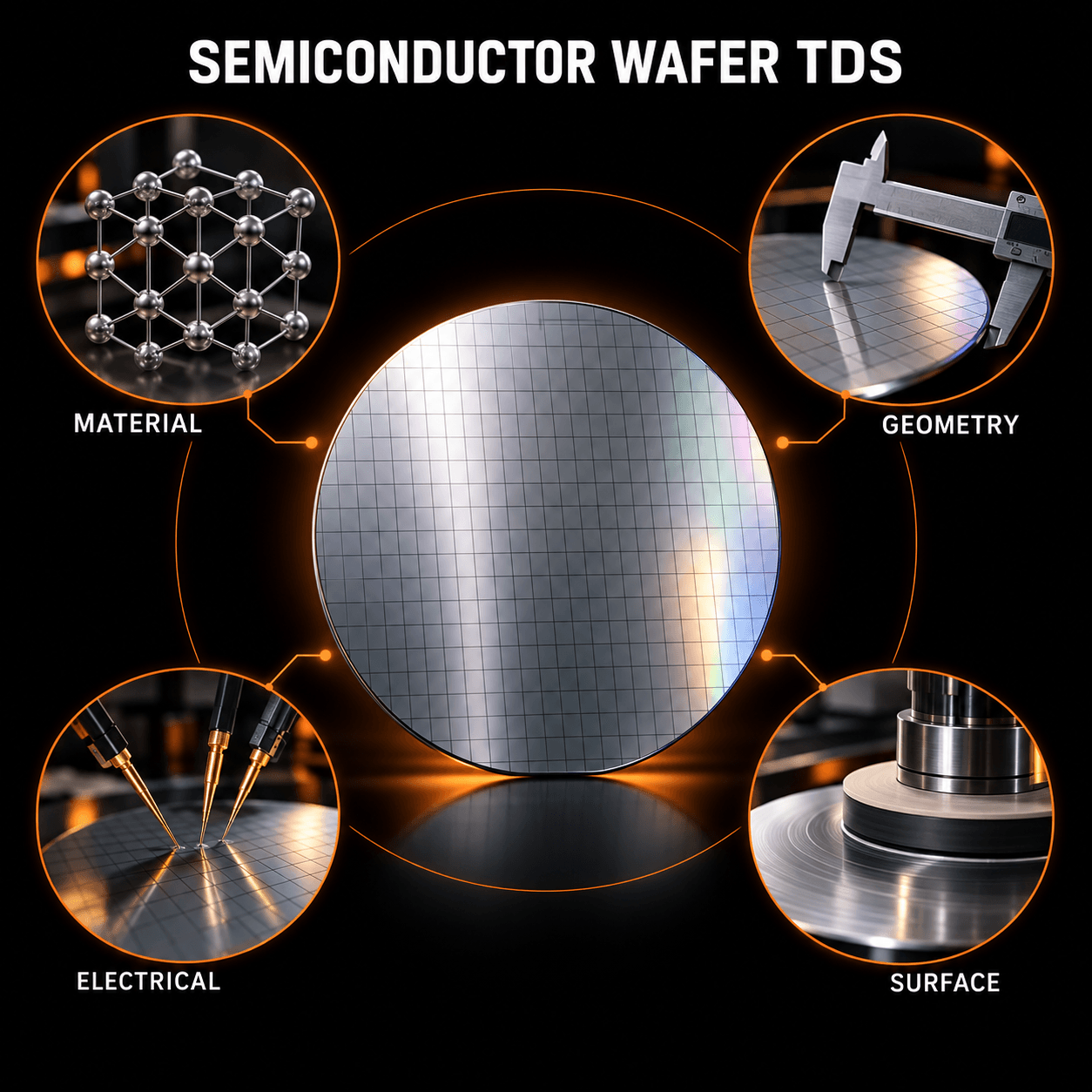
Technical Data Sheet

UW Logo

What Is a Technical Data Sheet?

Below is a sample of TDS requested by clients.

We need Confirmation on whether a Certificate of Conformity (CoC) is provided for the products Quantity-based price breaks (including lower and upper limits for the requested amount) Pricing, lead time, delivery terms, and payment terms Minimum order quantities, if applicable Technical Data Sheet (TDS) and Material Safety Data Sheet (MSDS) for the product.

and

Please send me ISO certificate of your company plus CE conformity, TDS (technical data sheet) and/or MSDS (material safety data sheet) for the ordered part(s)with the order confirmation together by e-mail.

TDS Form

CoC Form

Get Your Dicing Quote FAST! Or, Buy Online and Start Your Research Today!


What Is a Technical Data Sheet (TDS)?

A Technical Data Sheet (TDS) is one of the most fundamental documents in the semiconductor industry. It serves as the “single source of truth” for the specifications, performance, limitations, and handling requirements of a semiconductor material, device, wafer, or process. Below is a clear breakdown:


A Technical Data Sheet is a formal document provided by a manufacturer or supplier that details the engineering-level characteristics of a semiconductor product.

It describes everything a process engineer, R&D scientist, device designer, or purchaser needs to know to use the material correctly and match it to their application.

In semiconductors, TDS documents exist for:


What Does a Technical Data Sheet Do?

A TDS provides the key technical information needed to evaluate and use a semiconductor material safely and effectively.

Typical functions include:

1. Defines Material / Product Specifications

The TDS lists measurable parameters such as:

  • Resistivity

  • Dopant type & concentration

  • Crystal orientation

  • Surface roughness (Ra/RMS)

  • Thickness

  • Defect density

  • Mobility & lifetime

  • Flat/Notch type

  • Bow/warp

  • Thermal properties

  • Optical properties

For chemicals or films:

  • Viscosity

  • Solids content

  • Spin curve

  • Bake & cure temperatures

  • Etch rates

2. Ensures Process Compatibility

Engineers use the TDS to determine whether a wafer or material will:

  • Survive specific temperatures

  • Support certain etchants

  • Match alignment systems

  • Work in CMOS, MEMS, power, or photonics processes

3. Helps With Quality Control and Vendor Comparison

A TDS lets buyers and engineers compare:

  • Mechanical and electrical parameters

  • Tolerances

  • Film qualities

  • Defects

  • Surface specs

This is critical for companies doing tenders, quotes, and sourcing decisions.

4. Sets Operating & Handling Limits

The TDS defines safe operating boundaries:

  • Maximum temperature

  • Chemical compatibility

  • Storage environment

  • Shelf life

  • Mechanical stress tolerance

  • Electrical maximum ratings (for chips)

5. Supports Certifications & Compliance

Includes:

  • ROHS

  • REACH

  • ECCN export classification

  • ASTM/SEMI standards


How Important Is a TDS in the Semiconductor Industry?

Extremely important – essential.
A TDS is not optional. It is required for:

✔ Device design

Engineers cannot incorporate a material or wafer into a process flow unless its properties are known and controlled.

✔ Process integration

Process steps must be matched to allowed temperatures, chemicals, and stress limits.

✔ Yield and reliability

If the TDS is wrong or missing, the result is often:

  • wafer breakage

  • contamination

  • poor adhesion

  • short lifetimes

  • total device failure

✔ Customer contracts and quality audits

During supplier qualification (QPL, AVL), a TDS is mandatory.

✔ Legal and compliance protection

It protects the supplier and the user by clearly stating capabilities and limitations.

✔ Failure analysis (FA)

Engineers reference the TDS to determine whether a failure occurred due to:

  • process overstress

  • material incompatibility

  • supplier out-of-spec manufacturing


🔧 Why It Matters So Much to UniversityWafer, Inc.

Since your business supplies wafers to thousands of labs, universities, and OEMs:

  • A strong TDS reduces back-and-forth questions

  • It improves customer trust

  • It accelerates purchase decisions

  • It reduces returns and complaints

  • It differentiates you from brokers who cannot supply real specifications

You can also publish generalized TDS templates on your site to drive SEO and conversions (“Download Silicon Wafer Technical Data Sheet PDF”).


What is Certificate of Conformity (CoC)?

A Certificate of Conformity (CoC) is a formal legal document issued by a manufacturer or authorized body confirming that a product meets all required standards, specifications, regulations, and safety requirements for a given market or industry.

If someone asks for “confirmation on whether a Certificate of Conformity (CoC) is available”, they are simply asking:

Does your product include a CoC?
Can you confirm that a Certificate of Conformity exists for this item?

Below is a clear explanation.


What Is a Certificate of Conformity (CoC)?

A CoC is an official declaration that a product complies with certain standards. In the semiconductor industry, a CoC generally confirms that:

  • The wafer, substrate, or material meets the buyer’s specifications

  • It conforms to SEMI/ASTM standards (e.g., crystal orientation, resistivity, TTV, bow/warp, flatness)

  • It was manufactured under controlled and traceable conditions

  • Inspection and quality checks were performed

  • Materials and tolerances are within spec

  • Certifications (RoHS, REACH, conflict minerals, ECCN, etc.) are met if applicable

A CoC is usually 1–2 pages and issued per lot or per shipment.


🔍 What Does “Confirmation on Whether a CoC” Mean?

Customers often ask:

  • “Can you confirm whether a CoC is provided?”

  • “Can you provide confirmation of CoC availability?”

  • “Does the shipment include a CoC?”

This means they want you to verify that:

  1. You can supply a CoC for the wafers/material.

  2. The CoC will accompany the shipment.

  3. The CoC documentation is valid and traceable.

They may need this for:

  • Quality audits (ISO9001, internal QC)

  • Research documentation

  • Import/export compliance

  • Government or defense projects

  • Supplier qualification (AVL/QPL)


📄 What’s Typically Included in a Semiconductor CoC?

A standard CoC for wafers/substrates includes:

1. Product Identification

  • Part number

  • Wafer type (CZ/FZ, SOI, DSP, etc.)

  • Diameter: 100mm, 150mm, 200mm, etc.

  • Specs (resistivity, orientation, thickness, dopant)

  • Surface finish (DSP, SSP, oxide, nitride)

2. Lot Information

  • Lot number

  • Batch number

  • Wafer count

  • Date of manufacture

3. Conformity Statement

A statement such as:

“We certify that the above material conforms to the specifications agreed upon in PO #### and complies with SEMI standards.”

4. Test & Inspection Results

  • Resistivity measurement

  • Thickness/TTV

  • Bow/warp

  • Particle/defect count (if applicable)

5. Standards & Regulations

  • SEMI M1, M2, M56

  • ASTM F723, F728

  • RoHS/REACH

  • ECCN classification (e.g., EAR99)

  • Conflict mineral compliance

6. Signatures

  • Authorized QA/QC representative

  • Date & stamp


🧩 Why Customers Ask for Confirmation

Customers want assurance that:

  • The product meets their required technical specs

  • The shipment won’t be rejected by their QA department

  • They can use the wafers in a certified environment

  • They have documentation for traceability

Without a CoC, many facilities—especially universities, government labs, and medical/defense contractors—cannot accept the material.